Wednesday, October 04, 2006

Presidential Punch.

Today, October 4th …

Rutherford Birchard Hayes, the nineteenth president of the United States, was born on this day in 1822. His domestic policy at the most personal level included an alcohol ban at the White House, a decision made perhaps to attract the increasingly vocal temperance voters, or to appease his wife Lucy who was a devout prohibitionist, or perhaps both.

"It seemed to me, that the example of excluding liquors from the White House would be wise and useful, and would be approved by good people generally. I knew it would be particularly gratifying to Mrs. Hayes to have it done."

The policy was hardly popular, and wry jokes abounded: "It was a brilliant affair; the water flowed like champagne" said Secretary Evarts after one official function, and Republican Representative Garfield described another state dinner as going down “with coffee and cold water."

There is another tale that is repeated almost every time “Lemonade Lucy’s” name is brought up, although it is by no means certain who was the perpetrator and who the butt of the joke. The story is that in spite of the policy, orange cups filled with frozen alcoholic punch or sorbet came to be served at the White House unbeknownst to the Hayes’ (which would have required a very subversive White House chef indeed). It is said that the punch became a regular feature of official functions, and was known as the “Life-Saving Station” by the non-teetotal guests.

The alternative slant was given by Rutherford Hayes, after he had left the White House:

“The joke of the Roman punch oranges was not on us but on the drinking people. My orders were to flavor them rather strongly with the same flavour that is found in Jamaica rum, viz … . This took! There was not a drop of spirits in them! This was certainly the case after the facts alluded to reached our ears. It was refreshing to hear ‘the drinkers’ say with a smack of the lips, ‘would they were hot!’”

It is a puzzle as to what, exactly, that flavouring would have been. Rum essence?

In spite of the policy, “Lemonade Lucy” herself was viewed as a gracious hostess, and no doubt she excelled herself on her husband’s birthday. What would she have ordered? Perhaps Angel Cake, which was her favourite? One thing we can be certain of is that Roman Punch prepared by a standard recipe would not have been on the menu, for it was usually exceedingly alcoholic.

Recipe for the Day …

It seems appropriate to give one of the recipes from “The White House Cookbook”, first published in 1887 by F.L Gillette, and “affectionately dedicated” by the author “To the wives of our presidents. Those noble women who have graced the White House and whose names and memories are dear to all Americans.”

Roman Punch No.2
Make two quarts of lemonade, rich with pure juice lemon fruit; add one tablespoonful of extract of lemon. Work well, and freeze; just before serving, add for each quart of ice half a pint of brandy and half a pint of Jamaica rum. Mix well and serve in high glasses, as this makes what is called a semi or half-ice. It is usually served at dinners as a coup de milieu.

Tomorrow’s Story …

"A Solace of Ripe Plums."

Quotation for the Day …

I'd hate to be a teetotaller. Imagine getting up in the morning and knowing that's as good as you're going to feel all day. Dean Martin.

Tuesday, October 03, 2006

“Dig for Victory”

Today, October 3rd …

The “Dig for Victory” campaign was launched in Britain on this day in 1939, in a broadcast by the Minister for Agriculture, Sir Reginald Dorman-Smith.

“In normal times our own farms produce nearly half our food requirements … While of course we can rely on our Navy to keep our trade routes open, and while we will still be able to draw on food supplies from our Dominions and other countries, those supplies may not always be unlimited. It is clearly our duty, just as it is a matter of elementary wisdom, to try to make doubly and trebly sure that we will fight and win this war on full stomachs.

To do this we want not only the big man with the plough, but the little man with the spade to get busy this autumn. … Half a million allotments properly worked will provide potatoes and vegetables that will feed another million adults and 1 ½ million children for eight months out of 12.

The matter is not one that can wait. So – let’s get going. Let “Dig for Victory” be the motto of every able-bodied man and women capable of digging an allotment in their spare time.”

The advice of gardening experts was that a 35 by 100 foot garden would provide most of the vegetable requirements for a family of four or five for a good part of the year, and allotments were created everywhere, in backyards, on wasteland, in public parks - even in the earth covering the Anderson bomb shelters.

There was much advice about what to plant, and vegetables that were “substantial and sustaining”, that would be ready to eat in winter and early spring, and which stored well either in the house or in the ground were favoured, as were greens that represented “bottled sunshine”.

Parsnips were the perfect choice. They fulfilled all the above criteria (apart from the "greens" bits), were a good starchy substitute for potatoes, naturally sweet enoug to find their way into puddings (as did beetroot), and extraordinarily versatile in savoury dishes.

Recipes for the Day …

Here is a selection of wartime parsnip recipes from the newspapers:

Cream of Parsnip Soup.
Ingredients: ½ leek; 1 – 1¼ lb parsnips; 3 pints of stock or water; 3 teaspoonfuls of salt; pepper; 2 oz. flour; ¼ pint of “household” milk; 2 tablespoonfuls of chopped parsley.
Method: Put stock or water on to boil while shredding the parsnips. When boiling add shredded parsnips and leek. Boil for 20 mins; season; add blended flour and milk and simmer for 3-5 mins, stirring all the time. Serve with chopped parsley.

Parsnip Savoury.
Ingredients: ½ lb cooked parsnips or carrots, heaped tablespoonful oatmeal, chopped rasher of bacon, a little made mustard, 1 teaspoonful vinegar, pinch of salt and pepper, 2 tablespoonfuls of milk or vegetable stock.
Quantity: 2 helpings.
Method: Lay the parsnips and chopped bacon in a pie-dish. Mix the other ingredients together. Spread this mixture over the parsnips and bacon, and brown for 10 minutes under the grill. Eat with bread and butter and mustard and cress.

Savoury Toast.
Ingredients: 4 oz cheese, 4 oz parsnips, 1 tablespoon vinegar, 1 teaspoonful dried mustard, 3 slices of toast.
Quantity: 3 helpings.
Method: Grate cheese and parsnips and mix together. Blend vinegar and mustard, cheese and parsnips, pile on toast and brown under grill.

Tomorrow’s Story …

Presidential Punch.

On this Topic …

PARSNIPS appear in the February 3rd 2006 story.
Wartime BEETROOT PUDDING appeared in the March 22nd 2006 story.

Quotation for the Day …

Life expectancy would grow by leaps and bounds if green vegetables smelled as good as bacon. Doug Larsen.

Monday, October 02, 2006

Gruel, Broth, and Bread.

Today, October 2nd …

The general conditions of life in the workhouses of the Victorian era were often worse than in the prisons – but then there was hardly intended to be much difference, as a core principle of the Poor Law Amendment Act of 1834 was that workhouse conditions be sufficiently severe to act as a deterrent to admission. The punitive approach was in line with the prevailing feeling that the poor were that way because they were indolent and improvident – a convenient moral justification for the desire for minimal spending on social welfare.

Work in the workhouse ranged from the unpleasant to the excruciatingly hard and disgusting. One common job was the crushing of bone to make fertiliser, and there were many reports of inmates fighting over rotting bones to gnaw on – which is not surprising, when you consider the standard daily ration in “the houses”.

Dietary orders were periodically reviewed, and on this day in 1871, the Board of Guardians of the workhouse in Aberystwyth in Wales submitted some changes for consideration by the Local Government Board. The suggestions were:

Breakfast (the same every day) was 6 oz bread, 1 ½ pint Oatmeal gruel.

On Sunday, dinner was 4 oz cooked meat, 16 oz potato, 2 oz bread, and supper was 6 oz. bread, 1 ½ pints Broth.

On Monday, dinner was 5 oz bread, 1 ¼ pints soup, and supper was 6 oz bread, 2 oz cheese.

With very slight variations (meat again on Thursday), this was the weekly ration for a man. Women, children, the elderly, infirm, and imbeciles got proportionately less.

A grossly insufficient quantity of food by any measure, I am sure you will agree, but consider also the quality of that food. Workhouse managers were often unscrupulous profiteers, and cheap food was commonly adulterated at that time, so it seems probable that the basic ingredients were pretty awful. Then there are the actual recipes to consider. The soup was not a stick-to-your-ribs kind of complete meal in a bowl, it was made with 24 oz of very inferior meat and bone to 8 pints of water, with 16 oz split peas or barley, 2 oz oatmeal, and 8 oz “fresh” vegetables. The gruel was simple – to 8 pints of water there was 10 oz oatmeal and 4 oz treacle, with allspice “to be used occasionally”. As for eggs, fruit, and fresh milk – they were totally absent from the ration. No wonder inmates of the worst houses sometimes committed crimes so that they could be sent to gaol, where they were better fed.

Recipe for the Day …

Isabella Beeton was not a cook, nor did she claim to be. “Ladies” in her day did not cook, they supervised kitchen staff who cooked. Isabella’s gift was in organising and editing the massive amount of information that she collected (and plagiarised) from many sources. She did, however, contribute one recipe to her Household Manual – a “Useful Soup for Benevolent Purposes”, because feeding the deserving poor of the neighbourhood was a responsibility of genteel ladies.

Her soup was certainly better than the workhouse variety, but it comes with a “Note” in the obligatory high moral tone of the Victorian era.

Useful Soup for Benevolent Purposes.
Ingredients: An ox-cheek, any pieces of trimmings of beef, which may be bought very cheaply (say 4 lbs.), a few bones, any pot-liquor the larder may furnish, ¼ peck of onions, 6 leeks, a large bunch of herbs, ½ lb. of celery (the outside pieces, or green tops, do very well); ½ lb. of carrots, ½ lb. of turnips, ½ lb. of coarse brown sugar, ½ a pint of beer, 4 lbs. of common rice, or pearl barley; ½ lb. of salt, 1 oz. of black pepper, a few raspings, 10 gallons of water.

Mode: Cut up the meat in small pieces, break the bones, put them in a copper, with the 10 gallons of water, and stew for 1/2 an hour. Cut up the vegetables, put them in with the sugar and beer, and boil for 4 hours. Two hours before the soup is wanted, add the rice and raspings, and keep stirring till it is well mixed in the soup, which simmer gently. If the liquor reduces too much, fill up with water.

Note: The above recipe was used in the winter of 1858 by the Editress, who made, each week, in her copper, 8 or 9 gallons of this soup, for distribution amongst about a dozen families of the village near which she lives. The cost, as will be seen, was not great; but she has reason to believe that the soup was very much liked, and gave to the
members of those families, a dish of warm, comforting food, in place of the cold meat and piece of bread which form, with too many cottagers, their usual meal, when, with a little more knowledge of the "cooking" art, they might have, for less expense, a warm dish, every day.

Tomorrow’s Story …

Dig for Victory.

Quotation for the Day …

Whoever tells a lie cannot be pure in heart – and only the pure in heart can make good soup. Beethoven.

Friday, September 29, 2006

Michaelmas Day.

Today, September 29th …

It is Michaelmas Day today, the feast day of St Michael and All Angels in the Christian calendar, and we started our preparations yesterday. Today, after it is blessed, you may eat the Struan-Micheil that you baked yesterday.

I forgot to remind you last Sunday to pick your carrots (preferably wild carrots) in readiness for today. You should (if you are female), on the Sunday preceding Michaelmas, have gone out with your 3-pronged mattock (representing St Michael’s trident), dug some triangular holes (to represent his shield), carefully removed the carrots, tied them with a triple thread of red yarn, and presented them to visitors on this day. If all else fails there is always the market.

Presumably you have put a few of your carrots aside to eat with your traditional dinner today, which of course is goose. The association with goose and Michaelmas is a very long one. Geese are fat from grazing the harvest stubble at this time of year, and in any case most livestock had to be culled before the onset of winter, so serendipity has something to do with it. Michaelmas was one of the old “quarter days” of the rural calendar, the four days in the year when rents and tithes were due and servants were hired or paid, and many agreements specified livestock such as goose as payment. The tradition is clearly NOT due – and will never be due, no matter how often the story is repeated - to Queen Elizabeth I being in the process of eating goose on this day when she heard of the defeat of the Spanish Armada, for the very good reason that that particular event happened in July. Got it?

P.S The “fallaid” that you saved from the baking of your Struan-Micheil yesterday is to be sprinkled ceremoniously on your sheep and land as a harvest blessing to ensure health and good crops in the coming year.

Recipe for the Day …

Naturally we have to have a goose recipe today, and whereas sage and onion the best known traditional accompaniments, apples are also popular because (in the Northern Hemisphere, where these traditions originate) it is also apple harvest time. The recipe today uses apples, and also keeps loyal to the Scottish theme. Here follow the instructions “to smother green geese” From Scotland’s first cookbook – Mrs McLintock’s “Receipts for Cookery and Pastry-Work”, published in 1736. Be not alarmed, it is not a method of slaughtering green-feathered animals, or disguising decomposing flesh, “green” in this context means young and fresh.

To smother green Geese.
Take a young fat Goose, fill their belly with butter, Apples, Cinnamon and Nutmeg, sew up their belly, and boil her in strong broth, then coddle two Dozen of large Apples, pare them, and take out the core, beat them well with Sugar, Cinnamon, and a little fresh butter and white Wine, when the goose is well boiled, lay her in the Plate, and put the Apples over her.

Monday’s Story …

Gruel, Broth, and Bread.

Quotation for the Day …

He who eats goose on Michaelmas day
Shan't money lack or debts to pay.
[Old English Saying]

Thursday, September 28, 2006

Michaelmas Eve.

Today, September 28th …

If you have any Scots ancestry, and wish to be true to any Celtic blood in your veins, today is the day to bake your “Struan Micheil” ready for blessing by the priest tomorrow, for today is Michaelmas Eve.

In your ancestral land it is harvest time, and the traditions of the Christian feast of St.Michael and All Angels are heavily blended with much more ancient traditions of harvest time and the necessity to appease the harvest deities. In case you have forgotten, a Struan-Micheil (“St Michael’s Cake” or Bread) is a type of “bannock” or unleavened bread cooked before the fire on a stone or on a griddle. It is essential to get the ritual and method exactly right, for baking disasters portend all manner of evil falling upon your family in the coming year. I will therefore remind you of the details.

The awesome responsibility of faultless production of the bread falls upon the oldest daughter of your house (or at least some other dependable female). The grains used must be in the proportion of those grown on your land (you probably have barley, oats, and rye). A peck (8 Imperial quarts) of flour from this grain (or two pecks if you have a large family) is to be mixed with an appropriate amount of sheeps’ milk into dough. This preparation is ideally done upon a lamb-skin. The dough is then placed on a “struan-flag” – a large stone which your menfolk brought in from one of yon bonnie banks earlier in the day – and is placed before the fire. During the baking three layers of a batter of cream, eggs, and butter is daubed over the dough to enrich and engolden it.

Important: do not throw away the flour ("fallaid") remaining on the baking surface, sweep it carefully up and place in something like a small bag or sock, you will need it tomorrow for Michaelmas.

Recipe for the Day …

Here is a basic bannock recipe for you to adapt to your ingredients.

Oatmeal Bannocks.

Rub half an ounce of fresh butter into two and a half pounds of Scotch oatmeal, and stir briskly in as much lukewarm water as will make it into a stiff paste. Sprinkle some oatmeal on the pastry board, and spread the mixture out into a round cake, about half and inch thick and four inches in diameter. Bake in a moderate oven for one hour. Sufficient for ten or twelve persons. [Cassell’s Dictionary of Cookery; 1870s]

[Surely it means a number of cakes four inches in diameter, not just one?]

Tomorrow’s Story …

Michaelmas Day.

Quotation for the Day …

“ … an entertainment is prepared with primeval simplicity, the chief part is a great oatcake, called Struan-Micheil, or St. Michael’s Cake, composed of two pecks of meal, and formed like the quadrant of a circle, it is daubed over with milk and eggs, and then placed to harden before the fire.” Thomas Pennant, A tour in Scotland, and voyage to the Hebrides.; 1776.

Wednesday, September 27, 2006

Game for Gourmets.

Today, September 27th …

Alas! I will never know the food pleasures of a food editors’ conference - although perhaps I won't be missing much after all, for something tells me that gastronomically speaking, such events are no longer what they used to be. One menu that leads me to this suspicion is for a luncheon held on this day in 1956 at the Ambassador Hotel, New York, during a conference for Newspaper Food Editors.

“GAME FOR GOURMETS”

Appetisers.
PHEASANT PATE IN ASPIC
WHOLE SMOKED BEAR HAM
SLICED ROAST WILD DUCKS
ASSORTED BREADS

Luncheon.
ESSENCE OF GAME WITH FRESH HERBS
PARMESAN CHEESE STRAWS

BREAST OF PHEASANT AMBASSADOR
WILD RICE COOKED IN BROTH
BRUSSELS SPROUTS WITH CHESTNUTS

FIELD SALAD
FRENCH DRESSING
MINIATURE CORN STICKS

GREEN GAGE SHERBERT
CHOCOLATE OAK LEAVES

BEER DEMI TASSE


To be sure, this meal was a mere shadow of an inconsequential snack compared to the grand Game Dinners held for several decades of the nineteenth century at the Grand Pacific Hotel – the banquets referred to reverently as “Chicago’s greatest feed”. We will perhaps study one of these spectacular banquets in a month or two, but until then we must be satisfied with a brief analysis of the one before us.

We could remark on the presence of pheasant in two of the dishes (the pate in aspic being rather too obviously a way to use up the non-breast meat of the other dish), and the lack of venison (which guests could reasonably have expected, given that there was a deer illustrated on the menu cover), or the political correctness of bear ham (but I bet it was delicious), or the nice theme details (the rice was wild and the dessert must have looked charmingly arboreal and rustic) – but unless food editors at conferences eat better now, fifty years later (do they?), our criticisms will have the hollow ring of envy.

The most intriguing question raised by this menu is “Why beer, and no wine?” This is extraordinarily easy to answer. The conference, or at least this meal, was sponsored by the United States Brewers Foundation.

Recipe for the Day …

“The American People’s Cookbook” was first published under the auspices of the Culinary Arts Institute in the same year as today’s menu. In case you find yourself with a pheasant or two, the side dish recipe is taken care of here:

Brussels Sprouts with Chestnuts.

Grease a 1qt casserole.
Wash, soak, and cook about 10-20 min or until just tender
2 cups (about ½ lb) Brussels sprouts.
Meanwhile, wash, make a slit on two sides of each shell and put into a saucepan
½ lb chestnuts.
Cover with boiling water and boil about 20 min. Drain. Peel off shells and skins. Return blanched nuts to saucepan and cover with boiling salted water. Cover and simmer 8 to 20 min, or until chestnuts are tender. Drain.
Prepare and set aside
¼ cup buttered bread crumbs.
When Brussels sprouts are tender, drain, reserving liquid.
Measure ½ cup of the hot liquid. Add to liquid
1 beef bouillon cube or ½ teaspoon concentrated meat extract.
Set aside.
Turn one half of the chestnuts and Brussels sprouts into casserole. Sprinkle with
Salt, Pepper, Accent, Nutmeg
Dot generously with
Butter or Margarine
Repeat layering
Pour the reserved beef broth into casserole. Sprinkle the buttered crumbs over casserole.
Bake at 350oF 15 to 20 min., or until crumbs are lightly browned.
4 servings.

Tomorrow’s Story …

Michaelmas Eve.

Quotation for the Day …

We all have hometown appetites. Every other person is a bundle of longing for the simplicities of good taste once enjoyed on the farm or in the hometown [he or she] left behind. Clementine Paddleford.

Tuesday, September 26, 2006

Plenty of eggs and sugar.

Today, September 26th …

Sugar rationing ended in Britain at midnight on Saturday 26th 1953, after 13 years, 8 months, 2 weeks and 6 days (only slightly less than the 13 years, 10 months, 19 days, 17 hours, 32½ minutes of the “noble experiment” of Prohibition in the USA). Ironically - because the philosophy behind the rationing system was to ensure the equitable distribution of supplies to all groups of society - many Britons were better nourished during the war than they had been before, and sugar restriction certainly did no one’s health any harm.

At the onset of rationing in January 1940, the sugar allowance was 12 ounces per person, per week. The exact amount fluctuated over the years, and there were usually extra ounces at Christmas and at jam-making time, but Britons learned to do with less of it, and to substitute with honey or golden syrup when these were available. Creative substitutes were found for many ingredients, but even when the real article was available again (cream, for example), young people who had never acquired a taste for it, retained a preference for the alternative (evaporated milk, for example).

One substitute that never acquired permanent fans was dried egg powder – in spite of copious promotional material from the Ministry of Food, it was stoically accepted or openly despised, but never liked. In April 1953, real eggs came off ration, so with sugar freely available again in late September, home bakers dusted off their old cookbooks with real joy.

One of the advisers for the Ministry of Good during the war was the well-known Marguerite Patten. She related her “feeling of pleasure” when she was able to demonstrate “a real Lemon Meringue Pie” on BBC Television.

Recipe for the Day …

Here is Marguerite Patten’s recipe.

Lemon Meringue Pie.

For the shortcrust pastry:
6 oz (175 g) plain flour.
pinch salt
3 oz. (85g) fat.
water, to bind

Pre-heat the oven to 200oC (400oF).
Sift the flour and salt into a bowl, rub in the fat and add sufficient water to make a dough with a firm rolling consistency. Roll out and use to line a 7-8 inch (18-20 cm) flan tin or ring on an upturned baking tray. Bake blind or 15 minutes or until the pastry is firm but still pale in colour. Remove the pastry shell from the oven and reduce the oven temperature to 150oC (300oF).

While the pastry is cooking, prepare the filling.

For the Filling:
2 small or 1 large lemon(s)
1 oz. (25 g) cornflour or custard powder, whichever is available.
Approx. ½ pint (300 ml) water.
2 oz. (50 g) caster sugar.
2 egg yolks.
½ - 1 oz. (15-3 g) butter or margarine.

Grate the lemon(s) finely to give 1-1 ½ teaspoons lemon zest. Use just the coloured part of the rind so there is no bitter pith. Halve the lemon(s) and squeeze out the juice. You need 3 tablespoons, or 4 tablespoons if you like a very sharp flavour.
Blend the cornflour or custard powder with the cold water. Use the full quantity with 3 tablespoons lemon juice but remove 1 tablespoon water if using the larger amount of fruit juice. Pour into a saucepan, add the lemon zest and juice. Stir over a low heat until the mixture has thickened well. Remove from the heat. Whisk the egg yolks and stir into the lemon mixture with the butter or margarine. Spoon into the partially cooked pastry case, return to the oven and bake for 10 minutes.

For the Meringue:
2 egg whites.
2-4 oz. (50-115 g) caster sugar.

Whisk the egg whites until stiff and gradually fold in the amount of sugar required. If serving the pie hot, you can use the lesser amount. Spoon over the lemon filling and bake for 25 minutes.

Tomorrow’s Story …

Game for Gourmets.

Quotation for the Day …

Love and scandal are the best sweeteners of tea. Henry Fielding, "Love in Several Masques"

Monday, September 25, 2006

On Mushrooms.

Today, September 25th ...

The widowed gentlewoman Elizabeth Purefoy lived with her son, Henry in Shalstone Manor in Buckinghamshire, England in the mid-eighteenth century. Country estates in those days were essentially self-sufficient, but the well-to-do of every era have always had little wants that have to be sourced elsewhere. On this day in 1751, Henry wanted mushrooms, and sent to Oxfordshire for them:

“I understand from the People of Astrop that you sell pickled mushrooms, so desire a line or two from you to let me know the price you sell’em at, & whether by the Quart bottle or in a Pan & when you will have any ready for sale”.

It is a little strange, that request, given that wild mushrooms must have been plentiful in Buckinghamshire, and every cook’s repertoire would have included several ways of preserving them. Perhaps there was some nervousness about sourcing wild mushrooms in view of their occasional serious toxicity, in which case there must have been an assumption that the dealer (or his supplier) would not make any identification errors.

A century later, ‘Cassell’s Dictionary of Cookery’ refers to ‘Esculent Funguses of England’ by Dr Badham, and goes on to say:

“According to Dr Badham, the majority of fungus are harmless, but his account of the poisonous effects of the minority, and the post-mortem appearance of the organs of those who have died through partaking of them, are enough to alarm the most stout-hearted.”

The Dictionary then advises that “All the edible species should be thoroughly masticated before being taken into the stomach, as this greatly lessens the effect of poisons … It is however, the safest way not to eat any of the good but less common kinds until they have been soaked in vinegar…” [but if they are edible varieties …?]

One of the thirty-plus headings on the topic of mushrooms is “Mushrooms, Edible and Poisonous, To Distinguish”. Seemingly this descriptive advice was considered sufficient for the “stout-hearted” English, whereas “On the Continent, persons are specially appointed to examine all fungi sent to market, so that only those which are safe to eat are allowed to be sold.”

Recipe for the Day …

Had Henry, or the Shalstone Manor cooks been confident of their mushroom-choosing ability, they might have followed a recipe such as the following one, from Elizabeth Raffald’s "The Experienced English Housekeeper … " (1769). Times do change however, scientific knowledge and the burden of ‘duty of care’ increase apace, and today we would not at all be confident about the safety of the recipe itself!

To keep Mushrooms to eat like fresh ones.
[WARNING: this method would not be considered safe today.]
Wash large buttons as you would for stewing, lay them on sieves with the stalk upwards; throw over them some salt to fetch out the water. When they are drained, put them in a pot and set them in a cool oven for an hour, then take them carefully out and lay them to cool and drain. Boil the liquor that comes out of them with a blade or two of mace, and boil it half away. Put your mushrooms into a clean jar well dried, and when the liquor is cold, cover your mushrooms in the jar with it, and pour over it rendered suet. Tie a bladder over it, set them in a dry closet, and they will keep well most of the winter.
When you use them take them out of the liquor, pour over them boiling milk, and let them stand an hour. Then stew them in the milk a quarter of an hour, thicken them with flour and a large quantity of butter, and be careful you don’t oil it. Then beat the yolks of two eggs with a little cream and put it in, but don’t let it boil after the eggs are in. Lay untoasted sippets round the inside of the dish and serve them up. They will eat near as good as fresh gathered mushrooms. If they don’t taste strong enough, put in a little of the liquor. This is a valuable liquor and it will give all made dishes a flavour like fresh mushrooms.

Tomorrow's Story ...

Plenty of eggs and sugar.

Quotation for the Day …

I confess, that nothing frightens me more than the appearance of mushrooms on the table, especially in a small provincial town. Alexandre Dumas.

Friday, September 22, 2006

The Banquet of the Mayors.

Today, September 22nd …

France expected the world to watch (and it did) on this day in 1900 when it celebrated the new century with a supreme example of “the supreme rite” of civilisation - a banquet. It was nearing the end of the fifth Exposition Universelle, and every mayor of every municipality in France was invited. By any standards it was a monumental production, and the catering firm of Maison Potel et Chabot did the city proud.

The reporting of the banquet in the press around the world was an exercise in hyperbole, and the specific numbers vary a digit or two in the telling, but are more or less as follows:-

Almost 30,000 guests sat down at 7 kilometres of tables set up under 35,000 square meters of tents in the Tuileries Gardens, and were fed food prepared in 12 separate kitchens spread over 4 km by an army of 4866 workers, of whom approximately 3,000 were waiters. Communication between catering staff was by a state-of-the-art telephone system, and four (or six) message-carrying cyclists, the whole being supervised via a roving automobile (or was it two?). It was reported that it all went off without a single hitch – apart, that is, from some anti-Semite comments by the Mayor of Algiers, and “the lights and brilliancy of the gay city” proving too much for three other mayors (“worthy peasants, who had probably never before left their native villages) who “went mad”.

To emphasise the scale of the catering exercise, for those of you who like big number trivia, the banquet required 2,500 litres of mayonnaise, 50,000 bread rolls, 3,500 salt cellars, 700 pots of mustard, 1500 Camemberts, one ton of sugar for the coffee.

As for the meal, all food was served piping hot with no delays between courses or wine-glass refills. The menu was the gold-standard eleven courses:

Potage St. Germaine.
Hors d'oeuvres varies.
Darne de Saumon Glacée Parisienne (or perhaps Sole Amandine? the reports vary)
Filet de boeuf en Bellevue.
Pains de canetons de Rouen.
Poularde de Bresse rotie.
Aspic de Saumon.
Ballottine de faisan Saint-Hubert.
Salade Potel.
Cheeses.
Glace Conde.

Naturally there was wine. As far as I can make out there were carafes of Preignac and Saint-Julien, and (not specified so presumably bottles of) Haut Sauternes, Beaune Margaux Jean Calvet 1887, Champagne Montebello.

Then there was the washing up …

Recipe for the Day …

It is no surprise that the chicken dish specified “Poularde de Bresse”. Bresse chicken is the only poultry in the world to have its own A.O.C designation – granted in 1957 in recognition of its four hundred year old reputation. You can recognise a Bresse chicken by its French-flag colouring: red (comb) white (feathers) and blue (legs), the metal band inscribed with the growers name around one of the legs, and the happy smile on its face because of its open air lifestyle.

Here are Auguste Escoffier’s no-frills instructions for Roast Chicken.

Poularde.
Truss the chicken, season it inside and out, wrap it in a strip of pork fat and roast it in a moderate oven or preferably on a spit.
The average time of cooking for a 3 lb chicken is 1 hour.
Gauge the state of the cooking by letting a few drops of gravy from the inside of the chicken fall on a plate. It should be quite colourless. Pour a little of the cooking liquor over it and serve it with the rest of the gravy and some watercress.

On Monday …

On Mushrooms.

Quotation for the Day ..

Every body loves Bresse chickens. Brillat-Savarin: Physiology of Taste (1825)

Thursday, September 21, 2006

The Eel Pie incident.

Today, September 21st …

An eel pie was blamed for the death at the age of 58 years, of Holy Roman Emperor Charles V on this day in 1558, but it seems a little unlikely that his dinner was to blame, given the known details. Fifty-eight years was a good age in the sixteenth century, and Charles was already a sick man, crippled with gout (proven by recent analysis of one of his mummified fingers), and possibly diabetic. Because of his poor health and limited mobility (and severe pain), he had virtually retired to the monastery at Yuste in Spain two years earlier.

We would probably now suspect that he suffered from the “metabolic syndrome” – a disease of over-nutrition, and rare in a time when most people had trouble getting enough to eat. He was known for his voracious appetite for meat and alcohol, and although his physicians apparently recommended a strict diet, it seems he ignored them, or it was already to late. It seems unfair to cast the blame at the monastery kitchens as he had three weeks of “indigestion” before his death, suggesting a cardiac problem rather than food-poisoning.

Eel was a popular food in previous times – one enjoyed by the poor (eels were common in the waterways of Europe) as well as the rich. It was particularly enjoyed on the many fast days of the calendar, probably because it is a “meaty”, substantial fish. In fact almost 60% of eel flesh calories come from fat, a high proportion of which is saturated - not the best dish for a middle-aged man with existing health problems such as the Emperor had.

Eel is not so popular nowadays. Why is it so? The high fat content that once made it a desirable food is a negative feature in these obese times, so the nutrition police have probably black-listed it. Our modern desire to remain as far away as possible from the more gruesome aspects of obtaining our daily food probably has something to do with it too, as most of us no longer relish jobs such as skinning eels, even if we still want to cook and eat them. I suspect however the major reason is that eels, although unequivocally fish, do, as Mrs Beeton said “in their general aspect and manners, approach, in some instances, very nearly to serpents”.

Recipes for the Day …

In case a consignment of eels comes your way (pre-skinned of course), or you get lucky fishing, I give you two recipes. One is from the cookbook of the Master Cooks of King Richard II in about 1390, and one from Mrs Beeton, who in spite of her negative opinion of eels, gives recipes for them boiled, stewed, fried, collared, à la tartare – and in pie.

Congur in Sawce.

Take the Conger and scald hym. and smyte hym in pecys & seeth hym. take parsel. Mynt, peleter, rosmarye, & a litul sawge, brede and salt, powdour fort and a litel garlec, clowes a lite, take and grynd it wel, drawe it up with vyneger thurgh a cloth. cast the fyssh in a vessel and do the sewe onoward & serue it forth.

Eel Pie.
1 lb. of eels, a little chopped parsley, 1 shalot; grated nutmeg; pepper and salt to taste; the juice of 1/2 a lemon, small quantity of forcemeat, 1/4 pint of bechamel (see Sauces); puff paste.

Skin and wash the eels, cut them into pieces 2 inches long, and line the bottom of the pie-dish with forcemeat. Put in the eels, and sprinkle them with the parsley, shalots, nutmeg, seasoning, and lemon-juice, and cover with puff-paste. Bake for 1 hour, or rather more; make the bechamel hot, and pour it into the pie.

Tomorrow’s Story …

The Banquet of the Mayors.

Quotation for the Day …

“Fear death, for when you’re dead, you cannot then eat eels.” Greek comic poet Philetaerus, 4th C B.C.

Wednesday, September 20, 2006

A drop of Toddy.

Today, September 20th …

The Endeavour , with Joseph Banks aboard, was in the Savu Islands west of Timor on this day in 1770. Banks made his usual copious notes on local life.

“ … the fan-palm requires more particular notice, for at certain times it is a succedaneum for all other food both to man and beast. A kind of wine, called toddy, is procured from this tree, by cutting the buds which are to produce flowers, soon after their appearance, and tying under them small baskets, made of the leaves, which are so close as to hold liquids without leaking. The juice which trickles into these vessels, is collected by persons who climb the trees for that purpose, morning and evening, and is the common drink of every individual upon the island; yet a much greater quantity is drawn off than is consumed in this use, and of the surplus they make both a syrup and coarse sugar. …”

Banks was discussing toddy from the fan palm, but it can be made from many of the thousands of species of palm tree in the tropical forests of the world, and has many local names. It has a short shelf life as fermentation starts within a couple of hours of collection and proceeds apace so that the wine quickly becomes vinegar – unless it is distilled into a potent spirit, which also goes by many local names. One of the names – “arrack”*, from the Arabic word for sweat or juice – has gradually become applied to such a wide variety of drinks that it is almost a generic term.

Language is a growing beast of course, and many adaptations and assimilations have a quirky beauty or humour all their own. There is a wonderful example in the wonderfully eccentric William Kitchiner’s “Cook’s Oracle” (1817):

Mock Arrack.
Dissolve two scruples of flowers of Benjamin in a quart of good rum, and it will immediately impart to it the inviting fragrance of “Vauxhall nectar”.

The “Vauxhall nectar” is his tongue-in-cheek reference to “Arrack punch” – both innocuous names for the obviously potent signature drink of the London pleasure gardens of the same name. The magic flavour additive he calls ‘Flowers of Benjamin’ is gum benzoin – a fragrant resin obtained from Styrax benzoin, a tree found in Sumatra and very popular in medicinal remedies and perfumery. By the Chinese-whispers process the strange word‘benzoin’ became the common name ‘Benjamin’.

[*to be distinguished from Arak, a Middle Eastern spirit with an aniseed flavour.]

Another Recipe for the Day …

You now have the Mock Arrack recipe, and if you combine this with a Mock Asses’ Milk recipe from Friday’s story, heat it up, and you will end up with something perhaps appropriately named Mock Mock Hot Rum Toddy. It might be a good nightcap after Kitchener’s Mock Mock Turtle Soup. No, “mock mock” is not a mistake missed by the grammar checker, Kitchener also has a recipe for basic Mock Turtle Soup, which is “an attempt ... to imitate the excellent and generally approved Mock Turtle made by Messrs. Birch, Cornhill” – which was canned. In modern parlance, go figure.

Mock Mock Turtle Soup.
Line the bottom of a stew-pan that will hold five pints with an ounce of nice lean Bacon or Ham, a pound and a half of lean gravy Beef, a Cow-Heel, the inner rind of a carrot, a sprig of lemon-thyme, winter savoury, three times the quantity of parsley, a few green leaves of sweet basil, and two eschalots; put in a large Onion, with four cloves stuck in it, eighteen corns of allspice, the same of black pepper; pour on these a quarter of a pint of cold water, cover the stew-pan, and set it on a slow fire, to boil gently for a quarter of an hour: then, for fear the meat should catch, take off the cover, and watch it; and when it has got a good brown colour, fill up the stew-pan with boiling water, and let it simmer for two hours; - if you wish to have the full benefit of the meat, only stew it till it is just tender, cut it into mouthsful, and put it into the soup. To thicken, pour to two or three table-spoonfuls of flour, a ladleful of the gravy, and stir it quick till it is well mixed; pour it back into the stew-pan where the gravy is, and let it simmer gently for half an hour longer, skim it, then strain it through a tamis into the stew-pan: cut the cow-heel into pieces about an inch square, squeeze through a sieve [with?] the juice of a lemon, a table-spoonful of mushroom catchup, a tea-spoonful of salt, half a tea-spoonful of ground black pepper, as much grated nutmeg as will lie on a sixpence, and a glass of Madeira or Sherry wine; let it all simmer together for five minutes longer. Forcemeat or Egg-balls may be added if you please.

Tomorrow’s Story …

The Eel Pie incident.

Quotation for the Day …


There has never been a better marriage made in heaven than that between food and wine. Baudelaire.

Tuesday, September 19, 2006

The King’s Spinach.

Today, September 19th …

King Edward VII was known to be a man of prodigious appetite, fastidious dress sense, and occasional violent temper. These came together in spectacular fashion (if an oft-repeated story of him is true) during one particular society dinner. According to the story a tiny speck of spinach fell upon the pristine white royal shirt-front, at which the King well and truly lost his regal cool, plunged his hands into the spinach bowl and proceeded to right royally besmear the rest of his bosom. In his defence, it must be said that he may have suffered from the royal “madness” of the inherited disease Porphyria. If not, he was a spoiled brat and ought to have been made to clean up his mess, but somehow I doubt that that happened.

The date of the Spinach-Incident is not recorded, but it could perhaps have been on this day in 1904, when spinach was on the menu at an official reception.

Homard Naturel Sauce Remoulade
Ragoût de mouton Provençale
Poulet et Langue à l'Anglaise
Les Viandes froides à la Gelée
Salade Vosgienne
Epinards au Beurre
Pommes de Terre Maître d'Hotel
Tarte aux Framboises et Groseilles
Compôte de Pêches
Pouding au Riz
Apple Dumpling

The spinach issue aside for a moment - the scrambled French/English on royal menus begs a comment. It was a common menu language situation of the time. Why was the very English dish of rice pudding, ‘pouding au riz’, but the apple dumpling was not called …. (what is the French word for apple dumpling?) ?

Recipe for the Day …

The National Training School for Cookery in the late Victorian era was situated in Buckingham Palace Road, and it is not too far-fetched to think that graduates might have found employment at that royal home just down the road. The Lady Superintendent, Mrs. Charles Clarke, published a book called ‘High Class Cookery Recipes’, and it contains this recipe for spinach which has some definite bosom-smattering potential.

Spinach.
Two pounds of spinach, two ounces of butter, half a gill of cream, pepper and salt.
Pick all the stalks off the spinach, wash it well in several waters, and put it in a stewpan with the drops of water that hang to the leaves; let it boil till thoroughly tender, then rub it through a wire sieve. Put it back in the stewpan with two ounces of butter, half a gill of cream, and a little pepper and salt; mix well till it is thoroughly hot, then serve with croutons around it. (Sixth ed. 1893)

Tomorrow’s Story …

A drop of Toddy.

Quotation for the Day …

On spinach: "I dislike it, and am happy to dislike it because if I liked it I would eat it, and I cannot stand it." Le Prudhomme; Flaubert's Dictionnaire des idées reçues.


Monday, September 18, 2006

A barberrying we will go…

Today, September 18th …

Whatever happened to barberries? They appear in a many, many cookbook recipes from medieval times onwards, then start to fade away in the second half of the eighteenth century, and virtually disappear by the nineteenth. Yet they are ubiquitous in nature, and one or other of the hundreds of species of the genus Berberis appears over a wide range of Europe, Asia, Africa, and the Americas. The vitamin C-rich, colourful berries are free for the taking, providing you are prepared to battle the thorny bushes. You also need a strategy for the severely sour taste. Isabella Beeton had a poor opinion of the barberry, saying that they were “a fruit of such great acidity that even the birds refuse to eat it”.

One person who thought it was a worthwhile exercise was Henry David Thoreau, who was out a-gathering on this day in 1856.

“By boat to Conantum, barberrying. … Gathered just half a bushel of barberries on hill in less than two hours, or three pecks to-day and yesterday in less than three hours. It is singular that I have so few, if any, competitors. I have the pleasure also of bringing them home in my boat. They will be more valuable this year, since apples and cranberries are scarce. These barberries are more than the apple crop to me, for we shall have them on the table daily all winter, while the two barrels of apples which we lay up will not amount to so much.”

Historic cookbooks show that the “poor man’s redcurrant” was a common ingredient in many meat and fish dishes where a piquant note or a colourful garnish were required – the kid pye or boiled sturgeon on your dinner table for example, as well as in sugary confections. Thoreau does not tell us how the barberries were to be prepared for his winter table, but his notes suggest they would be preserved in some way.

Recipes for the Day ….

Here is a selection of nineteenth century recipes which Thoreau might have enjoyed.

To Pickle Barberries.
Take white wine vinegar and water, of each an equal quantity; to every quart of this liquor, put in half a pound of common sugar, then pick the worst of your barberries and put into this liquor, and the best into glasses; boil your pickle with the worst of your barberries, and skim it very clean. Boil it till it looks of a fine colour, and let it stand to be cold; then strain it through a cloth, wringing it to get all the colour you can from the barberries. Let it stand to settle, then pour it clear into the glasses. In some of the pickle boil a little fennell; when cold, put a bit at the top of the pot or glass, and cover it close with a bladder and leather. (The Frugal Housewife, or Complete Woman Cook … ‘. Sussannah Carter; 1803)

To prepare Barberries for Tartlets.
Pick barberries that have no stones, from the stalks, and to every pound weigh three quarters of a pound of lump-sugar; put the fruit into a stone jar, and either set it on a hot hearth or in a sauce-pan of water, and let them simmer very slowly till soft; put them and the sugar into a preserving-pan, and boil them gently fifteen minutes. Use no metal but silver. (New System of Domestic Cookery; Maria Rundell, 1807.)

Barberry Ketchup.
Three quarts of barberries, stewed and strained; four quarts of cranberries, one cupful of raisins, a large quince and four small onions, all stewed with a quart of water, and strained. Mix these ingredients with the barberries, and add half a cupful of vinegar, three-fourths of a cupful of salt, two cupfuls of sugar, one dessert-spoonful of ground clove and one of ground allspice, two table-spoonfuls of black pepper, two of celery seed, and one of ground mustard, one teaspoonful of cayenne, one of cinnamon and one of ginger, and a nutmeg. Let the whole boil one minute. If too thick, add vinegar or water. With the quantities given, about three quarts of ketchup can be made. (Miss Parloa's New Cook Book and Marketing Guide; 1882)

Tomorrow’s Story …

The King’s Spinach.

Quotation for the Day …

Well, Art is Art, isn't it? Still, on the other hand, water is water! And East is East and West is West and if you take cranberries and stew them like applesauce they taste much more like prunes than rhubarb does. Now, uh... Now you tell me what you know. Groucho Marx.

Friday, September 15, 2006

The Koumiss Cure.

Today, September 15th …

There will always be health and nutrition fashions, and in the late nineteenth century in England and Europe, according to a comment in the Pall Mall Gazette on this day in 1884, it was fermented mare’s milk.

“The koumiss cure is growing greatly in popularity ... Sometimes patients spend six or seven summers at the koumiss establishments.”

It seems obligatory for fashionable “cures” to come from far-away exotic places, presumably on the assumption that (a) the locals have healthier, happier, longer, and more beautiful lives, and (b) these benefits are due solely to the ingestion of the product under discussion (or being marketed). In the case of the koumiss, the land was “Tartary” (Central Asia), and it would almost certainly never have crossed the minds of the European adherents of the Cure that the active outdoor life of those men of the Steppes might have been relevant to their vigour.

It seems a little hard to believe that there were milking herds of mares suddenly established in the late nineteenth century to cater for the popularity of the koumiss cure, but if “substitutions” were made, how many of the adherents would have known? Milk from various animals (including humans) has been used medicinally for centuries, including mare’s milk for “phthisis”, bitches milk (yes, from dogs) in obstetric emergencies, and asses’ milk (which was supposedly the closest to human milk) in the frail, elderly, or consumptive. Supply often could not keep up with demand, so alternatives had to be found, and there is no shortage of recipes for artificial milks in old medicine and cookery books.

Recipes for the Day …

Artificial Asses Milk (1705).
Boil 2 ounces of Eringo* roots and half an ounce of pearl Barley in three pints of spring water till its reduced to a quart, let it stand to settle, then strain it off, and add half a pint of boiling milk.
This quantity should be drank, every day, at anytime when most agreeable, but particularly half a pint, in a morning fasting. [From the manuscript book of D. Petre].

Asses’ Milk, Artificial (a quick way of making) (1870’s)
Take a tea-spoonful of prepared barley. Mix it smoothly with a table-spoonful of water, and stir it into half a pint of boiling water. Put with it a lump of sugar-candy. Let it simmer, stirring all the time, for five minutes. Strain it, then mix with it half a pint of new milk, and a well-beaten new-laid egg. This is a wholesome and agreeable drink for invalids. Time to prepare, ten minutes. Probable cost, 3d. Sufficient for a pint and a half. [Cassell’s Dictionary of Cookery].

*Eringo is the candied root of the Sea Holly (Eryngium maritimum), and was formerly used as a sweetmeat.

On Monday …

A barberrying we will go…

Quotation for the Day …

My illness is due to my doctor's insistence that I drink milk, a whitish fluid they force down helpless babies. W.C. Fields.

Thursday, September 14, 2006

Feeding the Farmhands.

Today, September 14th …

The victualling of farmhands at harvest time was a significant undertaking in the days when gathering in the crop involved hard manual labour. James Woodforde of Norfolk, who we have met on several previous occasions, always took this responsibility seriously, and on this day in 1776 he wrote:

"Very busy all day with my Barley, did not dine till near 5 in the afternoon, my Harvest Men dined here today, gave them some Beef and some plumb Pudding and as much liquor as they would drink…"

In Herefordshire, another eighteenth century gentleman farmer called William Ellis wrote a farm management manual entitled “The Country Housewife’s Family Companion … ”, and devoted a considerable part of it to this very issue. There are headings such as “pork, pickled, its use in harvest”, “plumb pudding to make in harvest”, and “suet, to provide against harvest”. He outlines the harvest-catering exercise, and explains why it was so important to get it right.

Of Victualling Harvest-men in Hertfordshire.
IN this County we hire Harvest-men long before Harvest, by Way of Security, that we may not be at Loss for them when we most want them; and give each Man Thirty or Six and Thirty Shillings for his Month’s Service, besides victualling and lodging them in the House all that Time, for then they are ready early and late to do our Work. Now in victualling these Men there are Variety of Ways practiced by Country Housewives; and she that can do it cheapest, and most satisfactory, is the best Housewife. To this purpose, I, and many other Farmers, single out some of our oldest Ewes, that are what we call broken-mouth’s Sheep (that is to say, such who by Age have lost most of their Teeth before) and timely put them into good Grass, for their coming out fat enough to kill in Harvest. Or instead of Ewes, others kill a fat Barrow-hog of twenty or thirty Stone Weight (one or more) the Offald of which we eat fresh, and the rest we salt down, as is my Way every Harvest. …. Some beef we commonly take of him [the butcher] every Week during the Harvest, and Suet with each Lot or Parcel, for making Harvest-puddings, which is so necessary a Part of our Victuals, that the Men think they cannot make a good Dinner without either a Plain or a Plumb one … These with several other Preparations of Food, with strong Beer and Ale, are what we victual oru Month or Harvest Men with. .. In short, it is our Notion in Hertfordshire, that That Gentleman, Yeoman, or Farmer, manages best, who victuals his Harvest-men with Beef, Bacon, or pickled Pork, Beans, Pease, Puddings, Pyes, Pasties, Cheese, Milk, with other culinary Preparations, and with well-brew’s strong and small Beer and Ale; for such a one stands the best Chance of hiring the best Hands, that will go on briskly with their Work and do a good deal of it in a Day.

Today’s Recipes …

Naturally the good Mr. Ellis gave some recipes for harvest fare.

Of making Puddings with Wheat-Flower, in Harvest and at other Times in the Year.
Now to make a Plumb-pudding of the better Sort for six Harvest-mens Dinners our Housewife makes use of a Pottle of Flower, a Quart of skim or new Milk, three Eggs, half or three Quarters of a Pound of Raisins, and half a Pound of chopt Suet. This being stirred and well mixed together, with a little Salt, is to be tied up in a Linen Cloth or Bag, but not too tight, that it may have Room to swell. Boil it three or (better) four Hours; and if they cannot dine on this with good boiled Beef, or with Pork, or with Bacon and Roots, or Herbs, they deserve to want a Dinner. [p 33]

To make a Hertfordshire Seed-cake for Harvest-men.
This cake is made much after the same Manner as Wigs are made, by stirring Flower, Yeast, Milk mix’d with some Cream, Sugar, and Carraway-seeds, which, after being kneaded and fermented, is baked in a round, deep, earthen or tin Pan, on a Hearth, or at the Oven’s Mouth, and serves for Beaver Victuals upon a Change; that is to say, it is sent into the Field about four of the Clock in the Afternoon with some Cheese, for the Harvest-men to eat this Cake dry with, or to dip it in Ale.

Tomorrow’s Story …

The Koumiss Cure.

Quotation for the Day …

Our Housewife’s Art lies in furnishing Variety of Eatables, and yet to do it in the most frugal Manner. Wm. Ellis, “The Country Housewife’s Family Companion ..” (1750)

Wednesday, September 13, 2006

‘First catch your rabbit.'


Today, September 13th …

A Melbourne journalist made a serious grammatical error on this day in 1862 in reporting a bill of fare which “included leporine, which is betwixt a hare and a rabbit”. There is no such hybrid animal as a leporine – it is not the mule of the bunny world. The word is not a noun at all, it is an adjective meaning “pertaining to a hare or hares; of the nature or form of a hare”. Many similar adjectives pertaining to animals are in common use, or at least easy to guess - such as bovine, porcine, piscine, assinine and feline - but in case you feel inclined to some adjective-dropping, here is a small selection of lesser known ones appropriate for food situations:

Acipenserine (relates to sturgeon)
Bubaline ( ... buffalo)
Cervine ( ... elk)
Coturnine (... quail)
Homarine ( ... lobster)
Macropodine (... kangaroo)
Meleagrine (... turkey)
Ostracine (... oyster)
Pullastrine (... pigeon)

One small issue is that the word “leporine” also pertains to rabbits, perhaps because lexicographers, like most of the rest of us, are not sure of the difference between rabbits and hares. I am reliably informed that hares are generally larger, have longer hind legs and longer ears, and that some of the more subtle lifestyle differences are as follows:

Rabbits: the young (called kittens) are born naked, blind, and helpless; the fur does not change colour during the year; they are social, live in underground burrows, and escape by hiding.

Hares: the young (called leverets) are born furry, eyes open, and active; the colour of the fur becomes lighter in winter; they are solitary, stay above ground, and escape by running.

There is also difference in culinary status, hares usually being considered rather more upper class than rabbits, as evidenced by numerous cookbook writers such as Hannah Glasse, who included recipes such as “To roast a Rabbit, Hare fashion” (1747), but never the opposite.

Since we are discussing the subject of rabbits and hares, it seems opportune to clarify one of the most mis-quoted and mis-attributed culinary quotations of all time. Isabella Beeton did not, ever, begin any recipe with the phrase “first catch your rabbit”. Neither did Hannah Glasse, to whom it is also sometimes attributed. Hannah did however start her recipe for roast hare with “take your hare when it is cas’d” – that is, skinned. Naturally this is our recipe for the day.

Today’s Recipe …

To Roast a Hare.
Take your Hare when it is cas’d and make a Pudding; take a Quarter of a Pound of Sewet, and as much Crumbs of Bread, a little Parsley shred fine, and about as much Thyme as will lie on a Six-pence, when shred; an Anchovy shred small, a very little Pepper and Salt, some Nutmeg, two Eggs, a little Lemon-peel: Mix all this together, and put it into the Hare. Sew up the Belly, spit it, and lay it to the Fire, which must be a good one. Your Dripping-pan must be very clean and nice. Pour two Quarts of Milk and Half a Pound of Butter into the Pan; keep basting it all the while it is roasting with the Butter and Milk till the Whole is used, and your Hare will be enough. You may mix the Liver in the Pudding, if you like. You must first parboil it, then chop it fine.
[The Art of Cookery Made Plain and Easy, 1747]

Tomorrow’s Story …

Feeding the Farmhands.

Quotation for the Day …

A pasty costly-made,
Where quail and pigeon, lark and leveret lay,
Like fossils of the rock, with golden yolks
Imbedded and injellied.
Alfred, Lord Tennyson, Audley Court (1842)

Tuesday, September 12, 2006

On gingerbread men.

Today, September 12th …

A food article in the New York Times fifty years ago today very conveniently gives us our topic for the day. The article was inspired by the acquisition of some antique cookie (biscuit) moulds by Bloomingdales’ ‘Au Gourmet’ shop, and which, it said, would be of interest to the “antique huntress”, and rather more easily explainable (justifiable?) to her husband than her usual purchases. In particular the article mentioned a twelve-inch tall gingerbread man mould all the way from London, for a mere $25. The article then went on to give instructions for Spice Cookies which did not contain ginger, and were to be cut into shapes, not pressed into moulds - which would seem a poor choice of recipe were it not for the long and complicated history of the thing we call gingerbread.

Gingerbread today is not bread, it is more usually in the form of cake, but over time the word has meant many other things. Originally “gingerbread” simply meant preserved ginger, the English word being related to the Old French gingebras – the last syllable of which became corrupted to become “bread”. Hundreds of incarnations of “gingerbread” have developed over hundreds of years, and at different times and in different places it might have referred to a fudge-like confection made with a base of bread-crumbs or almonds and pressed into moulds, or a sweet pastry-like dough cut and baked in “what shape you please”. The sweetener might have been sugar or honey or molasses or treacle. It may have been “white”, or coloured red with sandalwood, or gilded with real gold, or decorated with lurid icing. Sometimes, as in The New York Times recipe for the day, the spice mix did not even contain ginger.

As for gingerbread men, the myth that will not go away will have to suffice until a better one appears. According to this story, gingerbread men were invented by Queen Elizabeth I who had them made in the image of her courtiers, as small gifts.

Today’s Recipe …

Spice Cookies.
1 cup shortening; 1½ cups sugar; 2 eggs; 2 tablespoons of milk; ½ teaspoon vanilla; 2½ cups sifted flour; ½ teaspoon baking powder; ½ teaspoon salt; ½ teaspoon cinnamon; ¼ teaspoon allspice.
Cream shortening, sugar and eggs thoroughly. Stir in milk and vanilla. Sift remaining ingredients together and stir into creamed mixture till well blended. Wrap dough in aluminium foil and refrigerate till ready to use. Pat with a rolling pin to flatten ball of dough and roll to about one-eighth-inch thickness on a well-floured pastry board or cloth. Cut into desired shapes. Bake in a hot oven (425 degrees F.) about six minutes. Yield: About eight dozen cookies. [New York Times, 1956]

Tomorrow’s Story …

‘First catch your rabbit’.

Quotation for the Day …

There are only two questions to ask about food. Is it good? And is it authentic? We are open [to] new ideas, but not if it means destroying our history. And food is history. Giuliano Bugialli.

Monday, September 11, 2006

Fried ink-pots.

Today, September 11th …

Today we celebrate the birthday of the D.H.Lawrence in 1885. He is now acknowledged as one of the twentieth century’s greatest writers, but many other names have been applied to him at different times (pornographer, misogynist, traitorous wartime spy etc), but was he - for want of a better word – a “foodie”? Probably not, although that is not to say that he did not have any opinions on the topic.

In the 1920’s he spent a lot of time in self-imposed exile in Europe, especially Italy. He recorded his impressions of Sardinia during his nine day trip across the island, and in his intensely graphic style he waxed lyrical about the honest rusticity of the food of the noble peasant:

“The peasants of Sicily, who have kept their own wheat and make their own natural brown bread, ah, it is amazing how fresh and sweet and clean their loaf seems, so perfumed, as home-made bread used all to be before the war.”

But he could be also be harshly critical, and - it has to be said – confused:

“The fish appeared. And what was it? Fried ink-pots. A calamio is an inkpot: also it is a polyp, a little octopus which, alas, frequents the Mediterranean and squirts ink if offended. This polyp with its tentacles is cut up and fried, and reduced to the consistency of boiled celluloid.”

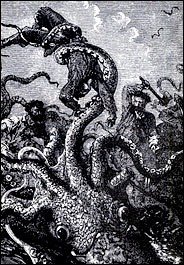
He (and we) are uncertain what exactly is this “fish” that he so dislikes – is it squid, cuttlefish, or octopus? They are all from the Phyllum Mollusca, Class Cephalopoda, but zoologically speaking there are small differences. To summarise, these are: octopus has 8 arms, no internal “shell”, squid have 8 arms, 2 tentacles, and a fine transparent internal “quill”or pen, cuttlefish have 8 (short) arms, 2 tentacles, and a large internal “cuttlebone”.

Culinarily speaking squid, octopus, and cuttlefish are interchangeable in most recipes. They have been popular in the rest of Europe for centuries, although recipes for them did not appear in English cookbooks until well into the twentieth century. There was one voice calling out in the wilderness however: a fascinating book called “The Edible Mollusca of Great Britain and Ireland, with Recipes for Cooking Them” was published by M .S. Lovell in 1884. It is a wonderful mix of science, history, and myth. A large part of the chapter on “Sepiadae” is given over to repeating mythical stories of encounters between seafarers and gigantic cepalopods such as the Norwegian kraken and the Hydra destroyed by Hercules. It is not a cookbook as such, but it does include some interesting recipes.

Recipes for the Day …

To Cook Cuttles.
First cleanse them thoroughly by scalding; then rub the body and legs (feelers?) with garlic, and after cut the whole into small pieces and fry in olive oil; one or two fresh gathered Chili peppers being introduced as a seasoning.

Jersey Method of Cooking Cuttlefish.
Boil them for ten minutes, then take them out, the skin will come off like a glove, leaving the fish like so many sticks of horseradish. Then boil them for an hour longer; take them out and cut them up, and fry them with onions. Some prefer slices of bacon fried with them instead of onions, and served up with milk sauce. They are plentiful about October, and large ones are sold in the markets at a penny each.

Spanish Method of Stewing Cuttles.
Stew them over a very slow fire in oil or butter, and, before serving, add a little water, salt, bread-crumbs, saffron, and a soupçon of new honey or sugar.

On this Topic ...

There is a little more on cephalopods, and a sixteenth century Catalan/Spanish recipe for a "Pottage of Squid and Cuttlefish", in the story of March 3rd 2006.

Tomorrow’s Story …

On gingerbread men.

Quotation for the Day …

The Spanish Wine, my God, it is foul, catpiss is champagne compared, this is the sulphurous urination of some aged horse. D.H Lawrence, in a letter to Rhys Davis.

Friday, September 08, 2006

No Bread for Dogs.

Today, September 8th …

The fondness of the English for their pooches and ponies is usually seen as an endearing national eccentricity, but even for their pets, the English will only go so far when the call to patriotism is heard. For the few who put their pets before their people in 1917, the law came down hard. On this day in 1917, The Times carried the following article:

“For using bread as otherwise than for human food, Miss Caroline Stiff was fined £5 at Dover yesterday. She had 14 dogs, and admitted to the food inspector that she gave them bread and milk for breakfast, oddments of bread and biscuits soaked in gravy for dinner, bread and biscuits for tea, and bread and milk for supper. She lived alone and had taken 20lb. of bread weekly.”

Miss Stiff got off fairly lightly. In May, a Miss Fawkes had been fined £9 for obtaining 16 loaves to feed a pet pony. Clearly a couple of very unpatriotic ladies got their comeuppance.

Wheat, and hence bread, was in very short supply at this point in World War I, and although it was not rationed as such, there were strict regulations as to its manufacture, and a strong expectation that everyone would do their bit and not waste a single crumb. One tenet accepted very early in the debate was that “too much human food could not be sacrificed to animals”. The public were assured by the London Zoo in May 1917 that:

“Bread formerly used for the apes and monkeys and some small mammals has been replaced by flour not up to the Board of Trade standard for human consumption, and by ship’s biscuits which have made one or two voyages unused and are then rejected as no longer fit for issue.”

What is even more astonishing, given the English love of horse-racing and blood sports is that there was support for reducing horse-racing and fox-hunting “to reduce the diversion of food to animals”. To that end, some Hunt Masters voluntarily slaughtered their fox-hounds! Now that is (was) English patriotism at its most extreme!

Naturally there was plenty of advice in the newspapers as to how to use every stale scrap of bread, and even better – to substitute for it as much as possible.

Recipes for the Day …

Patriotic citizens with culinary skills contributed their food-saving ideas to the newspapers during the war: here are a couple of recipes from this week in 1917.

Potato Cakes.
To the Editor of The Times.
Sir. – Owing to flour’s being dearer than potatoes, potato cakes would bevery appetising at breakfast or tea. To make them take 1lb. of well-mashed potatoes, add pepper and salt according to taste, also some butter (about the size of a walnut); then add an egg, but milk is used for economical purposes. Form them into small rounds and bake to a golden brown, and then they will be found to be excellent.
Yours faithfully, S. Lisle-Simpson, Compton, Milford-on-Sea, Hants. [The Times, Sept 6th 1917]

Economy Pudding.
A “Mother” writes that her children like best for their luncheon at school a slice of what she calls “economy pudding”. “To make it I soak scraps of stale bread and cake overnight,” she says. “Then, after straining it till dry I beat them with a fork, till fine, and add a little orange peel if I can get it, or lemon peel, with dripping, sugar, and spice, a pinch of baking powder, and a little milk. This I place in a basin and steam or bake in the oven. It is very good when sliced cold, or for dinner the slices can be fried and spread with syrup or jam.” [The Weekly Dispatch, September 9th 1917]

Monday’s Story …

Fried ink-pots.

Quotation for the Day …

Bread that must be sliced with an axe is bread that is too nourishing. Fran Lebowitz

Thursday, September 07, 2006

On the Road Again.

Today, September 7th ..

We met Viscount John Byng in another story, while he was enjoying a good gooseberry tart in one of England’s fine coaching inns, and we meet him again today on another of his journeys around the country. This time the year is 1782, and this time the meal was not a success, and he is not impressed.

“Andover, Hampshire. I never dined worse, or was in a crosser humour about it; a little miserable stale trout, some raw, rank mutton chops and some cold hard potatoes, For the sake of hasty gain, innkeepers hire horrid servants, buy bad provisions, and poisonous liquors; would any man dare, with a large capital, to set up a good inn, with the best beds, and wine, he would get a fortune, let him charge ever so highly. I am more and more convinced that fowls are the only things to bespeak at an inn, every other dish is either ill-dress’d or the leavings of other companies.”

Over two hundred years later most of us who have travelled anywhere can relate to this story of eating badly on the road. There may not have been much in the way of legislation in Byng’s day to help protect the innocent traveller from dodgy inn-keepers, but there were certainly standards, and plenty of books to explain them.

We can consider Byng’s dilemma with reference to a book published in the very same year - E.Spencer’s “The modern cook; and frugal housewife’s compleat guide to every branch in displaying her table to the greatest advantage .. ”

Here we find that trout is in season in April, May, and June – and Byng is offered it in September, which surely is significant? The inn-keeper either did not know or did not care that fish “are known to be new or stale by the colour of their gills, their easiness or hardness to open, the hanging or keeping up their fins, the standing out or sinking of their eyes … or by smelling their gills.” We also find that to judge good mutton “you must look at the lean part, where the fore quarter is cut off from the hind, and it will be marbled with fat, and the lean of a dark red …”.

To add insult to injury, Byng would probably have been aware that at his home in Torrington he would have been served something closer to the book’s suggested bill of fare for September:

First Course.

Dish of Fish.
Chickens. Veal Collops.
Pigeon Pye. Gravy Soup. Almond Tourt.
Harrico of Mutton. Ham.
Roast Beef.

Second Course.

Wild Fowls.
Peas. Ragou’d Lobsters.
Sweetbreads. Fruit. Fry’d Piths.
Crawfish. Fry’d Artichokes.
Partridges.

Recipes for the Day …

How much better might Byng’s meal have been with these recipes from the book?

To stew Trout.
Take a large trout, wash it, and put it in a pan with white wine and gravy, then take for stuffing two raw eggs, some pepper, salt, nutmeg, lemon peel, grated bread, a little butter or suet, and thyme, mix them all together, and put in the belly of the trout; then let it stew a quarter of an hour, and put a piece of butter into the sauce, serve it hot, and garnish with lemon sliced.

To dress Potatoes.
Boil them in as little water as you can, cover the sauce-pan close, and when the skin cracks they are enough; drain the water out, and let them stand covered for a minute or two, then peel them, and have ready boiled milk and water to throw them into, as you pare them, which will keep them hot and of a good colour, till you send them to table, but drain them through a cullender.

To broil Mutton Chops.
Cut your chops off the best end of a neck of mutton, pare them neatly, and flat them with a cleaver; season them with pepper and salt, broil them over a clear fire, turning them often; when done, lay them in a hot dish with some gravy under them, and a spoonful of mushroom catchup, and serve them up hot with pickles in a saucer. You may crumb them with bread, the same as veal cutlets.

Tomorrow’s Story …

No Bread for Dogs.

Quotation for the Day …

More than any other in Western Europe, Britain remains a country where a traveler ... has to think twice before indulging in the ordinary food of ordinary people. Joseph Lelyveld "Fish and Chips: Britain's Bargain Fare" 1986