Monday, March 27, 2006

A gay rugby dinner.


Today, Monday March 27th …

The Welsh rugby team were entertained at dinner in the Hotel Lutetia in Paris on this day in 1957, during the Five Nations competition. The dinner was as would be expected from such a fine venue, but the actual paper menu has a most unexpected phrase on the reverse. Above a drawing which could conceivably demonstrate two players holding hands, are the words “gay rugby”. It meant that they were “light-hearted, exuberantly cheerful, sportive, merry”?

Le Saumon de l’Adour au Champagne
Le Carré d’Agneau Périgourdine
Les Bouquets de Primeurs
Le Chaud-Froid de Vollaile Rose de Mai
Coeurs de Laitues Mimosa
Le Plateau de Fromage
L’Ananas Voilé a l’Orientale
Les Friandises

VINS
Chablis 1er Cru Fourchaume 1954
Chateau Montrose Saint-Estephe1954
Mercurey Clos du Roi 1953
Magnums
Le Taittinger Blanc de Blanc 1950
Café, Liqueurs

March 27th was also the anniversary of the very first international rugby game in 1871, which took place between England and Scotland in Edinburgh. There is no record of an associated dinner, but surely there was one?

The Baron Brisse, an impoverished French aristocrat who earned a living by becoming probably the first food journalist, wrote a book called “366 menus and 1200 recipes” in 1868. For March 27th, his suggested menu was:

Potage à la purée de pois.
Morue à la maître d’hôtel
Côtelletes de mouton sauce tomates
Pâté de bécassines
Macédoine de légumes en salade
Soupirs de nonne


His recipe for “Soupirs de nonne” (Nun’s sighs) seems to be a ridiculous choice for what started out as a rugby theme, so here it is:

Nun’s sighs.
Warm a lump of butter the size of a walnut, a lump of sugar, a little lemon-peel, and a pinch of salt in a tumblerful of water, let it boil over two or three times; stir in some flour until it becomes a thick paste, and continue stirring until it is cooked, which you can tell, if the paste does not stick to your finger; leave it in the saucepan until cold, then stir in one egg at a time until it is thin enough to drop out of a spoon. Take a dessert spoon and drop lumps of the paste about the size of a walnut into lard which is not quite boiling, take out when swollen to four times their original size and of a golden colour. Sprinkle with sugar and serve hot; they are also nice cold.

[The Baron also goes on to say “The flavouring can be varied by omitting the lemon-peel and stirring in a little orange-flower water with the first egg.”, but that would take me far over my allowed word-count, so please dont try the variation.]
Tomorrow: Death in the Pot.

Friday, March 24, 2006

All the wheat that's good to eat.


The final episode in our week of WW II food.

Today, Friday March 24th …

The Federation of Bakers was formed on this day in 1942, to assist in organising the wartime production and distribution of bread, and in particular to promote the ‘National Wheatmeal Loaf’ – the Plus Loaf.

Eating this brown version of the staff of life became a patriotic duty, and an awful lot of propaganda was applied to persuading the British from away from their standard white bread. The National Loaf was made with flour of 85% extraction, and it was desirable because it was a more efficient way of using imported wheat, at a time when “Ships and more ships are wanted for war materials. Less space can be spared for food. That’s why we must all think of food in terms of ship-savers”.

It might be “All the wheat that’s easy to eat”, but as the war progressed barley and oats were included, and in 1943 potato flour was allowed – probably the point at which some reluctant eaters called it ‘Hitler’s Secret Weapon’. Every propaganda angle was used: customers who bought it were smart as well as patriotic because it was “the wise ones who want it”, because the bread was “one thing better than it was before – better and no dearer!”.

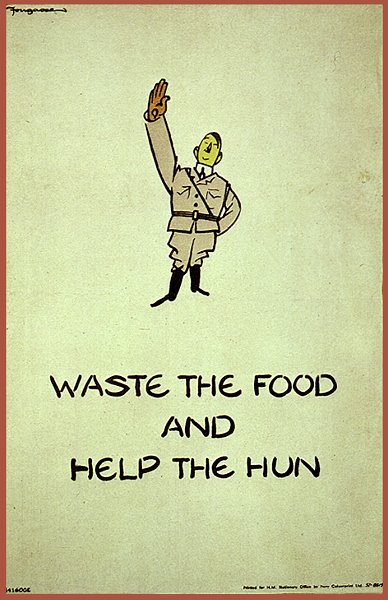
No bread was to be wasted: one way or another all waste played directly into the hands of The Hun.

REMEMBER that if everyone in Great Britain wasted ½ oz. of bread daily we should be wasting 250,000 tons of wheat a year, and that 30 wheat ships would be required to carry that amount.

For the housewife “To-day’s scraps are tomorrow’s Savouries”, and pamphlets and newspapers gave and solicited hints for using every scrap of stale bread. This was one Ministry of Food ‘recipe of the week’:

Savoury Meat Roll.
¾ lb sausage meat
4 oz stale bread
5 oz pinto beans
1 teaspoonful thyme
1 teaspoonful made mustard
pepper and salt
gravy browning.
Soak the stale bread in water until soft. Squeeze out the water and mash the bread with the sausage meat, the beans – cooked and mashed, pepper, salt, made mustard, and thyme. Add gravy browning until the mixture is a rich brown. Press very firmly into a greased 2 lb, stone jam jar or tin, and steam for 2 hours. Roll in browned bread-crumbs and serve hot with brown gravy, or cold with a raw cabbage heart salad, and boiled potatoes.

On Monday: A gay rugby dinner.

Thursday, March 23, 2006

A Scarcity of Fat.


Today, Thursday March 23rd …

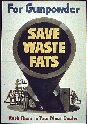
During World War II, every Allied household was encouraged to save every scrap of fat so that it could be re-directed to the making of glycerine, which was a key ingredient in the manufacture of explosives. Fat in all forms was rationed for much of the war in both Britain and America, and the housewife was vigorously encouraged to salvage whatever she could from whatever did make it into the kitchen. Meat was trimmed, roasting dishes scraped, stews skimmed, and the grease strained into an empty can which was then collected by the butcher.

The regular wartime column ‘News of Food’, in the New York Times on this day in 1943 carried an article on how to cope with the ‘fat scarcity’. Readers were advised that butter could be substituted with meat drippings in many dishes, or could be ‘stretched’ by various methods, such as this:

Spread D
(Makes half a pound)
¾ teaspoon gelatine
1 tablespoon cold water
¼ pound softened butter
½ cup evaporated milk
¼ teaspoon salt.
Put the gelatin in a bowl, add the cold water and place bottom of bowl in hot water until gelatin melts and dissolves.Gradually add the softened butter, the evaporated milk and salt, beating continuously with a fork or electric mixer. When well blended, pack in a mold or in waxed paper and chill until firm in the ice box.

In the event of no fat being available, and therefore a deficiency of Vitamin A looming, it was suggested that this could be obtained from dark green leafy vegetables, carrots, milk and liver.

Spinach as a substitute for bacon grease, now there’s an interesting concept!

The newspaper had been publishing ideas for daily menus. In the light of the scarcity, these had been adapted to be lower in fat. The suggested menu for the following day (24th) was:

Breakfast
Stewed prunes* **
Bran flakes with milk
Toasted muffins* Jelly
Coffee Milk

Luncheon
Toasted cheese sandwiches
Carrot strips
Fresh apples Milk

Dinner
Broiled porgies
Stewed celery and tomatoes**
Boiled potatoes with parsley
Fruit salad with mayonnaise
Reheated cup cakes* with lemon sauce if desiered
Tea
* indicates use of a leftover
** indicates use of a rationed food.

There must have been side-benefits to health from all this fat re-cycling. Can we not find some other vital thing to manufacture from it? Lard-powered computers? Bacon-fat-driven mobile phones?

Tomorrow: All the wheat that’s easy to eat.

Wednesday, March 22, 2006

Nella's Sadness.


More on this week’s theme of WW II food.

Today, Wednesday 22nd March …

Nella Last was an ordinary British housewife – a bored, slightly neurotic one, prone to headaches and nervous turns – when she responded to the call for volunteers for the Mass Observation campaign of WW II.

The simple act of keeping a diary of the day to day events of the war provided her with a creative outlet that she had not known she needed, and her lowly ‘knack’ of making something out of nothing suddenly made her a local expert in wartime domestic management. She lost her headaches and thrived.

Ironically, she never knew that she had become a writer (an impossible fantasy in her pre-war life) – and a very good one - as her diary was not published until after her death. ‘Nella Last’s War’ is not only a marvellous record of everyday life on the home front, it is a wonderful story of one woman finding fulfillment through day-to-day activities in the most awful circumstances.

On this day in 1941, Nella wrote her diary after returning from the market.

“There were closed stalls everywhere in the market today … no eggs, fowls or golden butter … golden honey or glowing home-made orange marmalade. …Only muddy-looking – and far too small – cockles and pieces of most unpleasant beetroot … I wandered about with sadness in my heart …”.

Nella was far more resilient than she knew, and I have no doubt that once she got home she would have just gotten on with making something pleasant from the unpleasant beetroot, or whatever it was that she finally purchased that day.

The Ministry of Food’s ‘Food Facts’ leaflet No. 40 had a recipe for “using the sweetness of beetroot to make a nice sweet pudding with very little sugar”, which would have been perfect.

Beetroot Pudding.
First mix 6 oz. wheatmeal flour with ½ teaspoonful baking powder, Rub in 1 ½ oz. fat and add 1 oz. sugar and 4 oz. cooked or raw beetroot very finely grated.
Now mix all the ingredients to a soft cake consistency with 3 or 4 tablespoonfuls of milk. Add a few drops of flavouring essence if you have it. Turn the mixture into a greased pie dish or square tin and bake immediately in a moderate oven for 35-40 minutes. This pudding tastes equally good hot or cold.

More Stories about Nella Last appear in 'Nella's Orange Jelly' and 'An indifferent Rabbit'.

Tomorrow: A scarcity of fat.

Tuesday, March 21, 2006

Beige Meals.


Continuing this week’s theme of WW II food:

Today, Tuesday March 21st …

On this day in 1941, Winston Churchill sent a memo to Lord Woolton, the Minister of Food, in relation to the “Community Kitchens” order.

“I hope the term ‘communal feeding centres’ is not going to be adopted. It is an odious expression, suggestive of Communism and the workhouse. I suggest you call them ‘British Restaurants’. Everybody associates ‘restaurant’ with a good meal, and they may as well have the name if they cannot get anything else”

The concept of “British Restaurants” had arisen out of the need to supply meals for workers who did not have access to a canteen, although anyone could use them. Local buildings were requisitioned, and wholesome hot meals at a maximum of one shilling were supplied with no ration coupons required. Within two months there were 800 of them around the country, and by the end of 1942 there were over 1800.

Anthony Burgess referred to British Restaurants as “that disastrous war-child of Winston Churchill”. Frances Partridge shows why:

"We joined a swelling stream of the citizens of Swindon, all following a series of notices marked 'British Restaurants’, to a huge elephant house, where thousands of human beings were eating as we did an enormous all-beige meal, starting with beige soup thickened to the consistency of paste, followed by beige mince full of lumps and garnished with beige beans and a few beige Potatoes, thin beige apple stew and a sort of skilly. Very satisfying and crushing, and calling up a vision of our future Planned World, all beige also …. "

“Skilly” is defined by the OED as “ A kind of thin, watery porridge, gruel, or soup, commonly made from oatmeal, and traditionally used especially in prisons and workhouses.” The use of that ultra-beige food, oatmeal, was encouraged during the war because it was home-grown. Many recipes were circulated, including this one, which can stand for soup or skilly:

OATMEAL SOUP.
1 oz margarine
2 medium onions, grated or finely diced
2 tablespoons oatmeal
1 pint cold water
salt and pepper
½ pint milk
3 medium carrots grated
Heat the margarine in a pan, add the onions and cook for 5 minutes. Blend the oatmeal with the cold water, tip into the pan and stir as the mixture comes to the boil; season lightly. Simmer steadily for 30 minutes, stirring frequently, then add the milk and carrots and cook for a further 15 minutes.


Tomorrow: Nella’s Sadness.

Monday, March 20, 2006

The expense of a sugar offence.

And now for Something Slightly Different: we will have an overall theme for this week: the food of World War II …

Today, Monday March 20th …


The Times of London on this day in 1940 reported a breach of the wartime Rationing Order:

“ … an employee of the Food Control Committee saw a Rolls-Royce car drive up the Messrs. Kay’s shop in the High Street, Watford. A chauffeur left the shop carrying a large cardboard container, the flaps of which were widely open and containing blue bags … Mrs. Reekie … was subsequently seen by officials of the Divisional Food Office, who told her that they had reason to believe that she was in possession of about 1 cwt sugar …“I paid Kay’s manager two guineas; I did not get a receipt” she said. Mr Temple said that this was not a technical offence. The sugar ration was enough for 140 people for one week."

That greedy little act cost Mrs. Reekie ₤75. She could probably afford it.

Food may have been plain and uninspiring during the war, but there is no doubt that an awful lot of Britons were better fed than before, because the abiding principle and watchwords were “share and share alike”. The authorities meant it, and Rationing Orders were enforced.

Most of the newspapers’ reports of breaches seem to concern offenders from Britain’s rich and powerful. Strange that. Lots of possible explanations. Later in the year it was Sir Percy Laurie unlawfully obtaining a new ration book (fine ₤550, costs 35 guineas), Lady Sligo “obtaining” a pound of butter from “friends” in Dublin (fine 40s. costs ₤3.3s), the Mayor, Aldermen And Burgesses of Wembley for supplying food without a licence (fine ₤150, costs ₤21).

Mrs. Ordinary Housewife couldn’t afford to “obtain” extra anything, but found ways around the shortages with the help of “Food Facts” leaflets from the Ministry of Food, radio programs such as “The Kitchen Front”, and of course the everlasting housewives recipe-swap network.

Golden syrup was a useful substitute for sugar.

SYRUP LOAF
4 oz self-raising flour or plain flour with 2 teaspoons baking powder
½ teaspoon bicarbonate of soda
pinch salt
2 tablespoons warmed golden syrup
¼ pint milk or milk and water
Sift the flour or flour and baking powder, bicarbonate of soda and salt. Heat the syrup and milk or milk and water, pour over the flour and beat well. Pour into a well greased 1 lb loaf tin and bake in the centre of a moderately hot to hot oven for 30 mins or until firm.

Tomorrow: Beige meals.

Friday, March 17, 2006

Daynty Sirrups and Grand Sallets

Today, March 17 …

According to the mediaeval calendar, the flower of today, dedicated to St Gertrude of Nivelles, is the Sweet Violet (Viola odorata). Violets have a long culinary and medicinal history in Europe, and these were often one and the same thing – the idea of food as medicine is hardly new. The herbalist John Gerard said: 'It has power to ease inflammation, roughness of the throat and comforteth the heart, assuageth the pains of the head and causeth sleep' – and if it can do all that and taste and look good, why are we not all growing it in our backyards?

An earlier OldFoodie considered the marigold, a flower whose culinary value resides solely in its intense colour; the violet has this and more. Its intense heady perfume and intrinsic sweetness can be imparted to wine, vinegar, sugar and ‘daynty sirrups’; its flowers are just the right size for crystallising, and the leaves are also useful in salads.

Why has our use of flowers as food fallen off so? Has the fragrance been bred out of them as the trade-off for longer vase-life? Is it the pesticide residue? Have the awful Parma Violet sweets in the cellophane roll poisoned our appreciation of the real thing?

We think we are being terribly adventurous today if we toss a few nasturtium flowers into our green salad, but one eighteenth century recipe for ‘A Grand Sallet for Spring’, suitable for a “great feast’, contained violet leaves and flowers as well as strawberry leaves and cowslip buds along with water-cresses, almonds, raisins, and many other ingredients. A fourteenth century recipe for something called “Mon Amy” which is a dish of creamy curds thickened with egg yolks, flavoured with saffron and decorated with “vyollettes” – how amazing does that sound?

To impress your guests and comforteth their hearts, you could keep some violet syrup on hand, to flavour your custards and “Oriental Sherberts”. This one is from John Nott’s ‘Cooks and Confectioners Dictionary’ (1724):

Syrup of Violets.
Beat a Pound of pickt Violets in a Mortar, with a little Water, just to moisten them. In the mean time boil four Pounds of Sugar till it is pearled; take it off the Fire, let the Boiling cease; then put in the Violets, and temper all well together. Strain all through a fine Cloth into an earthen Pan; when it is cold put it in Bottles.

On Monday: The expense of a sugar offence.

Thursday, March 16, 2006

The Muse and the Murder.

Today, March 16th …

France outlawed the sale of absinthe on this day in 1915. The drink that the New York Times called “the most pernicious and treacherously fascinating of all alcoholic stimulants” had already been banned in several countries. France however was reluctant to vanquish the drink that was so closely associated with the artistic life, the “green fairy” that Lautrec, van Gogh, Degas, Manet, Picasso, Hemingway, Wilde and many others painted, wrote about, and drank to assist the muse. Then in 1905 a man called Jean Lanfray shot his pregnant wife and two daughters (and failed to kill himself), after consuming a huge amount and variety of alcoholic drinks. France was shocked, absinthe got all the blame and the outcry against it became impossible to ignore.

Part of the allure of absinthe was its colour - bright green turning milky yellow when water was trickled into it through the special perforated spoon that was also part of the mystique – and part was due to its supposed psychoactive properties - it contains thujone, a hallucinogenic similar to the active ingredient in marijuana. In reality the alcohol content will do the damage long before you can get enough hallucinogen.

Absinthe is legal again, but if you prefer the aniseed/liquorice flavour in your food, try this eighteenth century recipe.

From “The cook’s and confectioner’s dictionary” (1724)

To stew a Filet of Beef the Italian Fashion.
Take the Skins and Sinews from a Filet of Beef, put it into a Bowl with White-wine, crush it in it and wash it well; then strew upon it a little Pepper, and a Powder called by the Italians Tamara (which is made of one Ounce of Aniseed, an Ounce of Cinnamon, and an Ounce of Cloves, beaten into a gross Powder, with a little Powder of Winter-Savoury; these all kept in a Glass-Vial) and as much Salt as will season it; mingle all these well together, and put in as much White-wine as will cover it; put a Board on it to keep it down, and let it lie in steep for two Nights and a Day; then take it out and put it into a stew-pan with some good Broth, that is not salt, but none of the Pickle [ie. the marinating liquid] ; put in whole Cloves and Mace, cover it close, let it stew till it is tender, then serve it with as much of the Broth as will cover it.

Tomorrow: For Daynty Sirrups and Grand Sallets.

Wednesday, March 15, 2006

A Bloodless Feast.

Today, March 15th …

Two hundred members of the New York Vegetarian Society attended a banquet on this day in 1892. A slightly mystified journalist from the New York Times noted that wine and toothpicks were, like meat, absent from the “bloodless feast”, and gave the menu.

Corn muffins.
Cream of celery soup.
Oyster-plant patties with slices of lemon.
Potato cakes and macaroni stewed with parmesan cheese.
Stewed parsnips and baked tomatoes.
Sorbet “Le Favre”.
Mushrooms broiled, on toast, Saratoga chips, boiled rice, lettuce salad.
Dessert: tapioca pudding with whipped cream sauce; vari-colored ice-cream; cakes; candies; oranges.
Coffee


The President, Mrs Le Favre, spoke on “The sanctity of the home is disturbed by the presence of meats. Those who eat flesh keep themselves in a condition of brutality”.

Oyster plant and tapioca hold no mysteries or fears for OldFoodie readers, so today we will consider a couple of other vegetarian delights.

From the very English (note the comment on garlic) Cassell’s Vegetarian Cookery (1891):

Macaroni - Italian Fashion.
This is very similar to sparghetti (sic), only ordinary pipe macaroni is used. Take, say, a teacupful of macaroni, wash it, break it up into two-inch pieces, and throw it into boiling water that has been salted. Strain it of off, put it in the stew-pan for a few minutes, with a little piece of butter and some pepper and salt. Add a tablespoonful of tomato conserve, and serve it with some grated Parmesan cheese, served separate in a dish.
Some rub the stew-pan with a head of garlic. This gives it what may be called a more foreign flavour, but this should not be done unless you know your guests like garlic. Unfortunately, the proper use of garlic is very little understood in this country.

From the very American “Science in the Kitchen” (1893) by the very vegetarian Ella Kellogg, something similar to corn muffins.

Corn Puffs.
Mingle the yolk of one egg with one cupful of rich milk. Add to the liquid one cupful of flour, one-half cupful of fine, yellow corn meal, and one-fourth cupful of sugar, all of which have previously been well mixed together. Place the batter on ice for an hour, or until very cold. Then beat it vigorously five or ten minutes, till full of air bubbles; stir in lightly the stiffly beaten white of the egg, and put at once into heated irons. Bake in a moderately quick oven, thirty or forty minutes.


Tomorrow: The Muse and the Murder.

Tuesday, March 14, 2006

The First Domestic Goddess.

Today, March 14th …

Today was the birth day in 1836 of Isabella Beeton, who did not get to celebrate nearly enough birthdays, dying as she did just before her 29th birthday from complications of childbirth.

In her too-short (and obviously computer-less) life she produced her encyclopaedic ‘Household Manual’ with no more formal education than ladies generally received at the time, between assisting her husband in his publishing business, managing the household, and bearing four children.

In the chapter which gives suggested ‘Bills of Fare’ for each month of the year, for a ‘plain family dinner’ for a Tuesday in March she suggested:

Mock turtle soup.
Hashed mutton, rump-steaks and oyster sauce.
Boiled plum-pudding.


The soup was “made with the liquor that the calf’s head [from Sunday’s dinner] was boiled in, and the pieces of head”.

Perhaps she might have had a small dinner party on her birthday? Her suggested menu for a dinner for 8 persons in March was:
*
First Course.
Calf’s head Soup.
Brill and Shrimp Sauce. Broiled Mackerel à la Maitre d’Hôtel.

Entrees.
Lobster Cutlets. Calf’s Liver and Bacon, aux fines herbes.

Second Course.
Roast Loin of Veal. Two Boiled Fowls à la Béchamel. Boiled Knuckle of Ham.
Vegetables – Spinach or Brocoli (sic)

Third Course.
Wild Ducks.
Apple Custards. Blancmange. Lemon Jelly. Jam Sandwiches.
Ice Pudding. Potatoes à la Maitre d’Hôtel.

Dessert and Ices.
*
The menu has two dishes “à la Maitre d’Hôtel” - literally meaning “by the master of the house”, but in practice referring to a base of classic “Maitre d’Hotel” butter – butter creamed with chopped parsley, lemon juice, salt and pepper, either used alone or incorporated into another sauce.

From her magnificent manual:

Potatoes à la Maitre d’Hôtel.
Potatoes, salt, water; to every 6 potatoes allow 1 tablespoonful of minced parsley, 2 oz. of butter, pepper and salt to taste, 4 tablespoons of gravy, 2 tablespoons of lemon juice.
Wash the potatoes clean, and boil them in salt and water; when done, drain them, let them cool; then peel and cut the potatoes into thick slices; if these are too thin they would break in the sauce. Put the butter into a stew pan with the pepper, salt, gravy and parsley; mix these ingredients well together, put in the potatoes, shake them two or three times, that they may be well covered with the sauce, and, when quite hot through, squeeze in the lemon juice and serve.

Tomorrow: A bloodless feast.

Monday, March 13, 2006

Flying fortresses and freezers.

Today, March 13th …

There was an article in the New York Times on this day in 1943, describing a novel way of making ice-cream. The geniuses were American airmen serving in England, flying Boeing B-17’s – better known as “The Flying Fortresses”. They probably considered it their patriotic duty to find a way to prepare their rations since the Secretary of War in the USA had declared ice-cream an “essential foodstuff”, presumably along with peanut butter and jelly.

The article said:

United States airmen based on British stations have discovered a handy way of making ice cream. They place prepared ice-cream mixture in a large can and anchor it to the rear-gunner’s compartment of a Flying Fortress. It is well shaken up and nicely frozen by flying over enemy territory at high altitudes. Care must be taken to drop bombs and not ice-cream on enemy targets, and to avoid Nazi fighters and anti-aircraft fire. That is all there is too it.

The ice-cream mix may have been simply some powdered flavouring added to milk or cream, or it may have been a complete mix, prepared by spray drying. Not to get too technical here, there are technological problems with spray drying because “dehydration of sugar-rich foods is often difficult because of caking and stickiness problems”. No doubt this difficulty was behind NASA’s development of Freeze-Dried Ice-Cream (amazing phrase, that) for the use of its astronauts in space. What is it about men who fly, and ice-cream?

A recipe for a war-time ice-cream had appeared in the New York Times the previous year.

Vanilla Ice-Cream.
2-3 cup condensed milk
½ cup water
1 ½ teas vanilla
1 cup whipping cream or condensed milk, whipped
Mix the condensed milk, water, and vanilla, and chill. Whip the cream, or condensed milk to a custard-like consistency , and fold into the first mixture. Freeze in the freezing unit of the refrigerator, with the temperature at the coldest possible point, until about half frozen. Then scrape from the freezing tray and beat until smooth, but not melted. Replace in the freezing unit until frozen.

The article went on to describe how to ring the changes on this basic recipe by using additives such as lemon extract or maple flavouring, but quite frankly, the basic mix sounds awful enough, without these ‘improvements’.

If the military version was anything like this, it would have served very well as a weapon of war.

Tomorrow: The First Domestic Goddess.

Friday, March 10, 2006

A cheering and strengthening sauce.

Today, March 10th …

The English writer John Ruskin described supper at the “salon” of “Mme. C” in Paris on this day in 1865.

The day had started quite well for the guests, as “Choice Yquem, Johannisberg, Laffitte, Tokay, and champagne of the finest vintages were served most lavishly throughout the morning”

Naturally, that raised an appetite:

Some English peers and members of Parliament were present, and appeared to enjoy the animated and dazzlingly improper scene. On the second floor the supper tables were loaded with every delicacy of the season. That your readers may form some idea of the dainty fare of the Parisian demi-monde, I copy the menu of the supper, which was served to all the guests (about 200) seated at four o'clock.

The menu was:

Consomme de volaille a la Bagration. 16 hors-d'oeuvres varies. Bouchees e la Talleyrand. Saumons froids, sauce Ravigote. Filets de boeuf en Bellevue, timbales milanaises, chaudfroid de gibier. Dindes truffees. Pates de foies gras, buissons d'ecrevisses, salades venetiennes, gelees blanches aux fruits, gateaux mancini, parisiens et parisiennes. Fromages glaces. Ananas. Dessert.

True to the trend of the day, classical dishes named for famous persons were served.
Prince Bagration (1765-1822) was a Russian general killed at the Battle of Borodino, and even in his own lifetime was known to be more interested in dining than in commanding his men. The French diplomat Talleyrand (1754-1838) has appeared before in TheOldFoodie, he also was passionate about food and its important role in facilitating diplomatic events, and had many dishes named in his honour.

Today, it is the sauce for the cold salmon that gets our attention. The sauce Ravigote gets its name from the French verb ravigoter, meaning to cheer or revive. This ability supposedly comes from the four herbs it traditionally contained - tarragon, chervil, chives, and burnet - which together had the reputation for being restorative. There are several versions – one with a velouté base served warm as an accompaniment to grilled meat or poultry, and the one served here, a vinaigrette type with a bright green colour which would have been a wonderful contrast to the salmon.

The classic vinaigrette version from Larousse is simple:

Sauce Ravigote.
Season with oil, vinegar, salt and pepper a mixture of capers, onions, chives, parsley, chervil and tarragon, all chopped
.

Try it over cold poached salmon when next you host an animated and dazzlingly improper scene.

On Monday: Flying fortresses and freezers.

Thursday, March 09, 2006

The accidental apple.

Today, March 9th …

Maria “Granny” Smith died on this day in 1870 in Ryde NSW, never knowing that her name would be immortalised by an apple. The experts are still debating the botanical details, but it seems that the fruit discovered by Maria was an accidental hybrid between a domestic apple and a “French Crab” variety from Tasmania.

Perhaps Maria bought the Tasmanian apples at market and threw some rotten ones out, or perhaps it was the trimmings and peelings from a pie-making session that sprouted in the garden compost heap? Whatever the source, she found the tree growing on the family property in about 1868 and recognised the virtues of its crisp green fruit - it was tasty, versatile, and best of all, had excellent keeping quantities.

The French Crab had been known in Europe since the eighteenth century, and may well have been one of the varieties brought by the First Fleet - if it had not arrived via an early exploratory voyage, it being the habit of sailors to plant seeds whenever they reached landfall, for future provisioning of ships or shipwrecked mariners. By the mid nineteenth century over 70 varieties of apples were being grown in the colonies – far more types than we find in the supermarket today – a fact which needs explaining as well as grieving over.

The “Granny Smith” was winning prizes at local agricultural shows by the 1890’s. In 1895 the fruit advisor for the NSW Department of Agriculture gave it official approval as being suitable for export, and the first significant cultivation began at the Experimental Station in Bathurst the same year. By 1924 a local orchardist claimed it was “the most valuable of all apples grown in Australia”.

Strangely, for so popular a fruit, Phillip Muskett’s “Art of Living in Australia” (1893) contained only one apple recipe. Or should that be a rice pudding recipe?

APPLES AND RICE
3 Large Apples, 2 oz. Rice, 2 oz. Sugar, 1 tablespoonful Jam,1 Egg,1/2 pint Milk
Peel the apples and scoop out the core and fill in with jam; put into a pie-dish and bake till the apples are soft. While they are baking, boil the rice and milk together till the rice is soft and the milk absorbed. Beat in the egg and sugar, pour over the apples; brush over with milk, and bake till a nice colour. Serve either hot or cold.

Tomorrow: A cheering and strengthening sauce.

Wednesday, March 08, 2006

The perfect picnic.

Today, March 8th …

Kenneth Grahame, author of “The Wind inThe Willows” was born on this day in 1859.
In one of the classic scenes in the book, Mole asks about the large wicker basket that Rat brings aboard the boat.

'There's cold chicken inside it,' replied the Rat briefly; “coldtonguecoldhamcoldbeefpickledgherkinssaladfrenchrolls
cresssandwidgepottedmeatgingerbeerlemonadesodawater.”

Not a bad little picnic for two little animals. In case of a bigger crowd they could have followed Mrs Beeton’s suggestions (1861):

BILL OF FARE FOR A PICNIC FOR 40 PERSONS.

A joint of cold roast beef, a joint of cold boiled beef, 2 ribs of lamb, 2 shoulders of lamb, 4 roast fowls, 2 roast ducks, 1 ham, 1 tongue, 2 veal-and-ham pies, 2 pigeon pies, 6 medium-sized lobsters, 1 piece of collared calf's head, 18 lettuces, 6 baskets of salad, 6
cucumbers.

Stewed fruit well sweetened, and put into glass bottles well corked; 3 or 4 dozen plain pastry biscuits to eat with the stewed fruit, 2 dozen fruit turnovers, 4 dozen cheesecakes, 2 cold cabinet puddings in moulds, 2 blancmanges in moulds, a few jam puffs, 1 large cold plum-pudding (this must be good), a few baskets of fresh fruit, 3 dozen plain biscuits, a piece of cheese, 6 lbs. of butter (this, of course, includes the butter for tea), 4 quartern loaves of household broad, 3 dozen rolls, 6 loaves of tin bread (for tea), 2 plain plum cakes, 2 pound cakes, 2 sponge cakes, a tin of mixed biscuits, 1/2 lb, of tea. Coffee is not suitable for a picnic, being difficult to make.

Things not to be forgotten at a Picnic.

A stick of horseradish, a bottle of mint-sauce well corked, a bottle of salad dressing, a bottle of vinegar, made mustard, pepper, salt, good oil, and pounded sugar. If it can be managed, take a little ice. It is scarcely necessary to say that plates, tumblers, wine-glasses, knives, forks, and spoons, must not be forgotten; as also teacups and saucers, 3 or 4 teapots, some lump sugar, and milk, if this last-named article cannot be obtained in the neighbourhood. Take 3 corkscrews.

Beverages: 3 dozen quart bottles of ale, packed in hampers; ginger-beer, soda-water, and lemonade, of each 2 dozen bottles; 6 bottles of sherry, 6 bottles of claret, champagne a discretion, and any other light wine that may be preferred, and 2 bottles of brandy. Water can usually be obtained so it is useless to take it.

Tomorrow:
The accidental apple.

Tuesday, March 07, 2006

Soup for the singer.

Today, March 7th …

“Anonymous” once said: “Stock to a cook is voice to a singer”, which is indisputably true.

The two associations come together beautifully in the story of Jenny Lind, “the Swedish Nightingale” who debuted on this day in 1838 at the Stockholm Opera. She became an international star and generated the sort of hype, hysteria and merchandising power that we associate with today’s Hollywood celebrities. In the “Jenny Rage” to glimpse her when she appeared in America “coats were torn, headdresses were crushed, several ladies were carried off”, and her name was given to the latest fashion in topcoats, cravats, boots and scarves, to carriages, locomotives, babies and family pets.

In the culinary field, a new variety of potato with blue ‘eyes’ was named for her, as was a melon (the association here was not recorded … ) a cake, and her famous soup with sago and eggs – which “have always been deemed very beneficial to the chest and throat”.

From “A Cyclopaedia of Domestic Economy” (1857):

JENNY LIND'S SOUP.
Make about three quarts of stock, which strain through a fine sieve into a middle-size stewpan; set it to boil; add to it three ounces of sago; boil gently twenty minutes; skim; just previous to serving break four fresh eggs, and place the yolk, entirely free from the white, into a basin, beat them well with a spoon; add to it a gill of cream; take the pan from the fire, pour in the yolks, stir quickly for one minute, serve immediately; do not let it boil, or it will curdle, and would not be fit to be partaken of. The stock being previously seasoned, it only requires the addition of half a teaspoonful of sugar, a little more salt, pepper, nutmeg; also thyme, parsley, and bay-leaf will agreeably vary the flavor without interfering with the quality.


From the Congregational church ladies of Holyoke, Massachusetts (1886):

JENNY LIND CAKE.
Two and one-half cups of sugar; one cup of butter; one cup of milk; four cups of flour; four eggs; two teaspoonsful of baking powder; bake in three sheets, two plain; after taking out the two plain, leaving less than a third, add one cup of raisins; one cup of currants; one-half cup sliced citron; two teaspoonsful molasses; one grated nutmeg; one teaspoonful each of cloves and cinnamon; spread with jelly and frost; putting the fruit cake between the two plain
.

Tomorrow: The perfect picnic.

Monday, March 06, 2006

A fruit worth gathering.

Today, March 6th …

The “Scientific American” of this day in 1847 published an article taken from a London newspaper, which gave a method for drying strawberries. Frankly, the story stretches culinary belief.

Last summer, by way of experiment, when strawberries were plentiful, I attached threads to their stalks, and hung up a few which were over-ripe to dry. I placed them inside a window facing the south, where they remained from June last until the present time, (Jan.28.) They have just been tasted, and the result is most satisfactory. That sweet refreshing acid which is peculiar to the strawberry in full perfection; the flavor of the fruit, without any watery taste, is delicious; … The experiment may be tried when the fruit is so ripe as to be scarcely worth gathering, without any further expense or trouble than being hung up.

I do not believe that this method would have worked. Not even for an “Ave-Maria while” do I believe it (see Dec 7th Old Foodie if you have forgotten this!).

Air-drying food requires long hot days with low humidity – not likely even in the best English summer - and the fruit most likely to fail would be whole, soft, juicy, over-ripe strawberries. It is stretching belief that they would be hanging nice and dry in the window six months later. Oozed off the stalks and bled all over the window sill more likely – if insects, birds and mould didn’t get to them first.

Housekeepers with a surplus have ever been desirous of preserving the fruit about which the seventeenth century William Butler said: "Doubtless God could have made a better berry, but doubtless God never did". The main method until the advent of home freezers and home dryers was as strawberry jam or conserve, but here is an alternative worth trying, from Mrs Beeton (1861).

PRESERVED STRAWBERRIES IN WINE
To every quart bottle allow 1/4 lb. of finely-pounded loaf sugar; sherry or Madeira.
Let the fruit be gathered in fine weather, and used as soon as picked. Have ready some perfectly dry glass bottles, and some nice soft corks or bungs. Pick the stalks from the strawberries, drop them into the bottles, sprinkling amongst them pounded sugar in the above proportion, and when the fruit reaches to the neck of the bottle, fill up with sherry or Madeira. Cork the bottles down with new corks, and dip them into melted resin.


Tomorrow: Soup for the singer.

Friday, March 03, 2006

Dinner for the taking.

Today, March 3rd …

In 1769, Capt James Cook was aboard the Endeavour, en route to Tahiti to observe the transit of Venus. After spending some time in Tierra del Fuego, they rounded Cape Horn in late January and entered the Pacific ocean.

The botanist Joseph Banks was aboard, and on this day he took advantage of calm weather and went out in a small boat. He killed 69 birds, but made his dinner from the piscatorial equivalent of road-kill.

I found also this day a large Sepia cuttle fish laying on the water just dead but so pulld to peices by the birds that his Species could not be determind; only this I know that of him was made one of the best soups I ever eat.

Very few of his contemporaries back at home would have eaten such a thing. One person who had was the writer Tobias Smollett, who was in Nice, France in 1766. He mentioned “The sepie or cuttle-fish, of which the people in this Country make delicate Ragout”.

Cephalopods were not part of the English diet until very recently: there is certainly no mention of them amongst Mrs Beeton’s almost two thousand recipes. Perhaps they were too “foreign”. The ancient Romans ate them, and there are plenty of recipes for them in fourteenth and fifteenth century European cookbooks, but strangely they do not feature in the haute cuisine of nineteenth and early twentieth century European chefs such as Escoffier. Perhaps they were too “peasant”.

This delicious-sounding recipe from the Spanish "Libro de Guisados" (1529) shows the Arab influence of that time, and would have been far from peasant food.

Pottage of Squid and Cuttlefish
The squid and cuttlefish must be well washed and clean, and after gently frying them, but not entirely, and when they are almost half cooked, take them out of the frying-pan and put them into a pot; and then put with them blanched almonds and raisins and pine nuts; and then take a few toasted almonds and pound them and strain them with a little vinegar watered down with fish broth if you have it; if not cast in a litle water so that it will not be too strong; and when the raisins and the almonds have been slightly fried with the squid and cuttlefish, take them and finish frying them; then cut them into pieces and when this is done prepare dishes
.

On Monday: A fruit worth gathering.

Thursday, March 02, 2006

The sailors’ feast.

Today, March 2nd …

In 1933 on this day, the U.S.Naval Ration was revised, so that “Each person, so entitled, may be served the following quantities of food each day”:

8 oz. biscuit, or 12 oz. soft bread or 12 oz. flour
12 oz. preserved meat, or 14 oz. salt or smoked meat, or 20 oz. fresh meat or fresh fish or poultry
12 oz. dried vegetables, or 18 oz. canned vegetables, or 44 oz. fresh vegetables
4 oz. dried fruit, or 10 oz. canned fruit, or 6 oz. preserved fruit, or 16 oz. fresh fruit, or 6 oz. canned fruit or vegetable juices or 1 oz. powdered fruit juices or 6/10 oz. concentrated fruit juices
2 oz. cocoa, or 2 oz. coffee or ½ oz. tea
4 oz. evaporated milk, or 1 oz. powdered milk, or ½ pt. fresh milk
1.6 oz. butter
1.6 oz. cereal, or rice, or starch foods
½ oz. cheese
1.2 eggs
1.6 oz. lard or lard substitutes
2/5 gill oils, or sauces, or vinegar
5 oz. sugar
Sundry spices and flavourings “as required.”

Navy men of 1794 had received:

Sunday 1 lb bread, 1½ lb beef, ½ pt rice
Monday 1 lb bread, 1 lb pork, ½ pt peas, 4 oz cheese
Tuesday 1 lb bread, 1½ lb beef, 1 lb potatoes or turnips and pudding
Wednesday 1 lb bread, 2 oz butter or, in lieu thereof, 6 oz molasses, 4 oz cheese and ½ pt rice
Thursday 1 lb bread, 1 lb pork, ½ pt peas or beans
Friday 1 lb bread, 1 lb salt fish, 2 oz butter or 1 gill oil, 1 lb potatoes
Saturday 1 lb bread, 1 lb pork, ½ pint peas or beans, 4 oz cheese.

I bet the 1.2 eggs of 1933 were not made into anything as delicious as this dish.

To dress a Military Omelet (1845)
Stewed sorrel, Parmesan cheese, Crumbs of bread, Drawn butter.
Make a ragout of stewed sorrels, with a little parmesan cheese rasped and mixed with the crumbs of bread; make two omelets, put this ragout between, and garnish the dish round with fried bread, standing up like a paste-board, which is done by dipping the edge of each bit in whites of eggs, to make them stick; pour a little melted butter over it, and strew bread crumbs and parmesan cheese as before; give color by setting it in a hot oven
.

Tomorrow: Dinner for the taking.

Wednesday, March 01, 2006

Rice pudding to complain about.

March 1st …

On this day in 1853 the Committee of Management of the Carlton Club in London considered “most seriously” a complaint from the the Duke of Birmingham about “the unfair way in which Members helped themselves to rice pudding”. It was resolved that in future, the Steward would “point out … to any Member who may help themselves unfairly, to the impropriety of so doing”.

It is difficult to understand, this attachment of grown men to rice pudding, considering its Victorian associations with the nursery (being bland) and boarding school (being cheap).
It was once an exotic and interesting dish, and it is difficult to understand how it had sunk so low from its origins – although such is often the fate of expensive imported foods when they become common enough for the common folk.

Rice appears in European cookery books of the fourteenth century as a thickening agent. It was an essential ingredient of “blancmange” (“white food”), the distant ancestor of our rice pudding, as well as the insipid jellied milk pudding which we still call by the same name. Blancmange was originally a dish made from shredded chicken mixed with boiled rice, almonds, sugar and sometimes cream and eggs. Even when the chicken got left out, it remained exotic and interesting - for a while.

From Thomas Dawson's The Good Huswifes Jewell (1596)

To Make a Tart of Ryse
Boyle your rice, and put in the yolkes of two or three Egges into the Rice, and when it is boyled put it into a dish and season it with sugar, synamon and ginger, and butter, and the juice of two or three Orenges, and set it on the fire againe."


Gradually it was reduced to this, from Mrs Beeton’s Household Manual (1861) - the dish that the Carlton Club gentlemen squabbled over:

Plain and Economical; a nice Pudding for Children.
1 teacupful of rice, 2 tablespoonfuls of moist sugar, 1 quart of milk, ½ oz of butter or 2 small tablespoonsful of chopped suet, ½ teaspoonful of grated nutmeg.
Wash the rice, put it into a pie-dish with the sugar, pour in the milk, and stir these ingredients well together; then add the butter cut up into small pieces, or intead of this the above proportion of finely minced suet; grate a little of the nutmeg over the top, and bake in a moderate oven, from 1 ½ to 2 hours.


Tomorrow: The sailors’ feast.

Tuesday, February 28, 2006

The breakfast of diarists.

Today, February 28th …

“Up in the morning, and had some red Herrings to our breakfast”, wrote Samuel Pepys on this day in 1660.

Herring and cod had been extraordinarily important commodities for centuries. They were easily preserved, and they were especially valuable for the many meatless days decreed by the Church. There were imperial as well as economic implications: the search for them was a powerful motivator of exploration and discovery, and the expansion of the fishing industry underpinned the development of naval seapower.

Unlike cod, herring is too oily to simply air-dry, so it is smoke-dried and salted to varying degrees which determine the end-product.

Bloater: a whole herring, only lightly salted and smoked, and must be eaten within a couple of days.
Kipper: split, gutted and smoked.
Buckling: gutted, beheaded, salted and hot smoked so that it is also ‘cooked’.
White herring: salted but not smoked.
Red Herring: heavily salted and given a long smoking – which gives it the red colour, prolonged keeping powers, and a spectacularly strong smell – a smell strong enough to put any hunting animal off any scent - that has given us the metaphorical use of the phrase.

Northern Europeans of course prefer their herrings pickled, but if salted, smoked, or pickled does not suit your historical tastebuds, there is always always pie. Sweet pie. Pies were early cans: a thick, unbreached crust would keep the contents edible for a frighteningly long time, and this was a popular way – for the wealthy – of serving herrings. A famous cookbook of Pepys’ time was by Robert May (1660) and he included this interesting recipe where the herring skin is refilled with the ‘enhanced’ flesh, before being put in the pastry ‘coffin’.

To make minced Herring Pies.
Take salt herrings being watered, crush them between your hands, and you shall loose the fish from the skin, take off the skin whole , and lay them in a dish; then have a pound of almond paste ready, mince the herrings, and stamp them with the almond paste, two of the milts or rows, five or six dates, some grated manchet, sugar, sack, rose-water and saffron, make the composition somewhat stiff, and fill the skins, put butter in the bottom of your pie, lay on the herring, and on them dates and gooseberries, currants, barberries, and butter, close it up and bake it, being baked with butter, verjuyce, and sugar.


Tomorrow: Rice pudding to complain about

Monday, February 27, 2006

Tuppence for mutton.

Today, February 27th

School dinners have never had a good reputation, but at Eton on this day in 1504 they were about to get a whole lot better. Provost Henry Bost, had just died and left a legacy of two pence a year per boarder, specifically to improve their dinners. His successor Provost Lupton followed suit, and since then the boys of Eton have gathered in College Hall every February 27th (“Threepenny Day”) to offer prayers to their benefactors.

Tuppence bought half a sheep per year per boarder, which does not sound much for growing boys, but until then students had had to feed themselves. Eton was originally a school for poor boys, so they would not have eaten well.

For some reason lost in transcription, mutton was the only meat provided to Etonians until 1820, when the rules were changed and they were to have chicken and greens twice a year (and raspberry tart once). There are a lot of questions going begging here, but we must focus on mutton. Eton scholars are commonly called “Tugs”, and this is either from the Latin togati, meaning "wearers of gowns", or alternatively from the “tugs of war” over scraps of “tough old mutton” in which they were frequently engaged.

If what Wellington supposedly said was true, that “the battle of Waterloo was won on the playing fields of Eton", it was probably because signing up for army rations sounded tempting after years of Eton mutton slops.

I shudder to think how the mutton was cooked, but think it is unlikely that it would have been anything like this rather delicious sounding recipe from ‘A Proper newe Booke of Cokerye’ from the same era (c.1545)

For to stewe mutton.
Take a necke of mutton and a breste to make the brothe stronge, and then scomeit clene, and when it hath boyled a whyle take part of the brathe and putte it intoanother pot and put therto a pounde of reysons, and let them boyle till they be tender, then strayne a little bread wyth the reysons and the broth all together, then chop tyme, sauery and perseley with other small herbes, and put into the mutton then putte in the streyned raisins wyth whole prunes, cloues and mace, peper, saffron and a lytle salte, and yf ye lyste ye may stew a chikin withal or els sparowes or such other lytle byrdes.


Tomorrow: The breakfast of diarists.

Friday, February 24, 2006

Restoration by Soup.

Today, February 24th …

The traditional Italian soup ‘Zuppa alla Pavese’ was supposedly invented on this day in 1525 in Lombardy, during the battle of Pavia. The battle was a defining point in the conflict over ownership of Italy which had begun some thirty years before, with the major protaganists being France, Spain, and Switzerland. François I’s army was virtually annihilated by the superior firepower of the army of The Holy Roman Emperor, Charles V of Spain, and François himself – after having distinguished himself in combat – was taken prisoner. It must have been a great present for the Emperor, whose birthday was also this day.

The story is that during a brief respite from the battle, with the Spaniards at his heels and defeat in view, Francis stopped at a cottage and asked for a meal. The good housewife, faced with a king for a dinner guest, improved on the simple broth heating on her stove by pouring it over buttered fried bread onto which she had carefully broken an egg and sprinkled some cheese.

In the corporate battlefield of today you may not have your horse shot out from under you by an enemy with an arquebus, leaving you to fight hand to hand, as did François, but head to head combat can still be pretty gruelling. Restoration by soup is still often required, and the quickly prepared Zuppa alla Pavese is just the job. I give you an adaptation of the recipe from Ada Boni’s classic book “Italian Regional Cuisine”.

Zuppa alla Pavese.

12 thick slices of bread
150 gm butter
12 eggs
6 tablespoons grated Parmesan
8-9 cups clear stock


Fry the bread quickly in butter until golden brown on both sides but still soft inside. Put 2 slices of bread into each soup bowl or cup.
Break 2 eggs very carefully into each bowl; sprinkle with Parmesan cheese and a very little salt. Bring the stock to a bubbling boil and swiftly but as carefully as possible pour a cup of this into each bowl. Le the stock continue boiling as you work. This is important for the stock must be so hot that it cooks the eggs in the bowls. If added carelessly, the eggs will break and spoil the appearance of the soup. Serve immediately.


Corporate soup might be best with dry toast - head to head tussles are not as calorie-demanding as sixteenth century combat !

On Monday: Tuppence for mutton.

Thursday, February 23, 2006

Putting on the Ritz.

Today, February 23rd …

This day in 1850 was the birthday of Cesar Ritz, father of the Ritz hotel chain. Not bad, for the thirteenth child of Swiss peasants. The process ultimately destroyed the health of the “little shepherd boy”, as he liked to call himself, but not before his name had become synonymous with absolute luxury and style. Indeed, his name became more than a metaphor, it became a word, or several words - a noun, verb, and adjective, all with various shades of meaning depending on the inflection, so that they can be used in either a complimentary or derogatory sense, while always connoting luxury and extravagance.

Cesar’s greatest legacy was the magnificent Paris Ritz, which opened in 1898. It was the hotel of which Ernest Hemingway (who claimed to have personally liberated it from the Germans in 1945) said “When I dream of afterlife in heaven, the action always takes place at the Paris Ritz.” It was Cesar’s lonstanding association with Auguste Escoffier - one of the greatest chefs of all time - that made it all possible.

Escoffier invented and named a huge number of dishes during his career, but none for Cesar Ritz, perhaps not surprisingly as currying favour with rich and honoured guests not colleagues was the motive. The oversight has been rectified since, and several cocktails have been named for him, including a version of the classic Sidecar. The Sidecar was certainly invented in Paris, perhaps or perhaps not at the Ritz itself, around the time of WW I. The basic formula is brandy, lemon juice, and Cointreau or Triple Sec.

The Ritz would have honoured Cesar’s memory better had they used Grand Marnier instead of Cointreau in their version, for it was Marnier La Postelle who loaned Cesar the money to develop the hotel, in return for Cesar’s suggestion of the name “Grand Marnier” for his newly invented liqueur.

And the recipe for the Ritz Sidecar is …

5/10 Ritz Fine Champagne 1865 Cognac
3/10 Cointreau
2/10 lemon juice.

The cognac is a pre-phylloxera vintage that survived in the hotel cellars throughout the seige of Paris in 1870 and two world wars – and avoided being liberated by the German army during the occupation of WW II. It is not available from your local bottle shop.

The cocktail costs over AUD$650 a glass, and is the most expensive cocktail in the world. Now that’s Ritzy!

Tomorrow: Restoration by soup.

Wednesday, February 22, 2006

A commentary on domestic manners.

Today, February 22nd …

Frances Trollope, the mother of the novelist Anthony Trollope, was in Cincinnati in 1829 escaping an unhappy marriage. On her return three years later, she wrote a scathing commentary on the “Domestic Manners of the Americans” which appealed to the English, and was the beginning of a long literary career.

On February 22nd 1829 Frances had attended a ball to celebrate Washington’s birthday.

I have omitted to mention the Birth-day Ball, as it is called, a festivity which, I believe, has place on the 22nd of February, in every town and city throughout the Union. It is the anniversary of the birth of General Washington … The arrangements for the supper were very singular, but eminently characteristic of the country. The gentlemen had a splendid entertainment spread for them in another large room of the hotel, while the poor ladies had each a plate put into their hands, as they pensively promenaded the ball-room during their absence; and shortly afterwards servants appeared, bearing trays of sweetmeats, cakes, and creams. The fair creatures then sat down on a row of chairs placed round the walls, and each making a table of her knees, began eating her sweet, but sad and sulky repast. The effect was extremely comic; their gala-dresses and the decorated room forming a contrast the most unaccountable with their uncomfortable and forlorn condition.

Some of the food items she mentioned in the book must have intrigued her readers, especially the ones made from corn, such as “Johnny cake”. In England, corn means grain, especially wheat. In America it is indisputably maize.

“Johnny cakes” are a similar concept to English griddle scones, but made of course from maize flour or meal. I give you a recipe for them from “Common sense in the household: a manual of practical housewifery”, by Marion Harland (1872)

Johnny Cake.
1 teacupful sweet milk, I teacupful buttermilk, 1 teaspoonful salt, 1 teaspoonful soda, 1 tablespoonful melted butter. Enough meal to enable you to roll it into a sheet half an inch thick. Spread upon a buttered tin, or a shallow pan, and bake forty minutes. As soon as it begins to brown, baste it with a rag tied to a stick and dipped in melted butter. Repeat this five or six times until it is brown and crisp. Break – not cut it up – and eat for luncheon or tea, accompanied by sweet or buttermilk.

Tomorrow:
Putting on the Ritz.

Tuesday, February 21, 2006

The great pancake mystery.

Today, February 21st …

In 1950 first International Pancake Race was held in on this day in the town of Liberal, Kansas against the women of Olney in Buckinghamshire, England. It was of course, Shrove Tuesday or Mardi Gras - or Pancake Day if you prefer a culinary appellation. I know! I know! this year the moveable feast of Pancake Day is a week away. The Old Foodie is giving you time to sort out your pancake recipes and make some choices.

There is no mystery about the association of Pancakes with Shrove Tuesday. They were an easy way of using up the eggs, milk and fat before Ash Wednesday and the beginning of Lent, when all animal products were banned from the diet until after Good Friday. The basic batter of flour, milk, and eggs is infinitely variable, which is where your choices come in. You can use cream or even ale instead of milk, you can sugar them, jam them, stack them, sauce them, or fill them. You can make them pink with beetroot puree, or green with spinach puree.

You can even flambée them, as in the classic Crepes Suzette. The exact history of this dish is a mystery. It was invented towards the end of the nineteenth century, almost certainly by the famous chef Henri Charpentier (at least he claimed it), possibly by accident (the sauce caught fire), and undoubtedly in honour of a beautiful woman, who is the real mystery. The favoured myth is that she was the mistress of Edward, Prince of Wales (the future Edward VII), although he vehemently denied knowing anyone by that name (surprise! surprise!).

The first published recipe is from the famous Escoffier, in 1903. His “ordinary pancake batter” contains 2 tablespoons of brandy and 1 tablespoon of orange flower water to the 3 egg amount, which is a good start for the dish.

Crepes Suzette.
The pancakes are cooked in the ordinary way and then finished at the table with the following sauce.
90gm butter, 90 gm castor sugar, 3 tablespoons Curaçao, juice 1 tangerine, sugar for sprinkling.
Cream the butter, add the sugar, and beat in well, add Curaçao and tangerine juice. Put the cooked pancakes in a pan over a spirit stove. Sprinkle with sugar, pour the sauce over, and serve very hot.

Strange! the original recipe makes no mention of setting it all ablaze! Will the mysteries never end?

Tomorrow: A commentary on domestic manners.

Monday, February 20, 2006

From health food to snack food.

Today, February 20th …

It took half a century for the milkshake to cross the Atlantic, if the newspapers are anything to go by. The first British mention of the American staple beverage appeared in the Daily Herald on this day in 1937, under the photograph of a newly opened mik bar in Tottenham Court Road.

The word first appeared in the late 1880’s in America, and apparently milkshakes then contained whisky. It has been downhill ever since then, as we will see. The gimmick was the “shake” of course, as the tradition of milk mixed with alcohol, especially for medicinal purposes, is very long. We met sack-whey in a previous Old Foodie, and then there are its cousins milk punch, posset, syllabub, and the eggy relatives such as egg nog. The social ingestion was not new either – whey-houses were the old milk bars and soda fountains.

Milk has always been a bit problematic for humans. It is undeniably a natural healthy food, but at the same time risky because it is very perishable, contaminable, and adulterable. Sir Thomas Elyot in his “Castel of Helth” (1539) includes it in his list of “Meates and drynkes makyng good iuyce [juice]”, especially if it is “mylke newe mylked dronke fastynge, wherein is sugar, or the leves of mintes”. It could also be “inflatynge or wyndy”, and laxative, as Sam Pepys found one day after drinking whey“which did by and by make my belly ake mightily”. Perhaps the alcohol reduced the risks? At some point however, it was dropped, and milkshakes became snack foods not remedies.

Milk drinks are still risky, but the danger is now toxicological (and perhaps calorific), not bacteriological. The milkshake has lost its alcohol and gained a vast number of “ingredients” with names like benzyl isobutyrate , hydroxyphenyl-2-butanone, and ethyl amyl ketone that sound more at home in a paint factory.

May I make a plea for the return of the simple, industrial chemical-free, alcohol-added milkshake, for health reasons? This recipe from the Cooks and Confectioners Dictionary (1724) will suffice. There is nothing to say you cant add ice-cream and shake it.

Milk Punch.
Take a Quart of good Brandy, a Quart of Water, nine good Lemons, and half a Pound of double refin’d Sugar, and a Pint and half of new Milk; mingle these well together, and strain them, over and over, until they are perfectly clear and fine.

Tomorrow: The great pancake mystery.

Sunday, February 19, 2006

The parson’s tongue and other parts.

Today, February 17th …

Parson James Woodforde needs no introduction to readers of The Old Foodie. The clerical diarist was still at Oxford on this day in 1763, and wrote:

“I dined at the Chaplain’s table with Pickering and Waring, upon a roasted Tongue and Udder…N.B. I shall not dine on a roasted Tongue and Udder again soon”

Tongue and udder were both common items of diet at the time and the good Parson ate tongue regularly over the next forty years, so it must have been the udder that was the problem. Samuel Pepys certainly enjoyed it a hundred years earlier:

“Mr. Creed and I to the Leg in King Street, where he and I, and my Will had a good udder to dinner.”

Udder must have been more prized than other bits of offal, judging from the royal household ordinances of 1474, as “uthers” (and ox-feet) were excluded from the perquisites of the “purveyors of beeves and muttons”, who got to keep the heads and “entrayles” of the beasts they supplied.

Not ever having knowingly eaten udder, I can only surmise that its texture is on the soft side, as many recipes call for it to be pressed through a sieve and used in forcemeat. It was often included in the filling of “great pies” along with cock’s combs, lambstones, beef palates and other delicacies. Perhaps it still is included in pies, and we are regular udder-consumers - the legal definition of “meat” in regard to pie-fillings is terrifyingly broad and vague.

If you are curious, your friendly neighbourhood purveyor of beeves might source you an udder, and you can try Gervase Markham’s recipe (1683), which sounds good enough for guests.

To roast a Cows Udder
Take a Cows Udder, and first boyl it well: then stick it thick all over with Cloves: then when it is cold spit it, and lay it on the fire, and apply it very well with basting of sweet Butter, and when it is sufficiently roasted and brown, then dredge it, and draw it from the fire, take Venegar and Butter, and put it on a chafing dish and coals; and boyl it with white bread crum, till it be thick: then put to it good store of Sugar and of Cinnamon, and putting it into a clean dish, lay the Cows Udder therein, and trim the sides of the dish with Sugar, and so serve it up.

On Monday: From health food to snack food.

Thursday, February 16, 2006

Extracting the goodness.

Today, February 16th …

Today in 1893 there was born in a village near Ballarat, a baby who would change the food culture of Australia. He was Cyril Callister, and he grew up and became a brilliant scientist. One day he was head-hunted by the entrepreneur Fred Walker, who gave him the challenge of making something useful from the nutritious but disgusting waste from the Carlton & United Breweries. Cyril eventually came up with a dark, salty spread with a strong taste that was not, it has to be said, immediately appealing to the general public.

The name “Vegemite” was chosen via a national competition for a fifty pound prize, and the product was launched in 1923. Sales were still too slow by 1928 and the name was changed to “Parwill” to attempt to lure customers away from the English yeast extract called “Marmite” (get the play on words?). That didn’t work either, so it was Vegemite again from 1935, and an intense marketing campaign was begun. By the time of WW II, it had become an essential part of Aussie troops’ ration kits, and civilians who did not need it “medicinally” were asked to deny themselves of it, so that it could be saved for soldiers and invalids.

Before there was yeast extract, there was “meat extract”, and in 1865 the Liebig Extract of Meat Company was formed to convert the nutritious but disgusting waste from meat carcasses into a meat substitute. Eventually the Liebig company became the Oxo company, and “stock” became a salty dark brown cube.

Cookbooks were often part of the marketing campaign for these extracts, and the 1899 edition of “Nelson’s Home Comforts” had a recipe for:

Mock Turtle Soup
This, like real turtle soup, can be made of Nelson’s Extract of Meat, and Bellis’s Mock Turtle Meat. Boil the contents of a tin of this meat in water or stock, salted and flavoured with vegetables and turtle herbs, until tender. Finish with Nelson’s Extract of Meat, as directed for turtle soup.


The book also described “Bellis’s Sun-dried Turtle Meat” (sold in boxes) and warned against “an inferior article, got up by negroes from turtle found dead … sold at a low price … but it is unnecessary to say it is not good or wholesome.” It did not specify what nutritious but disgusting waste the tinned Mock Turtle Meat was made from, which may have been a sensible marketing decision.

Tomorrow: The parson’s tongue and other parts.

Wednesday, February 15, 2006

Alcohol and other food for invalids.

Today, February 15th …

John Byrom was an English poet, hymnist, Fellow of the Royal Society, and inventor of a type of shorthand. On this day in 1728 he was in London, and wrote to his wife in Manchester:

“I am fain to keep to my bed all day for this disorder, which, when I stir, troubles me; I am got to sack whey, nettle broth &c”

Sack-whey was a mixture of sherry and whey, usually taken warm, and just the thing for any of the minor ills and colds and “universal cachexies” that annoy us. Whey is one of the latest (i.e rediscovered) health food fads, so surely sack-why must be on the cusp of a revival too? I’ll have mine without the whey, thanks.

Nettles are a diverse and widespread weed, cooked (to destroy the formic acid which stings) and eaten since beyond the mists of antiquity as peasant food, as a spinach substitute, and as in John Byrom’s case, for invalid food.

The types of food that have been considered suitable for invalids over the centuries makes for fascinating study. Mrs Arthur Webb’s “Invalid Cookery”, written in the early 1940’s has this recipe in its chapter on “Light Puddings”:

Banana Rissoles.
2 bananas, 2 teaspoonfuls flour, 1 tablespoonful breadcrumbs, I egg.
Cut each banana in half after peeling, roll each piece in flour, coat with beaten egg and breadcrumbs. Fry in boiling fat. Serve with slices of lemon and sugar.


A favourite old alcoholic restorative for centuries was “cock-ale”. It was supposedly originally given to fighting cocks, to make them stronger and more aggressive, and minor variations of the recipe occur in many, many cookbooks. Samuel Pepys enjoyed it regularly. Here is a recipe from “The Closet Of the Eminently Learned Sir Kenelm Digby Opened, 1677”. It may be useful if you are suffering from a “decay’d nature” at any time.

To make Cock-Ale
Take eight gallons of Ale, take a Cock and boil him well; then take four pounds of Raisins of the Sun well stoned, two or three Nutmegs, three or four flakes of Mace, half a pound of Dates; beat these all in a Mortar, and put to them two quarts of the best Sack: and when the Ale hath done working, put these in, and stop it close six or seven days, and then bottle it, and a month after you may drink it.


Tomorrow: Extracting the goodness.

Tuesday, February 14, 2006

Saints, sex, and soup.

Today, February 14th …

There was no contest for today’s topic: it is St Valentine’s day, so naturally we will get around to the subject of chocolate.

First, the mythology lesson. The traditions of the day are the usual synthesis of ancient folklore (birds chose their mates on this day), pagan belief (the day was the Roman fertility festival of Lupercalia, which included a “lovers lottery” for a fun partner for the year), and the attempts of the early Christian church to put its own stamp on the celebrations, it being impossible to eradicate something as popular as the licence to licentiousness. Pope Gelasius formally banned Lupercalia in 496 AD, chose St Valentine as the celebratee, and the lovers lottery was changed to a saints lottery in which a saints name was drawn at random, and the “winner” was to emulate that saint for the ensuing year. Funnily enough, a millennium and a half later, this has never really taken off. Anyway it was all based on a cheat, as it is unclear as to exactly who St Valentine was - there are three possible contenders, all apparently very pious celibates, so he/they must be turning in his/their heavenly graves considering his/their popular associations.

Today’s traditions seem very tame in comparison to the lovers lottery, but luckily since the Victorian era we have been able to compensate with chocolate. It is hard to believe now, but for most of its history “chocolate” was a drink, not a solid confection. The first solid eating chocolate was made by the industrial pioneers of the Fry family in England in 1849. The whole family deserves a sainthood, and someone ought to nominate them, because in truth we don’t have a real saint for the day anymore: St Valentine(s) had his/their sainthood revoked in 1969, presumably because of the identity confusion. Note:
the Church has not reinstated the lovers lottery.

How about this chocolate soup from 1890 instead of boring old boxed chocolates? (What am I saying … ? what is wrong with having both? But hold the fried bread.)

Chocolate Soup.
¼ lb. chocolate, 2 ½ qts milk and water, sugar to taste, 1 egg yolk, a little vanilla or cinnamon.
Cook the chocolate soft in a little water, and add the rest; when boiling put in the other ingredients, and cook the beaten white of an egg in spoonfuls on the top. Serve with fried bread.

[Practical Sanitary and Economic Cooking Adapted to Persons of Moderate and Small Means. American Public Health Association, 1890.]


Tomorrow: Alcohol and other food for invalids.

Monday, February 13, 2006

Flowery, fishy, and fried.

Today, February 13 …

According to the mediaeval saintly calendar of flowers, the plant of the day is Primula polyantha, dedicated to St Catherine de Ricci whose feast day is today. My sources tell me that Primula polyantha is not a single species but a group of cultivars of great variety which includes the primrose and cowslip. The confusion does not signify, for the genus Primula is, for the most, particularly edible.

The culinary use of flowers is very old, and was far more extensive a few hundred years ago than it is today. They were used in everything: in “sallets” of course, and pottages (primrose pottage was favourite Easter dish in the fifteenth century), as candied sweetmeats, and in brewing (cowslip wine has a long and enduring fame in the north of England).

I have decided to give you some outrageous old ideas for the next time you have a fish fry-up. First, a 15thC almond and rose-petal sauce for loche (loach, “a small European fish highly prized for food”):

Roseye
Take Almaunde Mylke and flowre of Rys, & Sugre, an Safroun, an boyle hem y-fere; than take Red Rosys, and grynd fayre in a morter with Almaunde mylke; than take Loches, an toyle hem with Flowre, an frye hem, & ley him in dysshys; than take gode pouder, and do in the Sewe, & caste the Sewe a-bouyn the lochys, & serve forth.

Secondly, you can use today’s primroses and cowslips in this recipe for your next catch of minnows, from Isaak Walton’s Compleat Angler” published in 1653. A “tansy” was a sort of eggy quiche-like pudding which took its name from the herb from which it was originally made (which is poisonous in quantity!).

... in the spring they make of them excellent minnow-tansies; for being well washed in salt, and their heads and tails cut off, and their guts taken out, and not washed after, they prove excellent for that use; that is, being fried with yolks of eggs, the flowers of cowslips, and of primroses, and a little tansy; thus used they make a dainty dish of meat.

In Olden Times of course there was no distinction between culinary and medicinal use of food, so you can be assured that your primrose dishes may help your “phrensie”, and your cowslip dishes your “hectical fevers”. Tomorrow, a rose dish will be useful to prevent faintings, swoonings, and trembling of the heart.

Tomorrow: Saints, sex, and soup.

Friday, February 10, 2006

The elaborate science of the confectioner.

Today, February 10th …

Victoria and Albert were married on this day in 1840, and the newspapers loved it. The 136 kg, 2.84 m. circumference wedding cake certainly inspired some effusive prose:

… it is described as consisting of the most exquisite compounds of all rich things with which the most expensive cakes can be composed, mingled, and mixed together into delightful harmony by the most elaborate science of the confectioner.

The cake had icing “of the purest white”, and was decorated with figures of Britannia, the royal couple (dressed “somewhat incongruously” in the costume of ancient Rome), a dog (to denote fidelity) a pair of turtle doves (denoting the felicities of the married state), and several Cupids – one recording the marriage date in a book, and others “sporting and enjoying themselves as such interesting little individuals generally do.”

Another newspaperman, tongue firmly in cheek commented:

We are assured that none of the cupids on the royal wedding-cake was intended to represent Lord Palmerston. The resemblance, therefore, pointed out by a correspondent must be purely accidental.

The first cookbook to give instructions for the now traditional wedding cake’s almond icing plus white icing, was Mrs Raffalds “Experienced English Housekeeper” (1769).

“The elaborate science” was hard physical work in those days.

To make Almond Icing for the Bride Cake.
Beat the whites of three eggs to a strong froth; beat a pound of Jordan almonds very fine with rosewater. Mix your almonds with the eggs lightly together [with] a pound of common loaf sugar beat fine, and put it in by degrees. When your cake is enough, take it out and lay your icing on and put it to brown.


To make Sugar Icing for the Bride Cake.
Beat two pounds of double-refined sugar with two ounces of fine starch, sift through a gauze sieve. Then beat the whites of five eggs with a knife upon a pewter dish half an hour. Beat in your sugar a little at a time, or it will make the eggs fall and will not be so good a colour. When you have put in all your sugar beat it half an hour longer, then lay it on your almond icing and spread it even with a knife. If it be put on as soon as the cake comes out of the oven, it will be hard by that time the cake is cold.


On Monday: Flowery, fishy, and fried.

Thursday, February 09, 2006

A thorny problem.

Today, February 9th …

A Spanish bishop and four gentlemen guests sat down to dinner on this day in 1568. The menu has survived:

Bread, wine, and sweet oranges
2 roast hens
6 roast partridges
Pastry of half a kid goat
Roast wild boar
Mutton meatballs with 8 egg yolks
Boiled mutton, 2 pounds
Turnips in bacon
Boiled pork, 2 pounds
Apples, 4 pounds
2 cardoons
Olives and cheese, 50 walnuts


It is to be hoped the gentlemen had superb digestive systems.
The menu raises a number of questions: what did the cook do with the remaining 8 egg-whites, considering Australia was not yet discovered, and pavlova did not exist? Why exactly 50 walnuts? And why do we not see cardoons on the menu anymore?

The cardoon is a member of the thistle family, and a relative of the artichoke, which probably originated in North Africa, from whence it went to southern Europe. It was usually referred to as “Spanish” by early English botanists, so it seems particularly appropriate to have been enjoyed by our bishop on this day.

Unlike the artichoke, it is the fleshy stalks of the inner leaves which are cooked and eaten, but as there is a dearth of instructions in modern books, I give you those from William Verral’s “A complete system of cookery …” (1759)

Cardoons, with piquant sauce.
Cardoons are a thistley sort of vegetables, and an exotick plant, and are managed in the garden as celery or endives, by being mouldred up as they grow in height to make them white. The French make use of this in some sort of sauces in the first course dishes instead of celery, &c. But for an entremets , or second-course dish, they generally do it in the following manner: One large one is enough for a small dish; cut the white part only in pieces about two inches long, blanch it in water, and if you have a braize tie it up, and stew it very tender in that; if not take broth, season it high, and stew it in that; take it out upon a cloth, and pull off the skin on both sides, and put it into a sauce piquant, as before mentioned; let it stew softly twenty minutes or half an hour, squeeze in the juice of a lemon or orange, and dish it up. This is very good sauce for roast beef or mutton.


Tomorrow: The elaborate science of the confectioner.

Wednesday, February 08, 2006

What does “cooking” mean?

Today, February 8th …

What does “cooking” mean? My favourite answer is:

It means the knowledge of Medea, and of Circe, and of Calypso, and of Helen, and of Rebekah, and of the Queen of Sheba. It means the knowledge of all herbs, and fruits, and balms, and spices; and of all that is healing and sweet in fields and groves, and savory in meats, it means carefulness, and inventiveness, and watchfulness, and willingness, and readiness of appliance, it means the economy of your great-grandmothers, and the science of modern chemists; it means much tasting, and no wasting, it means English thoroughness, and French art, and Arabian hospitality, and it means, in fine, that you are to be perfectly and always "ladies" -"loaf-givers”; and you are to see … that everybody has something nice to eat.

The answer was given by the English author, artist, philosopher, and socialist John Ruskin, who was born on this day in 1819. It is given to the little girl Mary, who asks the question in his book “The Ethics of the Dust: Ten lectures to little housewives”, a book of philosophical dialogues set in a girls school – hence the reference to “ladies”. The words “lord” and “lady” have very ancient roots, and come from the Old English word for loaf - “hlaf”, so the superior male, responsible for feeding his dependents, was the “loaf-guardian” and his wife the “loaf-maker” or “loaf kneader”.

Ruskin’s multi-ethnic references made me think of a little book called “365 foreign dishes for every day in the year”, published about 1908 by Anonymous. There are two obvious choices for “something nice” to eat today:

The recipe for today, February 8th is:

Bombay Spinach.
Boil the spinach in salted water until tender; drain and chop fine. Fry 1 chopped onion in 2 tablespoonfuls of butter; add the chopped spinach, a pinch of pepper and curry-powder. Cover and let simmer five minutes. Serve on a platter with stewed prawns and garnish with croutons.

And a single recipe which gives new meaning to the idea of fusion cuisine!

Spanish Canapes.
Prepare circular pieces of buttered toast. Then mix 1 cup of chopped fish with 3 sweet pickles minced fine, and 2 tablespoonfuls of Madras chutney; moisten with 2 tablespoonfuls of Hollandaise sauce. Spread this mixture over 8 pieces of toast; sprinkle with 3 tablespoonfuls of grated Parmesan cheese. Let bake for five minutes and serve.

Tomorrow: A thorny problem.

Tuesday, February 07, 2006

An Australian mention.

Today, February 7th …

This day in 1891 was the birthday of Ambrose Heath, the extraordinarily prolific English food writer and broadcaster. Between 1932 and 1968 he wrote over 70 books, in addition to his regular newspaper and magazine contributions, and it is well-night impossible to find a food topic he did not cover.

He described in detail the preparation of turtle (The Slaughtering of the Turtle, The Treatment of the Carapace, the Plastron, and the Flippers …) and wrote a whole book about cooking with tinned food. Several books were devoted to cooking on an Aga, in a hay-box, and on a single gas ring; others were dedicated to specific ingredients, such as honey, cheese, potato or onion (with 14 recipes for onion soup); many more covered a diverse range of topics such as home made wines, children’s party fare, “American Dishes for English Tables”, and pig curing and cooking. A number were devoted to wartime cookery.

Heath’s last book, “A menu for all seasons”, was published posthumously in 1971 and is a charming insight into the man and the era. Australia is mentioned twice.

To accompany a menu of Mushroom flan, Cod maitre d’hotel, and Pineapple ice-cream he suggested “An Australian White Wine: a medium dry riesling”.

Secondly, in the dessert dish in the menu: Eggs mayonnaise, Hollenden halibut, and Australian pancakes, served with “Portuguese White Wine: Serradayres”.

I give you the halibut recipe, because it is curious, and the pancake recipe because I am baffled as to the connection with Australia.

Hollenden Halibut.
Lay half a dozen thin slices of blanched pickled pork in a fireproof dish, spread some thin slices of onion over them and put a bay leaf in the middle. On this put a two-pound piece of halibut and spread on it an ounce and a half of butter kneaded with the same quantity of flour. Sprinkle with buttered breadcrumbs and arrange a few narrow strips of pickled pork on top. Cover with buttered paper and bake for thirty-five minutes in a moderate oven. Then take off the paper and bake for another quarter of an hour. Garnish with lemon and chopped parsley and hand a white sauce made with the cooking liquor instead of milk.

Australian pancakes.
Make pancakes and fry them in the usual way, and when they are done pile them up one on top of the other between layers of thick hot stewed fruit
.

Tomorrow: What does “cooking” mean?

Monday, February 06, 2006

A theme too far?

Today, February 6th …

In the second half of the nineteenth century there was a campaign by “men who, by their high social position, could exert a salutary influence on public opinion” to promote the consumption of horsemeat. Some of these “hippophagists” were almost evangelical in their zeal to popularise it – not necessarily for their own tables of course, but as a cheap and nourishing food for the masses.

The move was most fervent in France, but enthusiasts in London took up the cause, and on this day in 1868 a horsemeat dinner was held at Langham’s hotel.

There were 29 dishes on the menu, spread over the traditional two “services”. Not quite every dish was of horse, but it was hard to avoid: even the sole and the lobster dishes were dressed with horse-oil. The meal started with two soups – consommé de cheval, and a puree of destriers (warhorses), and went on to include such delights as horse sausages with pistachios, little pastries with horse marrow, jellied horse feet, and boiled withers. I bet the chefs even snuck some horse-oil into the petits pois à la Francaise, and the choux-fleurs au parmesan.

Frank Buckland was a naturalist famous for his enthusiasm to try anything as food: he once even disinterred and ate a leopard that had died at the zoo. He was present at the dinner, and said:

“ … I devoutly wished I had the talent of a Hogarth to be able to record the various expressions … there seemed to be a dubious and inquisitive cast spread over the features of most who were present … A very pleasant party at our end of the table, but the meat simply horrible.”

If you come across some dead horse, you could try

Veterinary students meatloaf.
Mix together ground horse meat and ground pork (3:1) with bread soaked in milk (2 slices per pound of meat), some finely chopped onions and chopped celery, beaten egg (1 per 2 pounds of meat), salt, pepper, dry mustard, crushed garlic, and a little Worcestershire sauce. Form into a loaf and bake at 350deg F. After the first half hour, pour off the fat and ladle over the loaf a mixture of canned tomato sauce and water (2:1) and some crushed garlic. Sprinkle with parmesan cheese and bake till done. [From Calvin Schwabe’s Unmentionable Cuisine]


[The OldFoodie will email the complete menu on request.]

Tomorrow: An Australian mention.

Friday, February 03, 2006

Husbandry and Housewifery.

Today, February 3rd …

On this day in 1557 a marvellous little book called “A hundreth good pointes of husbandrie” was published by Thomas Tusser. It was an almanac written in rhyming couplets which recorded the activities of the rural year, and was so popular in its own time that in 1573 was expanded to “Five Hundreth Pointes of Good Husbandrie, united to as many Good Pointes of Huswifery. The poems have become one of our best sources of information on domestic and agricultural life in Elizabethan England, and many of its aphorisms have entered our daily speech. Every time you say “A fool and his money are soon parted”, “Christmas comes but once a year”, “The stone that is rolling can gather no moss”, you are quoting Tusser.

One of the important responsibilities of the “huswife” was management of the kitchen garden and the proper cooking of its products. Apart from the obvious benefits to household economy, this had the added bonus of maintaining the husband’s affections:

In Marche and in Aprill, from morning to night:
in sowing and setting, good huswives delight.
To have in their gardein or some other plot: t
o trim up their house, and to furnish their pot.

Haue millons [melons] at Michelmas, parseps [parsnips] in lent:

In June, buttred beanes, saveth fish to be spent.
With those and good pottage, inough having than:
thou winnest the heart, of thy laboring man.

Why parsnips in Lent? The parsnip is a native of Europe, and has a longer history as a staple food there than the carrot which was imported sometime in the early middle ages, and the potato which arrived in the 16th Century and which eventually usurped it. Because the parsnip is filling and nourishing, it was particularly welcomed as an alternative to meat in Lent, when the roots were sweet from the frosts of winter.

An old name for parsnips was “pasturnakes”, and they are mentioned as an alternative to turnips in this recipe from Englands earliest cookbook (“The Forme of Cury”, 1395)

Rapes in Potage.
Take rapus [turnips] and make hem clene and waissh hem clene. quare hem [cut them in squares] parboile hem. take hem up. cast hem in a gode broth and seeth hem. mynce Oynonns and cast therto Safronn and salte and messe it forth with powdour douce. the wise [the same way] make of Pasturnakes and skyrwates. [skirrets, another root vegetable.]


On Monday: A theme too far?

Thursday, February 02, 2006

Boats and biscuits.

Today, February 2nd …

If you were to be in Marseilles on this day, it would be difficult to avoid eating “navettes” – small orange-scented dry biscuits shaped like little boats – and indeed, why would you want to avoid them? Ideally you would have bought them from the bakery near the abbey of Saint-Victor, where they have been made continuously since 1781.

Navettes are popular all year round, but they are particularly associated in Provence with the Christian festival of Candlemas. The pagan roots of Candlemas involved the lighting of candles to symbolise the light of spring ending the dark of winter, and in Marseilles the candles used to be set upon little boats, with the hope that as many as possible would arrive still alight at their destination downriver. Somehow this became transformed into the baking and eating of little pastry boats. The pastries also serendipitously symbolised the little boat containing the Saints Maries (Magdalene, Jacob, and Salome) and Saint Lazarus who, according to local legend fled the Holy Land after the crucifixion and were washed ashore in the Camargue region at the site of the town now called Les Saintes Maries de la Mer. Naturally, navettes are also a specialty of this little town.

The best known speciality of the area is of course Bouillabaisse, and every town claims its version as the authentic one. The people of Les Saintes Maries de la Mer justify their claim by divine providence: they say that when the exhausted saints woke on the beach after their ordeal, they found the local fishermen preparing fish stew for their special guests.

For your Candlemas or end of summer (Southern Hemisphere change of reference!) celebration, please have fish stew and follow with navettes.

Navettes.
Flour 500gm; Sugar 250 gm; Butter 75 gm; 3 eggs; zest of one lemon, 1 teaspoon each orange-flower water, water, and milk; 1 egg yolk.
Mix the flour, sugar and peel, add the butter, eggs, water, and orange-flower water. Add the butter and eggs, and mix to a stiff dough. Set aside for an hour. Separate into small balls, about 50gm each, roll each into an oval, and pinch the ends sharply (to make the ends of the boat). Put on a greased tray, and slash down the centre of each (to open up the boat). Set aside for 2 hours. Brush with yolk and milk. Cook in a medium oven. They will keep well.


Tomorrow:
Husbandry and Housewifery.

Wednesday, February 01, 2006

Dishes for the deserted.

Today, February 1st ...

The man on whom Daniel Defoe supposedly modelled his character Robinson Crusoe was rescued on this day in 1709 from Juan Fernandez island off the coast of Chile.
Alexander Selkirk was a hot-headed Scot aboard the privateer “Cinque Ports” when he quarrelled with the captain about the seaworthiness of the vessel. Thinking to make a point, and expecting to be picked up fairly soon by another ship, he asked to be put ashore on the island. Although he regretted his decision immediately, ultimately it was the correct one as the ship sank with all hands a short time later. He was, however, marooned there for four years and four months.

The captain of the rescue ship, Edward Cooke, published a book about his voyage in 1712. He described Alexander’s food:

“.. living on Goats and Cabbages that grow on Trees, Turnips, Parsnips, &c. … He might have had Fish enough, but could not eat 'em for want of Salt, because they occasion'd a Looseness; except Crawfish, which are there as large as our Lobsters, and very good: These he sometimes boil'd, and at other times broil'd, as he did his Goats Flesh, of which he made very good Broth … in the Season had plenty of good Turnips, which had been sow'd there by Capt. Dampier's Men, … He had enough of good Cabbage from the Cabbage-Trees, and season'd his Meat with the Fruit of the Piemento Trees, which is the same as the Jamaica Pepper, and smells deliciously.”

Alexander’s main activity apart from finding food, and playing with his half-domesticated feral kittens and goats, was reading the Bible he had taken ashore. He said … he was a better Christian while in this Solitude than ever he was before, or than, he was afraid, he should ever be again”. He would have found “The family dictionary; or household companion” by William Salmon, published while he was away buccaneering, to be a very useful practical companion. It had chapters on medicines, animal husbandry, and the making of potable liquors, as well as cookery. Recipes like this might have given him some inspiration for varying his diet:

Venison to counterfeit another.
Bloody your Beef, or Mutton, in Sheeps, Lambs, or Pigs blood, or any Good New Blood; Season it as before, and Bake it either for hot or cold Eating. After this manner you may manage Young Pork, Kid, or Lamb.

Tomorrow: Boats and biscuits.