Thursday, November 09, 2006

The Condensed Milk Man.

Today, November 9th …

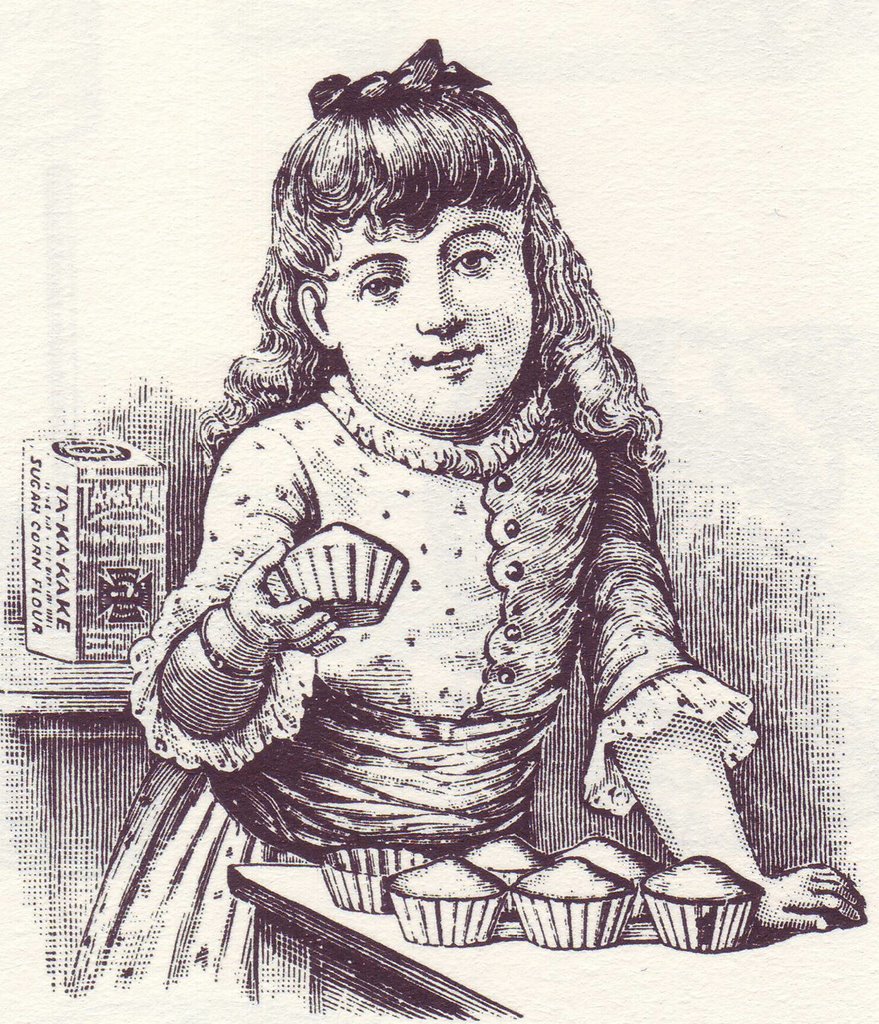
The man who invented condensed milk was born on this day in 1801. Gail Borden had many careers in his life –surveyor, cattleman, customs agent, newspaper editor, real estate salesman, and civic official – but is best known as an inventor. He had little formal education and no scientific training, but became very interested in food preservation in the 1840’s. This interest may have been precipitated by news of the gruesome fate of the “Donner Party” – a group of westbound settlers who became stranded in the Sierra Nevada over the winter of 1846-7, some of them surviving by eating their dead companions.

Borden spent years perfecting a “meat biscuit” or “portable desiccated soup-bread” which won a gold medal at the Great Council Exhibition in London in 1851, but ultimately was a commercial failure. The idea for a preserved form of milk came on his voyage home after the Exhibition. This time he was moved by the plight of babies who sickened because the cows kept aboard for that purpose were unable to provide sufficient milk. He was certainly persistent. His patent application for condensed milk was rejected three times before being accepted in 1856, after a recommendation from the editor of the Scientific American. The product was well timed, and business never looked back after the Civil War.

At some point in time, cooks realised that the heavily sweetened, thick milk – itself a sort of canned dairy confection – could be very useful in baking. The world has good reason to be grateful to the person who first thought of converting it to caramel pie filling, but perhaps less grateful to the one who first thought of using it as the base for a salad dressing. I am not sure when this latter invention was first perpetrated upon the world, and would be grateful to any readers who can find an earlier instance than the one in Alice Bradley’s little book “For Luncheon and Supper Guests”, published in 1923.

Alice’s book contained ten menus, with a total of 100 recipes. She avoided the dilemma of what to do with the leftover condensed milk when a recipe calls for only part of a can by ensuring that another recipe in the same menu used the exact remaining amount. No more “cook’s treat’ of furtive spoonfuls straight from can to mouth every time the fridge door is opened.

So, for Menu VII for luncheon or supper, which was:

Anchovy Canapé
Shellfish à la Queen
Stuffed Celery Sandwich
Butterscotch Biscuits
Orange and Grapefruit Salad
Chocolate Float
Cocoanut Cakes
Orange Opera Fudge

- she uses exactly one can of condensed milk in the following pair of recipes:

CONDENSED MILK SALAD DRESSING
Beat
1 egg until thick and lemon colored, and add
1/2 teaspoon mustard
1/2 teaspoon salt
1/4 teaspoon pepper and
1/2 teaspoon paprika, then add
1/3 cup vinegar
1/3 cup condensed milk and
1/4 cup melted butter.
Beat thoroughly, but do not cook. Chill before serving.

COCOANUT CAKES
Mix thoroughly
2 ½ cups shredded cocoanut
2/3 cup condensed milk and
1 teaspoon vanilla.
Beat
2 egg whites until stiff, combine mixtures, shape into cakes, using a knife and spoon, and allowing 1 rounding tablespoon mixture to each cake. Place on greased tin sheets 1 inch apart. Bake in moderate oven or at 350 degrees F. for 20 minutes.

A previous Story for this Day …

On November 9th 2005, the story was “All Hail the Apple Trees

Tomorrow’s Story …

A Whale of a Feed.

Quotation for the Day …

Condensed milk is wonderful. I don't see how they can get a cow to sit down on those little cans. Fred Allen.

Tuesday, November 07, 2006

An indifferent rabbit.

Today, November 8th …

Nella Last was an ordinary British housewife when World War II broke out in 1939. The diary she kept during the days of the war however, is anything but ordinary - it is a wonderfully eloquent record of day-to-day life on the Home Front, and we have taken inspiration from it in previous stories.

On this day in 1940 she wrote:

“It’s the custom for fish and fruit shops in Barrow to print their special lines on the outside window with a small brush dipped in whitening: ‘SPECIAL! RABBITS, CRABS.’ The better-class shops never do, and I was really amused by one such shop today for on both windows – its on a corner – was printed neatly and in extra large letters:

NO EGGS
NO LEMONS
NO ONIONS
NO LEEKS
NO PAPER BAGS

I wondered how many times Mrs Jones had to say those words before, in exasperation, she printed them on the window. The fishmongers shop was quite nicely stocked – especially with rabbits. I got one and paid 1s.8d. Considering the time of year, I thought they were an indifferent sample – I like to see pale pink flesh and the kidneys sunk in creamy fat. I hunted well through the furry furrows, and did not feel so well suited with what I got finally.”


Today we would say that Nella “found herself” during the war. Her “personal growth” (to use another modern phrase) is revealed through her diary. Without ever consciously realising it, she became “a writer”. Dowdy, nervy Nella also became something of a neighbourhood guru in the domestic arts. The minor housekeeping skills that neither she nor anyone else had valued before the war suddenly became important – the “make do and mend”, the budgeting and improvising and substituting and recycling of everything were what she had always done as a matter of course.

Nella got particular satisfaction out of making a good meal out of not much. Often she recorded exactly how she did this, but not on this day. We don’t know how Nella cooked the rabbit, but it would have been something thrifty, that could be stretched to serve at another meal, because that was her way.

Recipe for the Day …

Perhaps Nella might have cooked something like this recipe from Marguerite Patten, the cookery expert and cookbook writer who acted as an advisor to the Ministry of Food during the war:

Rabbit Surprise.
Small rabbit, 1 ½ pints of water, 1 teaspoon of salt, ½ pint of rice, 1 onio or 3 spring onions, 3 tomatoes, ½ teaspoon of pepper; pinch of ginger or cayenne, ½ pint brown gravy, fat for frying.
Bone the rabbit and cut into bite sized pieces. Boil up some salted water and pour in the rice and leave to cook for about 15 minutes. While you’re waiting for it to cook you can be preparing the rabbit. Heat up the fat and gently cook the pieces of rabbit until a golden brown. Drain the cooked rice and to it add thinly chopped onion(s), sliced tomatoes, pepper and ginger or cayenne. Place a little of this mixture onto a greased casserole dish and then lay the rabbit on top. With the remainder of the rice mixture cover the rabbit and add half a pint of gravy. Cover the casserole and cook gently for about an hour.

Previous Stories about Nella Last …

“Nella’s Sadness”
“Nella’s Orange Jelly”

A previous Story for this Day …

The story for November 8th 2005 was “Food for Cowboys and Popes”.

Tomorrow’s Story …

The Condensed Milk Man.

Quotation for the Day …

On Wartime Food : “There is something magic about all of Faringdon, and Lord Berners himself, in his skull cap, looks not unlike a magician, but perhaps the greatest, most amazing conjuring tricks are reserved for the dining room. In this pleasant sunny white room, scattered with large silver-gilt birds and wonderful Sevres and Dresden china, a standard of culinary perfection has been maintained through the darkest days of war. Cook or no cook, raw materials or no raw materials, a succession of utterly delicious courses would somehow waft themselves to the sideboard, and the poor Londoner, starved, or sated with Spam, would see sights and taste tastes he had long ago forgotten to believe in.” Nancy Mitford.

The Competition Winner.


And the winner is ...

I am pleased to announce that we have a competition winner: Elizabeth Chow, of Artamon in New South Wales. Her correct entry was first out of the bowl, but by an amazing co-incidence it also happended to be the first entry received!

Elizabeth says:

"What can I say about myself? I have an 8-month-old daughter and I'm a stay-at-home mum. I thought when I left work I'd have lots of time at home to whip upwonderful and exotic meals, but so far I've only hadtime to read about such things while nursing my baby."

Congratulations Elizabeth, the book is on its way. I'm sure you will enjoy browsing it while you nurse your baby.

Diet for a Complexion.

Today, November 7th …

The New York Times carried an article promoting a vegetarian diet as a beauty aid, on this day in 1897. The article header said:

DIET FOR A COMPLEXION
A Pink and White Fra Beato Angelico Countenance Induced by Vegetable Food.

And the writer went on to pronounce:

“There is no doubt that too much meat is eaten in this country. Americans are a nervous people, and they do not need the constant stimulus of meat.”

… while acknowledging that a change, however necessary, might present some difficulties:

“Where, as in the case in one family at the present time, a man under doctor’s orders is to eat meat only once a day, the bill of fare to be drawn from seems to be exceedingly limited.”

… which would, however, bring a flavour bonus …

“Vegetarians say that the true flavour of a dish of vegetables is never fully appreciated when eaten with meat, and it may be so.”

… although the justification given was factually incorrect:

"As examples of the benefit of a vegetable [diet?] they mention the Scotch race, brought up on oatmeal, the beautiful teeth of the Italian peasants … ".
Since when was oatmeal a vegetable? and who says that Italian peasants are vegetarian? And if the medical rationale failed to convince, there was the vanity one, although this was accompanied by an even more seriously incorrect nutrition statement:

“The beauty expert appealing to the well known weakness of women, says there is more oxide of iron contained in vegetables than in meat, and it is this property with gives rosiness to the cheeks and lips. The old Carthusian and Trappist monks were noted for their Fra Beato Angelico faces, and their diet was most abstemious and entirely vegetable.”

More oxide of iron may indeed contribute to rosy cheeks, but vegetables most assuredly do not contain more iron than meat.

Naturally the article was accompanied by several vegetarian recipes, as well as a suggested menu for a vegetarian Thanksgiving dinner, just in case any readers were converted by the power of the rhetoric.

Recipes for the Day ….

One of the recipes was for “Monastery Soup”, which was abstemious indeed – even in the version luxuriously thickened with one teaspoon of flour to 3 pints of water.

Monastery Soup.
Cut one carrot, one turnip, and three potatoes into small dice, and with one small onion chopped fine, simmer in three pints of water until very soft. Season with salt and pepper. If it seems thin, thicken with one teaspoon of flour. A small quantity of chopped cabbage, string beans or peas may be added, if desired.

At least there was a dessert with cream, to mitigate against the excess of abstemiousness with the soup.

Apple Charlotte.
To make it, take six large apples, one-half box gelatine, one pint of cream, and sugar to taste. Pare the apples, steam until tender, and press through a colander. Add the sugar. Take the gelatine, which, covered with water, has been soaking for half an hour, and add to the hot apples, stirring until it is dissolved. Pour the mixture into a tin basin, place in a pan of ice water, and stir continually until it begins to thicken. Add quickly and carefully the cream which has been whipped. Place in a pudding mold, and set in a cool place to harden.

A previous Story for this Day …

The story for November 7th 2005 was “Elephant (not) on the Menu”.

Tomorrow’s Story …

An indifferent rabbit.

Quotation for the Day …

Everything you see I owe to spaghetti. Sophia Loren

Monday, November 06, 2006

Salem Pepper.

Today, November 6th …

Almost two hundred years of lucrative pepper trading ended for the city of Salem on this day in 1846, when the brig Lucilla entered the harbour carrying the last bulk cargo of pepper.

The Salem pepper trade began with a man called Elihu Yale. Yale was born in Massachusetts but was taken to England at the age of three years, never to return to America. He made his fortune working for the East India Company in its heyday, and a large part of his success was the establishment of the pepper trade out of the port of Salem. In 1654 he sent representatives to Aceh in northern Sumatra in 1654, with the aim of breaking the European monopoly of the lucrative spice trade.

The venture was successful almost beyond the dreams of avarice. In 1806 one single consignment of five hundred tons of pepper was valued at over one million pounds. As an acknowledgement of the source of its wealth, the seal of the City of Salem still bears an image of an Achenese person in traditional dress. On a different scale altogether, as an acknowledgement of his financial backing, a college back in the country of his birth, in New Haven, Connecticut, would be re-named in Elihu Yale’s honour.

Pepper (Piper nigrum) probably originated on the Malabar Coast of India in what is now called Kerala. It was known to the ancient Romans, and returning crusaders no doubt brought some of the precious and tasty spice back to Europe after their adventures, but it was not until the fifteenth century that commercial trade had its beginnings. Seafaring know-how had advanced sufficiently by then to make it technically possible, and the huge demand for spices provided the impetus for voyages of exploration to seek out the sources – the explorations that ultimately changed the map of the known world.

Black, white, red, or green – the peppercorns that we know are all derived from the same plant, the final product depending on the details of harvesting and processing. We think of it as a cheap, everyday spice but it was once, quite literally, worth more than gold. It is said that Alaric the Visigoth demanded three thousand pounds of pepper as part of his ransom from the citizens of Rome when he besieged their city in the year of 408. It is ironic that today a “peppercorn rent” today means a nominal sum, but once upon a time, when debts were sometimes actually paid in peppercorns, it may have meant a very hefty rent indeed.

Recipe for the Day …

Today, in recognition of the origin of the pepper in India, and the great Empire-building that occurred as a result of the search for it and other spices, we have a very Anglo-Indian recipe from the Victorian era.

Pepper Water (for flavouring).
Strain the juice of a fresh lemon into a pint and a half of cold water. Slice an onion and pound it in a mortar, with twelve peppercorns, three cloves of garlic, a table-spoonful of curry powder and a dessert-spoonful of salt. Put all into a saucepan, bring the liquid to the point of boiling, cover closely, and let it simmer gently for a quarter of an hour, then strain it through muslin. Put with it a small onion which has been chopped small and fried lightly in butter. Boil up once more, and the pepper water is ready to be bottled. Cork closely, and store in a cool, dry place. In India, where this recipe is in great repute, a piece of tamarind is substituted for the lemon juice. Probable cost, 2d. per pint.
[From Cassell’s Dictionary of Cookery (1870’s)]

Tomorrow’s Story …

Diet for a Complexion.

Quotation for the Day …

Americans can eat garbage, provided you sprinkle it liberally with ketchup, mustard, chili sauce, Tabasco sauce, cayenne pepper, or any other condiment which destroys the original flavor of the dish. Henry Miller.

REMINDER: you have about twelve hours left (from the time of this posting) to enter the QUIZ and win the prize!

Saturday, November 04, 2006

Pumpkin Fruit Cake.

If you haven’t given yourself a chance to win “A Good Plain Cook: an edible history of Queensland” yet – you have a little more time. It has been brought to my attention that “the end of the weekend” in sunny Queensland is only “half way through the weekend” in other parts of the world, so the deadline for entering the quiz has been extended to Monday 5th November, 5pm Brisbane time (which, to give you an idea - is 2 am in New York and 7 am in London)

The quiz is HERE.

To whet your appetite, here is a recipe for Pumpkin Fruit Cake from “A Good Plain Cook”, chosen because “Queensland Blue” pumpkins are the best eating pumpkins in the world (we eat them here, rather than use them for Halloween decorations!), and because those of you in America might have need of pumpkin recipes at this time of the year.

Pumpkin Fruit Cake.

Cream 4 oz. (125 g) butter with 1 cup brown sugar. Beat 2 eggs and add to creamed mixture. Add 1 cup warm mashed pumpkin, 2 tabs Golden Syrup, 1 tab rum, 1 tsp vanilla. Stir in 1 ½ cups dried mixed fruit. Lastly fold in 2 cups S.R.flour. Bake in a moderate oven in a deep 8 inch (20 cm) tin for 1 ½ hours.

Friday, November 03, 2006

St Hubert’s Day.

Before you read any further: have you considered entering the Quiz and giving yourself a chance to win a copy of "A Good Plain Cook"? The details are HERE.

Thankyou for your attention, You can now read today's story.

Today, November 3rd …

This is the feast day of St Hubert of Liege, the patron saint of Belgium as well as the hunt and everything associated with it. Legend has it that Hubert was a wealthy, pleasure-loving young aristocrat in seventh century Belgium, and of all the possible pleasures of the rich and self-indulgent, he loved hunting the most. One Good Friday morning, the stag that he was pursuing in the forest turned toward him and Hubert saw that there was a crucifix between his antlers – and to cut a longish story short and cut to the culinary chase, Hubert saw the error of his worldly ways and promptly relinquished them and became a bishop.

St Hubert’s day is the beginning of the hunting season in many parts of Europe. In many places it is celebrated with a stag hunt – which seems an awfully odd way to celebrate the life of a man who gave up hunting for religious reasons. Surely he would be a more appropriate patron saint of vegetarianism, or the increasingly vocal “ethical eaters” such as the folk who have managed to get foie gras banned in Chicago?

The traditional St Hubert’s day hunt begins with the blessing of a special bread which is then shared out amongst the hunting dogs in the belief that it will protect from rabies. Other than the bread, all dishes “à la St Hubert” are based on some sort of game: you can chose from consommé, purée of pheasant (or any game), tournedos of venison, petites bouchées (“vol au vents”), timbales, and even an omelette.

The perfect accompaniment to one of those rich game dishes would be a good Cabernet Sauvignon from the Yarra Valley (Victoria, Australia) vineyard of the same name. The winery was established in 1862 by Hubert De Castella (whose Saints' Day would have been today), and in 1880 St Hubert wine won the award given by Emperor Wilhelm I of Germany's award for the most successful exhibitor at the Melbourne International Exhibition.

Recipe for the Day …

Omelette à la Saint-Hubert.
Fold into the omelette some purée of game meat, bound with a thick Demi-glace sauce based on concentrated game stock. Put on the omelette a row of sliced mushrooms, lightly fried in butter. Serve with a ring of Demi-glace sauce.

Story from November 3rd 2005 …

Green Peas from Adam and Eve.

Monday’s Story …

Salem Pepper.

Quotation for the Day …

There are two types of onions, the big white Spanish and the little red Italian. The Spanish has more food value and is therefore chosen to make soup for huntsmen and drunkards, two classes of people who require fast recuperation. Alexandre Dumas.

Thursday, November 02, 2006

Marie-Antoinette and Cake.

Today, November 2nd …

Marie-Antoinette was born on this day in 1755, and in view of the new movie about her, it is timely to consider her again - this time to focus on the pesky “Let them eat cake” story.

The movie has been criticised for its historic inaccuracies and its focus on the trivia and excesses of her life, but in doing so it is surely only following the precedent of “history” itself, which – being written as is usual, by the victors and propagandists - has not been kind to her. Imagine any 14 year-old girl that you know. Imagine sending her off to another country (where she was not fluent in the language) and marrying her off within a few days to a man she had never met. Give her the huge dual responsibilities of facilitating the diplomatic relations between the two countries, and of providing an heir and preferably also a spare. Imagine this child’s homesickness. Imagine her distress at the public ridicule she endured for not immediately producing an heir when the real reason was that her marriage was not able to be consummated until Louis submitted (years later) to minor surgery to correct a minor anatomical “glitch” that had made consummation impossible. This adolescent spent her first seven years as a virgin royal bride assuaging her homesickness and filling her time with all sorts of fun and games, as any teenager would. She does not seem to have been gratuitously unkind, and motherhood, when it finally happened, and maturity, when the years gave it, made her quite courageous.

Marie-Antoinette was accused of many things both during and after her life, for which there is no evidence. It is time to put to an end, once and for all, the malicious slander that she said of the hungry at the gate, when told they had no bread, “Let them eat Cake”. The phrase was written when she was a child, in a fable by the philosopher Rousseau who attributed it to a “great princess” to indicate her insensitivity to the poor. It was appropriated by post-revolutionary publicists and re-attributed to her to support their propaganda.

As far as the food depicted in the movie goes, until I have seen it I must restrain from judgement, but judging by some of the publicity stills, the cakes at any rate are far from historically accurate. “Cakes” in Marie-Antoinette’s time were leavened with beaten eggs, or yeast, and were baked in “hoops” supported by paper cuffs and set on flat baking trays – they were not airy, fluffy, butter-cream-frosted, highly decorated concoctions which require baking powders and shaped tins, both of which were developed after she was dead.

Which all only matters of course if we demand the facts, and only the historical facts, from Hollywood.

Recipes for the Day ...

The French cook François Menon’s book “The professed cook; or the modern art of cookery, …. ” was published during Marie-Antoinette’s lifetime, so surely we can rely on his recipes to give us an accurate idea of the food of the time? I have chosen a cake recipe – naturally, but also give you a regal beef dish, in case you should wish to have a more complete meal in her honour (although to do that properly, you would have to have an awful lot more dishes – see the link below to an earlier posting which includes a menu from the Trianon).

The recipes are taken from the 1769 English translation of the book.

Aloyau à la Dauphine. Surloin Dauphine Fashion.
Take a Surloin thoroughly bon’d, make a Hole in the middle large enough to put in it a Salpicon, viz. Stuffing after this Manner, cut in pretty large Bits Pieces of Ham raw, a Fowl bon’d, two scalded Sweet Breads, a Tongue, all minced together and chop’t Parsley, a Garlick Clove, Mushrooms, Salt and Pepper, rasped Lard, Laurel and Thyme, four Yolks of Eggs; put it in the Beef and secure it well, boil it in a Pot near to its Bigness in a little Broth, a Bottle of white Wine, a large Nosegay, three Cloves, a Laurel Leaf, six Tarragon Leafs, three or four Onions, a few Roots, finish on a slow Fire; serve it upon a Sauce à l’Espagnole.

Gateaux d’Amandes. Almond Cake.
Take half a Pound of Flour, half a Pound of pounded sweet Almonds, and five or six bitter with it, half a Pound of Sugar, six Eggs, and work it well all together; form it into a Cake; bake it on a sheet of Paper, well buttered; when cold, glaze it with a white Sugar-glaze: another Method for the same Sorts of Cakes; bake it in a Mould, or Baking-hoop; pound a Pound of sweet Almonds very fine, and one Dozen of bitter ditto, putting Whites of Eggs, to hinder them from turning to Oil; then put to it half a Pound of fine Sugar-powder by Degrees, two whole Eggs, Lemon-peel, finely chopped or rasped; when this is properly mixed, add eight Eggs, the Yolks and Whites first beat up separately; stir it, and mix it all properly; and pour it in the Mould, to bake about an Hour: serve in its natural Colour.

Another Marie-Antoinette Story ...

See a menu from the Trianon at "Dining with Marie-Antoinette", with two more recipes from M.Menon's book.

Last Year's Story...

The story for November 2nd 2005 was "An Old Take on Seafood Extender."

Tomorrow’s Story …

St Hubert’s Day.

Quotation for the Day …

In France, cooking is a serious art form and a national sport. Julia Child.

Dont Forget to enter the QUIZ!

You have a chance to win a charming book on Queensland's culinary history. Scroll down or go to the post HERE.

Wednesday, November 01, 2006

Sundae any Day.

Today, November 1st …

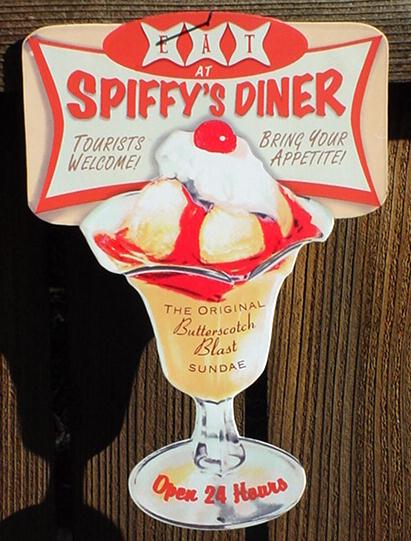
The French writer Henri Troyat was born on this day in 1911, and this is his paean to ice-cream sundaes, taken from the travel-memoir of his trip to America in 1948:

"... I shall remember that ice-cream all my life. In a sumptuous confectioner's shop, light, airy, full of fragrance, we were served with a mountain of coffee ice cream, sprinkled with cream and scattered with walnuts, honey, peanuts, and various fruits. When I carried the first spoonful to my mouth...my taste buds experienced a violent ecstasy. A whole opera of sensation rolled off my tongue ..."

Henri must have eaten ice-cream before, of course – they do have ice-cream in France, but French ice-cream is of the exquisite but austere kind, not this totally over-the top dressed-to-kill, operatic mountain of abundance. Ice-cream did exist before “America”, but it does seem as if Americans did invent the sundae. The invention happened sometime in the second half of the nineteenth century, perhaps as an almost illicit treat on Sunday when many states had “blue laws” regulating the sale of anything except newspapers, milk, and ice on the Sabbath. The spelling was changed to confuse or appease the offended religious, and “Sunday” became “Sundae” - or so the story goes.

There is one particularly glorious and over-the-top form of sundae however which is entirely English, or at least, all references are as an English treat. I refer of course, to the “Knickerbocker Glory”. English to the last lick. Or is it?

The name is unequivocally American – “Knickerbocker” is a Dutch-American surname, and the name of a New York basketball team, and “knickerbockers” are the American version of knee-breeches (which are the same as golfers’ “plus fours”). Which of these lent its name to an ice-cream sundae served in a tall, tall glass? And how did it get to be English?

One of the many delightful theories is that the name comes from the colourful layers of the ice-cream and its embellishments (cream, custard, jelly, fruit …. ) in the requisite tall, tall glass, which resemble the stripes on knickerbockers (or the hose worn with them). It is a good enough theory for me, until a better one comes along.

It seems that perhaps the Knickerbocker Glory was a brief fashion in America, for there is a recipe for it in a Soda Fountain manual of 1915 – and fashion is the operative word, for staying one step ahead of the competition was an essential skill for soda fountain operators. During Prohibition in America, displaced bartenders swelled the ranks of soda jerks and wreaked their own creativity on ice-cream sundaes, and fashions changed even more quickly than hemlines. By the 1930’s it had migrated to England (we will probably never know who packed it up and bought it a ticket), where, in the absence of any competition, the briefly famous and quickly forgotten American Knickerbocker Glory, became a naturalised and enduring English Celebrity. You can still order one at the seaside today.

Recipe for the Day …

The Knickerbocker.
Ice cream, 4 ounces; chocolate syrup, 1/2 ounce; raspberry crushed fruit, 1/2 ounce; whipped cream, 3 ounces; 2 brandied cherries.
Place the ice cream in a glass and add chocolate syrup, some of the whipped cream and 2 dashes of essence of rose. Add raspberry fruit and then balance of whipped cream and the rose essence; top with cherries. Each of the separate portions will appear as a separate layer in glass. This sundae should be served in a tall, narrow, 10-ounce, thin glass, and the dispenser in serving should insert long spoon to the bottom of the glass just once and draw slowly towards top, so as to slightly mix the ingredients. This is done for appearance only. Fifteen cents should be secured for this sundae and all materials should be of the very best.
[The Dispenser’s Formulary, or, Soda Water Guide; compiled by the editorial staff of The Soda Fountain; New York: D. O. Haynes, 1915]

Last Year's Story ...

Last year's story for November 1st was "Eating the Flower of Death".

Tomorrow’s Story …

Marie-Antoinette and Cake.

Quotation for the Day …

The sundae is a mixed drink and consists of ice-cream smothered in everything except young onions. Owing to the Prohibition wave thousands of skilful bartenders have been thrown out of employment, but most of them have since been hired to manufacture the ice cream sundae in long wriggling relays. Every few days some former barkeeper will bring out a new sundae which is harder to cook than a welsh rarebit in a hay cooker. The New Castle News, a Pennsylvanian newspaper, in 1916.

COMPETITION REMINDER ...

Dont forget to enter the quiz! To see the details, scroll just a little further down to yesterday's post.

Tuesday, October 31, 2006

Birthday Competition Quiz.

Today is Birthday Competition Day …

Today The Old Foodie is one year old. Her body is considerably older, and the blog is slightly younger, but these events will be celebrated in their own time.

To celebrate The Old Foodie birthday, and to thank you for your enthusiasm and kind comments, The Old Foodie is going to give a prize for the first correct answer drawn out of her biggest mixing bowl, to a ten-question quiz.


The Prize:
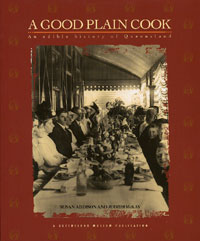
The prize is a copy of “A Good Plain Cook: An edible history of Queensland” by Susan Addison and Judith McKay, and published by the Queensland Museum. If you have ever wondered how to roast bandicoot or wallaby, or use dry coffee as a preservative, or make Poor Man’s Goose, then this is the book for you. If not, it also has recipes for Anzac biscuits, Miss Schauer’s Cup Cake, and pikelets and such like, which are sure to please. The book is delightfully illustrated with photographs, advertisements and images from by-gone days.

The Conditions: [Note: changed deadline]

In order not to penalise those of you around the globe who will be sleeping soundly at that time, it will not be “first correct answer wins”, it will be “first correct answer drawn out of my largest mixing bowl wins”. I will give until "the end of the weekend" - which I have designated as Monday 6th November 5 pm Australian Eastern Standard time (2 am in New York and 7 am in London).

I will print off all correct answers and will pick a suitably qualified person to draw out a winner.

Please respond by email to THE OLD FOODIE, or post your answers in the comments to this post.

The winner will be announced on Monday morning, Australian Eastern Standard Time.

The Questions:

1. When is “Split-Stomach Day”?

2. What is the principal ingredient of “black butter”, as enjoyed by Jane Austen?

3. The first cookbook to give instructions for the now traditional wedding cake’s almond icing plus white icing, was …… ?

4. What year was “Vegemite” launched?

5. When is Woodruff Wine traditionally drunk?

6. What did Edmund Hilary and Tensing Norgay eat at the summit of Everest in 1953?

7. Whose coronation is associated with the dish “Coronation Chicken”?

8. What is the “Scarcity Root”?

9. Who is “Chicken Tetrazzini” named for?

10. What is “Sack” better known as today?

There, that wasn’t too hard, was it? If you’ve been paying attention, all the answers are in an Old Foodie story on this blog.

P.S. There is a also real food story for this day, with a recipe of course – you will find it by scrolling down a little further ….

Dinner for the Workers.

Today, October 31st …

The five hundred workmen who had completed the renovated the exterior of Buckingham Palace in only 13 weeks were entertained at dinner by King George V on this day in 1913, at a Holborn restaurant.

The King himself did not attend, but his “gracious thought” was carried out with “tact and hospitality”. The tact presumably included the fact that “there was no ceremony or formality on the part of the members of the Royal Household”, who merely wore morning dress so as not to intimidate the workers, who had their own hierarchical dress code:

“The men came in their best clothes, and although black coats and linen collars were predominant, many were to be seen in tweeds, corduroys, and woollen mufflers, for there were labourers of all kinds in the company as well as masons and carvers.”


A large number of the public who “recognized that the dinner was a well-deserved tribute to the craft and discipline of British workmanship”, came along to watch the men arriving, and a large number of souvenir sellers had a nicely profitable evening.

A letter of thanks from the King was read out by the Master of the Household.

“I congratulate you upon an achievement both in handicraft and rapidity of execution. You have raised what is acknowledged to be a distinct architectural improvement in London, and a worthy addition to the Empire’s memorial to Queen Victoria”.

The “comrade who lost his life in the execution of his duties” was given an honourable mention, and the men were finally able to tuck into what was probably for many of them the most spectacular meal they had ever had in their lives, accompanied by “an abundant supply of good ale”.

Scotch Broth
Boiled Turbot with Hollandaise Sauce
Roast Saddle of Mutton
Roast Beef
Baked Potatoes
Brussels sprouts
Cauliflower
Saxon pudding
Dessert

Recipe for the Day …

Saxon pudding may or may not have been chosen as a nod to the King’s German heritage, but it would certainly have been popular with his dinner guests on the day, who would all have loved steamed puddings. This one is a lighter and more elegant version than the solid suet pudding which would have been more familiar to the British Victorian working man.

Saxon Pudding.
According to high authority this is one of the best puddings of Germany. Boil a gill of milk, put into a stewpan half a pound of flour. Gradually dilute the flour with the milk, so as to obtain a fine smooth paste. Add four ounces of butter, and salt to taste. Place the saucepan on a moderate fire, stir the preparation till it begins to thicken, then take it off the fire, but still continue working it. When the paste is smooth, place it again on the fire, working it still, and gradually introduce into it the yolks of ten eggs, four ounces of oranged sugar, four ounces of butter, and a little salt. When the preparation is frothy, introduce seven or eight whipped whites of eggs. Pour the preparation into a dome or cylinder mould which has been buttered and glazed with sugar and potato-flour. Set the mould in stewpan with boiling water reaching to half its height. Bake in a slack oven for forty minutes.
[Cassell’s Dictionary of Cookery, 1870’s]

Tomorrow’s Story …

Sundae any Day.

Quotation for the Day …

That was the best ice-cream soda I ever tasted. Reported last words of Lou Costello, died March 3rd 1959.

Monday, October 30, 2006

A Fish dinner on the Beach.


Before We Start ...

The Old Foodie has two announcements:

1. There was an extra posting on Saturday, as my belated contribution to October's Breast Cancer Awareness "Pink" theme. To find it, please scroll down to below today's story, which will first take you past ...

2. A competition announcement:
As a celebration of the one-year birthday of The Old Foodie on Tuesday, October 31st, there will be a quiz, with a prize. The questions will be posted on Tuesday. If you have been paying attention the answers will be easy. For more details as to the prize and the entry conditions, please scroll down below today's story, which starts now ...

Today, October 30th …

John Oxley and his men explored the course of the Macquarie River (in New South Wales) in 1818 - at one point believing that it led to a vast inland sea, thus creating a persisting, and sadly untrue myth to intrigue a later series of explorers. On this day they finally reached the continental coastline.

“ … We passed for five miles and a half through the country described yesterday, when we arrived on the beach south-west of the Sugarloaf Point. … we went nearly six miles farther on the beach, and halted near a rocky point for the evening. This beach was a peculiarly productive one to us; a great number of fine fish resembling salmon, had been pursued through the surf by larger fish, and were left dry by the retiring tide: we picked up thirty-six, and a welcome prize they proved to us.”

Hunger has been an occupational hazard of explorers throughout history, and sufficient hunger will make almost anything palatable, so it is no wonder Oxley’s men were delighted with their serendipitous dinner. We don’t know exactly what they ate, but the coastal waters of eastern Australia provide a magnificent variety of fish, so it is reasonable to assume it would have been not just dinner, but delicious dinner - which makes the attitude of early settlers quite strange. For those who chose to settle in Australia in the early days, everything at “Home” (i.e England) was the Gold Standard, and that included the fish. An awful lot of “English” salmon found its way to the country (preserved of course) as the fish course for elegant dinners, and there were serious and prolonged attempts to establish an English salmon industry in Tasmania.

Ironically, now that we truly appreciate our fish, such largesse would be an unlikely find on a beach walk on the beautiful northern New South Wales coastline. Such appreciation took some time to develop. Even by 1893, when Philip Muskett published his “Art of Living in Australia”, he felt moved to say:

“ Along with its great ally, the oyster, fish undoubtedly occupies one of the highest places on the food list. Unfortunately, it is not met with in every home as it should be, its high price and scarcity combining to make it conspicuous by its absence. That such a state of things is actually the case in Australia can only be deeply deplored. Let us suppose, for instance, that we were as well supplied with fish as we are entitled to be, considering that we are of a maritime race and that we live near the sea. If such were the case—and I would it were so— how would a sudden reversal to the present state of our fish supply be received? Would it not give rise to protestations, to indignation meetings, to questionings in the House, and to the papers being filled with complaints, till matters were put right again? Yes, indeed, all these things would happen! meanwhile, however, we continue placidly in our fishless state of existence, and the finny tribe, outside in the deep sea, have a good time in consequence.”

The book did include some recipes “created by Mrs H. Wicken, Lecturer on Cookery to the Technical College, Sydney”. Here is one of them, chosen for no better reason than its “S” shape, proving that one can make something interesting and elegant with mere local fish.

FISH PUDDING
1/2 lb. Blue Cod*—5d.
1 lb. Potatoes—1d.
1 oz. Butter—1d.
1 Egg
Pepper and Salt—1d.
Total Cost—8d.
Time—Half an Hour
Use cold fish and potatoes, if there are any in the larder; if not, boil a piece of blue smoked cod in some water for five minutes. Flake it up free from skin and bone and put it into a basin; mash up the potatoes and mix them in with the pepper and salt. Bind into a paste with an egg; rub some dripping on a baking sheet, turn the mixture on to it and shape into the letter S, brush over with egg or milk, and bake till brown. Slip it off on to a hot dish, and garnish with parsley.

*Common fish names are always problematic, and it is not possible to be certain that the cook was referring to what we now call Blue Cod or Trout Cod, and which was officially named Maccullochella macquariensis a century after Oxley’s journey. It would not have been Oxley’s fish, in spite of the fact that it was named after the river he explored (which was named for Lachlan Macquarie, Governor of NSW from 1810-1821), as it is a fresh-water fish. In another irony, it is one of the species that is now sufficiently rare that it is fully protected.

Tomorrow’s Story …

Dinner for the Workers.

Quotation for the Day …

A correspondent in the “Magazine of Domestic Economy” asserts that it is a well-known fact, not only in our own country, but in every part of the world, especially on the North American continent, that icthyophagists, or feeders on fish, who dwell on the sea-coast, are a hardy, well-conditioned, and healthy race of men. Edward Abbott, “The Australian Aristologist” (1864).

Sunday, October 29, 2006

Old Foodie Birthday Competition.

The Old Foodie will be one year old on October 31st (her actual body has a rather larger-numbered birthday in December, and the actual blog has a birthday in March, but lets not get too complicated), and in celebration she invites you to enter a competition for which she will give a prize.

The prize is a copy of “A Good Plain Cook: An edible history of Queensland” by Susan Addison and Judith McKay, and published by the Queensland Museum. If you have ever wondered how to roast bandicoot or wallaby, or use dry coffee as a preservative, or make Poor Man’s Goose, then this is the book for you. If not, it also has recipes for Anzac biscuits, Miss Schauer’s Cup Cake, and pikelets and such like, which are sure to please. The book is delightfully illustrated with photographs, advertisements and images from by-gone days.

There will be ten questions taken from Old Foodie stories. If you have been paying attention they will be easy to answer.

The questions will be posted on Tuesday morning, October 31st at whatever time I get around to posting (usually quite early Australian Eastern Standard Time). In order not to penalise those of you around the globe who will be sleeping soundly at that time, it will not be “first correct answer wins”, it will be “first correct answer drawn out of my largest mixing bowl wins”. I will give until the end of the weekend, which I have determined to be midnight on Sunday the 5th November, Australian Eastern Standard Time. You can work it out, I know you can.

Saturday, October 28, 2006

A Pink Tea for Breast Cancer Month.


With the month of October almost over I am almost too late to make my contribution to the Pink Theme for Breast Cancer Awareness. I offer my small effort to redress this with a short extract from a late ninteenth century American cookbook on the subject of a Pink-Themed Tea Party, and some "pink" recipes from two eighteenth century English cookbooks.

From: Aunt Babette's cook book. Foreign and domestic receipts for the household. A valuable collection of receipts and hints for the housewife. Many of which are not to be found elsewhere. By "Aunt Babette" (America, 1889).

PINK TEA.

"Pink Teas," just now so fashionable, are rather novel if carried out to the letter, and an expensive way of entertaining, too, yet, as the old saying is, one might as well be dead as out of fashion. So all those who wish to be fashionable come and listen, and I will give you a few hints in regard to getting up a "Pink Tea." As a matter of course the table linen should be in harmony. If you possess a tablecloth with a drawn-work border, line the border with pink cambric. If not, cut the cambric the width desired and sew it on to any tablecloth and cover it with some cheap lace inserting; it will look very pretty. You may draw pink ribbons through the napkins. Suspend sash ribbons from the chandeliers in dining-room to reach half way down the center of the table, or, better still, to reach the four corners. Your lamps all over the house should have pink shades. They may be of pink paper; the dishes also of a delicate pink shade, which you may borrow for the occasion. Arrange the white cakes on high cake-stands, lined with fancy pink paper, or pink napkins, and put the pink frosted cakes on low cake-stands lined with fancy white paper or napkins. The flowers for decoration must also be of pink. Serve the creams and ices in novel designs made of pink paper, such as baskets, boxes, buckets, freezers, cups and saucers, shells, wheelbarrows, vases, etc. I am not able to tell you all the different designs they have for this purpose. You may procure these and many more beautiful designs at almost any fashionable caterer's. Each guest should have a pink boutonniere, or a white hyacinth, tied with a pink satin ribbon. Have miniature fans placed for each guest, with a card attached containing his or her name. These are to be taken home as souvenirs. Serve the butter in pink individuals, each piece of butter moulded differently and garnished with a wreath of parsley. A handsome center-piece for the table is indispensable, so get a large fruit-stand and trim it prettily with ferns, smilax and flowers, or have an ornament of spun sugar for a center piece. If you live where there are no caterers you may try this: Make a large nest of macaroons, oval in shape. Join the macaroons with sugar boiled until it candies and have this filled with charlotte russe and resting on a rock of spun sugar. You may color the charlotte russe pink and the effect will be beautiful, for the spun sugar will look like crystal. A nice way to serve charlottes at a "Pink Tea" is to hollow out large "Acme" tomatoes, skin them carefully, cut off the tops and scoop out the inside, set on ice until wanted, then fill with whipped cream and ornament with candied cherries. (At a "Yellow Tea" you may substitute oranges for this purpose.)

("Aunt Babette" does give a recipe for Pink Cream Cake, but it uses “Dr. Price's fruit coloring”, which sounds a little dubious today)

And now for the eighteenth century "pink" recipes:

Pink-coloured Pancakes.
Having boiled a large beet-root till it is tender, beat it fine in a marble mortar. Put to it the yolks of four eggs, two spoonfuls of flour, and three spoonfuls of cream. Sweeten it to your taste, grate in half a nutmeg, and add a glass of brandy. Mix all well together, and fry them as before directed. Garnish with green sweetmeats, green sprigs of myrtle, or preserved apricots.
(‘The universal cook, and city and country housekeeper…. ‘ F.Collingwood; 1797)

To Make Raspberry Fritters.
Grate two Naples biscuits, pour over them half a gill of boiling cream. When it is almost cold, beat the yolks of four eggs to a strong froth, beat the biscuits a little, then beat both together exceeding well. Put to it two ounces of sugar, and as much juice of raspberry as will make it a pretty pink colour and give it a proper sharpness. Drop them into a pan of boiling lard, the size of a walnut. When you dish them up stick bits of citron in some, and blanched almonds cut lengthways in others. Lay around them green and yellow sweetmeats and serve them up. They are a pretty corner dish for either dinner or supper.
(Elizabeth Raffald “Experienced English Housekeeper” (1769)

Friday, October 27, 2006

Emily Post does Lunch.

Today, October 27th …

Emily Post, the woman who was to become the authority on good manners, was born Emily Price on this day in 1872 in Baltimore. Her book “Etiquette in Society, in Business, in Politics and at Home” was published in 1922, and the rest, as they say, is etiquette history.

Her theory was quite simple: “Manners are a sensitive awareness of the feelings of others. If you have that awareness, you have good manners, no matter what fork you use”. The practice, however, was not. Luncheon, she says “is never so formidable as dinner”, even though it differs from that meal “in minor details only”. Some of the minor details in relation to luncheon are:

… fashionable ladies never take off their hats. Even the hostess herself almost invariably wears a hat at a formal luncheon in her own house …

The usual lunch hour is half past one. By a quarter to three the last guest is invariably gone.

The hostess, instead of receiving at the door, sits usually in the center of the room in some place that has an unobstructed approach from the door. Each guest coming into the room is preceded by the butler to within a short speaking distance of the hostess, where he announces the new arrival’s name, and then stands aside.

The gentlemen never offer their arms to ladies in going in to a luncheon.

The places are never left plateless, excepting after salad, when the table is cleared and crumbed for dessert.

… “corsage bouquets” laid at the places with flower pins complete are in very bad taste.


Emily also has something to say about the luncheon menu itself.

Five courses at most (not counting the passing of a dish of candy or after-dinner coffee as a course), or more usually four actual courses, are thought sufficient in the smartest houses.

She goes on to give more details as to the alternative menus:

Fruit, or soup in cups
Eggs
Meat and vegetables
Salad
Dessert

or
Fruit
Soup
Meat and vegetables
Salad
Dessert

or
Fruit
Soup
Eggs
Fowl or “tame” game with salad
Dessert.

And yet more details about the individual courses, (without, of course, giving actual recipes). She says about eggs at luncheon:

Eggs that are substantial and “rich,” such as eggs Benedict, or stuffed with pâté de foie gras and a mushroom sauce, should then be “balanced” by a simple meat, such as broiled chicken and salad, combining meat and salad courses in one. On the other hand, should you have a light egg course, like “eggs surprise,” you could have meat and vegetables, and plain salad; or an elaborate salad and no dessert. Or with fruit and soup, omit eggs, especially if there is to be an aspic with salad.

Recipe for the Day …

The aim of the rules and formulae of etiquette was to ensure every social event proceeded in calm and predictable fashion, and that no guest was embarrassed, upstaged, or unnerved. It appears that only the eggs were allowed to be a surprise. There are savoury and sweet versions of “Eggs Surprise”, although the placement of her comment suggests she meant the savoury version. Etiquette is all about certainty however, so I give you both versions, rather than risk making a gaffe.

EGGS EN SURPRISE.
Cut stale bread in two-inch slices and then in circular or elliptical shapes. Remove centres, leaving cases. Fry in deep fat until delicately browned and drain on brown paper. Half fill cases thus made with Creamed Asparagus tips. French poach six eggs, coat with egg (slightly beaten and diluted with one tablespoon cold water), roll in bread crumbs to which has been added Parmesan cheese (allowing two tablespoons cheese to three-fourths cup crumbs) and fry one minute in very hot, deep fate. Drain and arrange in croustades. Garnish with parsley.
(A New Book of Cookery; Fanny Farmer, 1912)

[Other versions of the era have the cooled poached eggs being battered and deep fried. TOF]

EGGS EN SURPRISE.
Take a dozen eggs, and make a small hole at each end of every egg, through which pass a straw and break the yolk; then blow out the yolk carefully. Wash the shells, and having drained, dry them in the open air; mix the yolk of an egg with a little flour to close one of the holes of the shells, and when dry, fill half the number by means of a small funnel, with chocolate cream, and the remaining six with coffee or orange-cream; close the other end of your eggs, and put them into a saucepan of hot water; set them on the fire, taking care they do not boil; when done, remove the cement from the ends; dry, and serve them on a folded napkin.
(The Cook's Own Book; Lee, N. K. M., Mrs. 1832)

Monday’s Story …

A Fish dinner on the Beach.

Quotation for the Day …

Etiquette is the science of living. It embraces everything. It is honour. Emily Post.

Thursday, October 26, 2006

In the name of Coleslaw.

Today, October 26th …

The Thursday “Household Hints” column of “The Perry Chief” (an Iowan newspaper) on this day in 1876 included a recipe for “Coldslaw”, or as we are more commonly (and correctly) likely to call it now “Coleslaw”. The word comes from two Dutch words – kool meaning cabbage and the word for salad, pronounced sla, but it is easy to see how the word was heard as indicating “cold” (sometime in the mid-eighteenth century) as that was the how the dish was served. It is a mysterious victory for the word police that the original version was restored, but it is not a complete victory. “Slaw” was not only sometimes spelled “slaugh”, it was occasionally used as if it was the cabbage word, so we can find “hot slaw” recipes (although I have not seen “hot slaugh”, thank goodness).

This whole wordy saga took place in America, for reasons which remain (to me) obscure. Cabbage is the quintessential English vegetable, as the number of jokes of the boarding-house/overcooked-cabbage variety will attest – but recipes for it served raw in salad simply don’t exist until well into the twentieth century, and probably not to any significant extent until after the second world war.

Coleslaw lost its virginity somewhere along the way. Cooks who want it “fancy” can make it with red cabbage (and maintain the colour theme by adding beetroot), and almost all cooks add other vegetables such as celery and carrot. A strange variation that merits specific mention is the jellied version. The short dark period of culinary history when the pinnacle of housekeeping was to place on the luncheon table a moulded jellied vegetable salad will, I am sure be a source of much discussion by future culinary historians. It seems to have been an American phenomenon, and the rest of us find it very puzzling. Perhaps an American reader could enlighten us as to what, exactly, is the appeal of jellied salad, especially as it is usually made, with sweet, coloured, fruit-flavoured Jell-O?

Recipe for the Day …

Here is the recipe from The Perry Chief of October 26th 1876 that started this discussion.

Coldslaw. – Cut up the cabbage very fine with a sharp knife, and sprinkle over it a teaspoonful of salt. For a large dish, say a quart of cut cabbage, use two eggs, a piece of butter the size of an egg, half a teacup of water and half a teacup of good vinegar. Beat the eggs, whites, and yolks together, very light, add the water ,vinegar, and butter, and put all in a tin on the fire, stirring all the time until it is of a creamy thickess. Pour it hot over the cabbage, stir up well with a fork, and leave to cool.

And here, just to prove that it can be done, is a recipe from the Jell-O pamphlet of 1927

Salad Supreme.
1 package Lemon Jell-O
1 pint boiling water (less 2 tablespoons)
2 tablespoons vinegar
¼ teaspoon salt
shake of Cayenne pepper
2 cups cabbage, cut fine
1 cup tart apples, cut fine
8 stuffed olives, cut fine.

Dissolve Jell-O in boiling water. Add vinegar, salt, and cayenne pepper. Chill. When slightly thickened, stir in cabbage, apples, and olives. Put into individual molds. Chill until firm. Serve on lettuce with mayonnaise. Serves 6.

Tomorrow’s Story.

Emily Post does Lunch.

Quotation for the Day ..

The English have only three vegetables - and two of them are cabbage. [Variously attributed, usually to a Frenchman]

Wednesday, October 25, 2006

Chaucer’s Cook.

Today, October 25th …

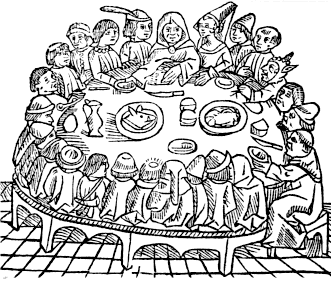
Geoffrey Chaucer died on this day in the year 1400, with his Canterbury Tales still unfinished. The Tales consist of a collection of stories in prose and verse told to while away the time, by a group of pilgrims on their way to Canterbury. One of the pilgrims is a Cook:

A Cook they hadde with hem for the nones,
To boil the chiknes with the marybones,
And powdre-marchant tart and galingale.
Wel coude he knowe a draughte of London ale.
He coulde roste, and seethe, and broile, and frye,
Maken mortreux, and wel bake a pie.
But greet harm was it, as it thoughte me,
That on his shine a mormal hadde he.
For blankmanger, that made he with the best.


In other words, the Cook is skilled at roasting, boiling and frying, he can make pies and stews and many other dishes, he knows how to use spices, and can determine the quality of ale. Unfortunately he also has a running sore on his shin (possibly leprous or syphilitic), which disgusts the narrator, as does his habit (mentioned later in the story) of repeatedly re-heating his pies – after he has drained off the gravy so that he can re-use it – and his shop is full of flies, which may make up some of the “parsley” in his stuffed goose. The reader is equally disgusted, and is grateful for modern times and modern food laws.

Rather than focus on bakers who ooze pus, and thereby risk losing our appetites for dinner, let us look at food words instead.

Marybones” are marrow-bones, for many centuries prized for their rich, unctuous, fatty, contents that were added to sweet and savoury dishes alike – although as we have discussed before, there was no such distinction in medieval times.

Poudre Marchant” appears to have been some sort of prepared spice mix, which seemed to be “tart”, although it seems that no-one recorded its exact composition. “Galingale” is interesting. Does it mean what we now call “Galingal”, or Alpinia galanga, the slightly gingery root familiar to us in South East Asian cuisine, or the European sedge Cyperus longus, which also has an aromatic root? The latter, most likely?

Blankmanger” means “white food”, and originally was a sort of custard or thick pottage made with almond milk and chicken – nothing at all like its modern bastard offspring – the sweet, insipid children’s party food we call “blancmange”.

Mortreux” (or Mortrews) meant a sort of meat stew which was ground up in a mortar (hence the name) and was sometimes (as in the recipe following) meant to be so thick “that it be standing” – in other words, similar to a meat paste or paté. The recipe uses two other spice mixes, powdour fort (strong) and powdour douce (sweet) – and again we must guess at the actual blend.

Recipe for the Day …

The cookbook of the Master Cooks of King Richard II, and called “The Form of Cury”, was published in the last decade of Chaucer’s life.

Mortrews.
Take hennes and pork and seethe hem togyder. Take the lyre of hennes and of the pork and hewe it small, and grinde it al to doust; take brede ygrated and do thereto, and temper it with the self broth, and alye it with yolkes of ayren; and cast theron powdour fort. Boile it and do therin powdour of gynger, sugur, safroun and salt, and loke that it be stondying; and flour it with powdour gynger.

Which means, very loosely:

Take chicken and pork and simmer them together. Take the liver of the chicken and pork, and chop it fine, and grind it until smooth. Take grated bread and add it, and blend it with some of the broth and thicken it with egg yolks, and sprinkle on some “powder forte”. Boil it and add “sweet powder” of ginger, sugar, saffron, and salt, and make it stiff, and dust it with powdered ginger.

Tomorrow’s Story …

In the name of Coleslaw.

Quotation for the Day …

We may live without poetry, music and art;
We may live without conscience and live without heart;
We may live without friends;
We may live without books;
But civilized man cannot live without cooks
Edward Bulwer-Lytton.

Tuesday, October 24, 2006

Thoughts on Puddings.

Today, October 24th …

Another story about Samuel Johnson today folks, with no apologies for referring to the man so often - he is a culinary-quotation lover’s one-man source. His eager biographer James Boswell scribbled down The Man’s fairly lengthy musings on the topic of pudding, on this day in 1773.

“ …. He then indulged in a playful fancy, in making a Meditation on a Pudding, of which I hastily wrote down, in his presence, the following note; which, though imperfect, may serve to give my readers some idea of it.

MEDITATION ON A PUDDING

Let us seriously reflect of what a pudding is composed. It is composed of flour that once waved in the golden grain, and drank the dews of the morning; of milk pressed from the swelling udder by the gentle hand of the beauteous milkmaid, whose beauty and innocence might have recommended a worse draught; who, while she stroked the udder, indulged no ambitious thoughts of wandering in palaces, formed no plans for the destruction of her fellow-creatures; milk, which is drawn from the cow, that useful animal, that eats the grass of the field, and supplies us with that which made the greatest part of the food of mankind in the age which the poets have agreed to call golden. It is made with an egg, that miracle of nature, which the theoretical Burnet has compared to creation. An egg contains water within its beautiful smooth surface; and an unformed mass, by the incubation of the parent, becomes a regular animal, furnished with bones and sinews, and covered with feathers. – Let us consider; can there be more wanting to complete the Meditation on a Pudding? If more is wanting, more may be found. It contains salt, which keeps the sea from putrefaction: salt, which is made the image of intellectual excellence, contributes to the formation of a pudding.”

The Great Man was rather less lyrical in his famous dictionary, as would be expected.

PUDDING:
1. A kind of food variously compounded, but generally made of meal, milk, and eggs.
2. The gut of an animal.
3. A bowel stuffed with certain mixtures of meal and other ingredients

PUDDINGTIME:
1. The time of dinner, the time at which pudding, anciently the first dish, is set upon the table.
2. Nick of time; critical minute.

Johnson’s definition of pudding clearly refers to the earlier meaning of a savoury dish, either a suet or batter pudding or the meaty version which is essentially sausage, rather than the sweet, dessert meaning more in use today. A suet or batter pudding (such as Yorkshire Pudding) was commonly served at the beginning of a meal, to fill the stomach before the rather more expensive meat was served – if indeed it was served at all. He nowhere hints at the use of sugar, and yet cookbooks of the time had many sweet versions, including the following one from the first Scottish cookbook, printed several decades before Sam’s pronouncements on the topic.

Recipe for the Day …

From “Mrs McLintock’s Receipts for Cookery and Pastrywork”, 1736.

To make an Orange Pudding.
Take four Oranges, and a Pound of Sugar; take the Skin off the Oranges, and beat the Pulp, boil the skins tender, and beat them very well, then take nine Eggs, keep out three of the Whites, and beat the Eggs and Sugar together, and beat your Oranges with a Quarter a Pound of Butter; then grate a half Penny Loaf, and beat the Loaf and them together; then put in your Sugar and Eggs, and half a Mutchkin of Sweet Cream, and beat them all together; then put on the Cover, and send it to the Oven.
[no salt]

Tomorrow’s Story …

Chaucer’s Cook.

Quotation for the Day …

If you could make a pudding wi' thinking o' the batter, it 'ud be easy getting dinner. George Eliot in "Adam Bede,"

Monday, October 23, 2006

Crisis Food.

Today, October 23rd …

A week into the Cuban Missile Crisis, the Kennedys dined with friends at the White House on this day in 1962. This was the menu:

Rockfish Souffle Ambassade
Breast of Pheasant St. Hubert
Wild Rice
Green beans aux Amandes
Salade Mimosa
Brie Cheese
Biscuit Glacee aux Peches
Petits-fours sec


A menu appropriate for the particular times? Heavily symbolic of the gravity of the situation and the intended unflinching response? Rockfish to indicate fine fighting ability, the dish “St. Hubert” because he was the patron saint of The Hunt, and rice that was very Wild? Sadly for the semiotically inclined – the answer is No. The menu was a very standard one for the White House at the time – firmly based in the French classic tradition, and of course, written in French. In any case, the Mimosa Salad would have been a mistake - certainly much mimosa is thorny, but much also is “sensitive” and the leaves curl up at the approach of danger, added to which the yellow of the egg-yolk garnish of the salad, (which imitates the fluffy mimosa flowers) would definitely have given the wrong message.

For years, as the Cold War continued, the American public had been offered advice as to how to prepare for the worst – that is, for Atomic War. A whole raft of leaflets with titles like “Facts about Fallout” gave advice about building or improvising shelters, none of which would actually have saved anyone from radiation poisoning, but no doubt gave the voters a satisfying illusion of security. One pamphlet advised the shelter to be stocked with “A two-weeks’ supply of water and pre-cooked foods for your family. Plenty of fruit juices and water. Your family’s favourite canned foods can be a morale lifter. Don’t forget a can opener and a bottle opener.” What? And by the time your rations were used up you emerged from your sandbagged pantry and went to the newly re-opened supermarket?

These were certainly uncertain times, and although we will never know what the Kennedys and their guests discussed over their petits-fours and coffee, one thing we can be certain of is that the petits-fours were plain, dry, un-iced. It seems appropriate to end the meal with a little comfort food in the form of a little cake. The name “petits-fours” comes from the French words meaning “little oven”, indicating that these little cakes were placed in the cooling oven after the bread and larger cakes were removed, and there are two classical types - plain and dry (sec), which includes such things as biscuits, meringues and perhaps madeleines, and iced or decorated (glacé) cakes made from a pound-cake-like base

Recipe for the Day …

Here is a recipe for Petits Fours of the glacé type – actually a series of recipes – from the New York Times, May 24th 1964.

PETITS FOURS.
1 recipe almond butter cake.
1 recipe hot apricot glaze.
1 recipe mock fondant.
1 recipe butter cream frosting.
1. Slice the cake into two layers using a long serrated knife.
2. Spread one layer with a thin coating of apricot jam. Top with the second layer. Brus the loose crumbs from the surface.
3. Brush the surface with hot apricot glaze. Allow to set twenty to thirty minutes. Cut into small rounds, crescents, oblongs, and triangles. Place the cakes far apart on a cake rack placed over a piece of waxed paper.
4. Pour the warmed mock fondant over the cakes to coat all sides evenly. The excess will run down onto the paper and may be scraped back into the pan and rewarmed to use again. Do not overheat the fondant or it will lose its shine.
5. Allow the cakes to harden. Cut off the rack and place in small paper cases. They may be decorated with butter cream frosting forced through a parchment paper cornucopia fitted with a decorating tube.
Yield: three dozen petits fours.

ALMOND BUTTER CAKE.
3 whole eggs
2 egg yolks
½ teaspoon vanilla
½ cup sugar
1 teaspoon grated lemon rind
¼ cup almond paste
¼ cup butter, melted and clarified (see note)
¾ cup sifted flour.
1. Pre-heat oven to 350 degrees.
2. Line jelly roll pan [swiss roll pan] with parchment paper.
3. Combine the whole eggs, one egg yolk, vanilla, sugar, and rind. Heat over hot water until lukewarm.
4. Cream the almond paste with remaining yolk.
5. Beat the warm egg mixture, preferably in an electric mixer, until tripled in bulk.
6. Add the melted butter to the almond paste and fold into the egg mixture with the flour. Fold gently. Pour into the prepared pan. Bake fifteen minutes or until lightly browned and firm to the touch.
Yield: one 10 by 15 by ¾ inch cake.
Note: to clarify butter, melt until foamy and pour off clear yellow liquid. Discard milky residue.

APRICOT GLAZE.
1 cup apricot jam, sieved.
1 tablespoon cognac.
Heat the sieved apricot jam and stir in the cognac.

MOCK FONDANT.
1 cup simple syrup.
3 cups sifted confectioners sugar (icing sugar), approximately.
2 teaspoons melted butter
2 teaspoons egg white
1 ounce unsweetened chocolate, melted.
1. Place the simple syrup in a pan and gradually stir in the sugar until a stiff paste is formed.
2. Warm the mixture to lukewarm while stirring. Add the butter and egg white. Adjust the consistency if necessary for coating the petit fours by adding more simple syrup or confectioners sugar.
3. Add the chocolate to half the mixture. Use other half white.
Yield: one and one half to two cups.

SIMPLE SYRUP.
2 ½ cups sugar
¾ cup white corn syrup
1 ¼ cups water.
1. Combine the ingredients in a large pan.
2. Heat gently while stirring to dissolve the sugar. Brush the sides of the pan with plain water to wash any undissolved sugar crystals down.
3. Raise the heat and boil rapidly without stirring for five minutes.
4. Cool. Store in a jar in the refrigerator until needed.

BUTTER CREAM FROSTING.
4 tablespoons soft butter
2 cups confectioners’ sugar (icing sugar), sifted
1 teaspoon vanilla.
1. Beat the butter with half the confectioners’ sugar until light and fluffy.
2. Gradually add the remaining sugar and vanilla until the desired consistency is reached.
The frosting may be flavored and colored if desired.
Yield: One cup.

Tomorrow’s Story …

Thoughts on Puddings.

Quotation for the Day …

Food is the most primitive form of comfort. Sheila Graham.

Saturday, October 21, 2006

Recipe Archive Updated!


The recipes from the September posts have been added to the RECIPE ARCHIVE.

The latest additions have been added to the bottom of each category, and each recipe is listed twice - under its "Type" and under "Date" (i.e century). The final listing, of recipes by cookbook author or cookbook is lagging behind, because each hyperlink is very slow to make, and I get bored.

Please enjoy, and do email me if you have any general comments.

The Old Foodie is about to complete 12 months worth of stories, and fully intends to continue. Watch out for the birthday competition announcement in a few days time.