Friday, August 04, 2006

A Huge Pie.


Yes, Yes, I know I promised you a story about the Crimea today, but I invoke my licence to change my mind on a whim. A pie whim. There will be a Crimea story later in the month. Promise.

Today, August 4th …

The Scotsman newspaper carried the following article on this day in 1928:

A HUGE PIE.
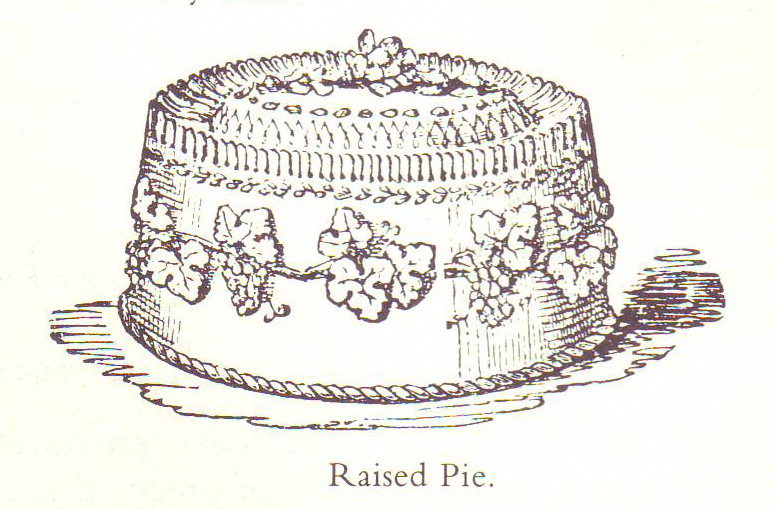
The baking of the world’s largest meat and potato pie began yesterday at Denby Dale, Yorkshire. This afternoon it will come out of its oven large enough to supply 20,000 people. Eighty stone of flour and two hundred-weight of lard are in the pie crust, and in the huge steel pie dish are fifteen hundred-weight of potatoes and the beef of six bullocks. Twenty-two picked Denby Dale housewives, declared to be the best cooks in the village, were engaged yesterday stewing the meat, preparing the potatoes, and making the dough for the crust. The pie dish was afterwards wheeled into a specially prepared oven. Denby Dale has had seven famous pies, the first being in 1788. All turned out successful except one, which was baked by professional pie makers. Since then Denby Dale housewives have insisted on baking the pies themselves.


It seems a journalistic lapse to omit the very interesting story about how the Denby Dale pie series began, so here is a summary:

1. 1788: The first pie: made by the village to celebrate the recovery of King George III from madness.
2. 1815: The Victory Pie, to celebrate the defeat of Napoleon at Waterloo.
3. 1846: A pie to celebrate the Repeal of the Corn Laws. Unfortunately the platform holding the 7’10” diameter pie did not survive the onslaught of the eager pie-eaters, and the whole thing got trampled underfoot.
4. 1887: An eight feet diameter, one and half ton pie to celebrate Queen Victoria’s Golden Jubilee. This was the one made by the professionals. Unfortunately the meat was rotten, and the pie was buried in quick lime.
5. 1887: The Resurrection Pie, baked by local housewives, in vindication of their skill.
6. 1896: A pie to celebrate the fiftieth anniversary of the Repeal of the Corn Laws
7. 1928: Another Victory pie, in belated celebration of the end of the war, and to raise funds for the Huddersfield Royal Infirmary.
8. 1964: The Village Hall pie, to raise money for the same, and to commemorate four royal births in the year.
9. 1988: The Denby Dale Bicentenary Pie: 20 ft. long, 7ft. wide and 18 inches deep.
10. The Millennium Pie.

Pie history is replete with other stories of giant pies, but the full explication of these must await completion of “The Pie: A Celebratory History”, which in turn awaits a publisher. Until then I feel quite justified in going hugely over the word budget on the topic of huge pies, so here is a recipe for the famous Yorkshire Goose (Christmas) Pie, from Elizabeth Raffald (1769).

A Yorkshire Goose Pie.

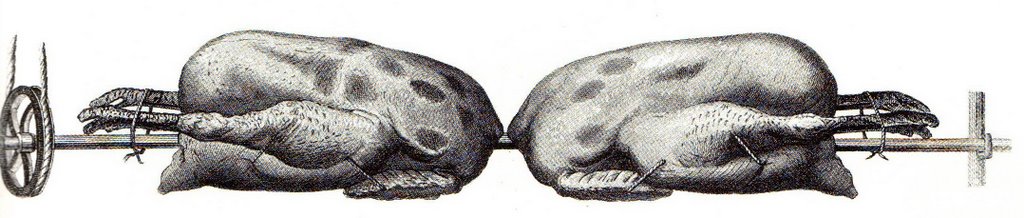
Take a large fat goose, split it down the back and take all the bone out; bone a turkey and two ducks the same way; season them very well with pepper and salt, with six woodcocks. Lay the goose down on a clean dish with the skin side down and lay the turkey into the goose with the skin down. Have ready a large hare, cleaned well; cut in pieces and stewed in the oven with a pound of butter, a quarter of an ounce of mace beat fine; the same of white pepper, and salt to taste, till the meat will leave the bones. Scum off the gravy; pick the meat clean off and beat it in a marble mortar very fine with the butter you took off, and lay it in the turkey. Take twenty-four pounds of the finest flour, six of butter, half a pound of fresh rendered suet, make the paste thick and raise the pie oval; roll out a lump of paste and cut it in vine leaves or what form you please; rub the pie with yolks of eggs and put your ornaments on the walls. then turn your hare, turkey and goose upside down and lay them on your pie with the ducks at each end and the woodcocks at the sides, make your lid pretty thick and put it on. You may make flowers, or the shape pf folds in the paste on the lid, and make a hole in the middle of your lid. The walls of the pie are to be one inch and a half higher than the lid. Then rub it all over with the yolks of eggs and bind it round with three-fold paper and the same over the top. It will take four hours baking in a brown bread oven. When it comes out, melt two pounds of butter in the gravy that came from the hare and pour it through a tun-dish, close it well up and let it be eight or ten days before you cut it. If you send it any distance, close up the hole in the middle with cold butter to prevent the air from getting in.


On Monday: Gooseberries in Grasmere.

Quotation for the Day …

A man that lives on pork, fine-flour bread, rich pies and cakes, and condiments, drinks tea and coffee, and uses tobacco, might as well try to fly as to be chaste in thought. Dr. John Harvey Kellogg, Plain Facts for Old and Young (1860-1951)


Thursday, August 03, 2006

Gastronomic Society.

Today, August 3rd …

On this stupendous momentous memorable day in 1950 in France, the constitution of “The Confrerie de la Châine des Rotisseurs” was registered.

So what? Good question.

Well, the event did represent the re-establishment of a society that was founded in 1248 and lasted until it fell victim to the Revolution in 1791 - surely a laudable idea on basic historical principles alone? Admittedly the original society was that of Masters in the Art of Roasting Geese – although at a pinch I suppose, this could be classed as a Gastronomic Society. Certainly the aim of the Châine is to promote all aspects of gastronomy “in its broadest sense” (evening dress, chains round necks, no salt and pepper on the tables), which is also laudable. And without doubt the chief instigator was a man worthy of honouring in his own right. He was Maurice Edmond Sailland, better known by his pen-name of “Curnonsky”, publicly honoured as “The Prince of Gastronomes”, and so famous and influential in his time that it is said that 80 restaurants in Paris would hold a table every night, in the hope of his patronage.

But what about The Food? The planning began when five men (of course) - Curnonsky, two other well-known gastronomes, and two professional chefs, got together over dinner at Easter 1950. So, what would five gastronomes chose to eat, when (presumably) chef, venue and money were no object? Highly fashionable, cutting edge cuisine? The 1950’s equivalent of Molecular Gastronomy?

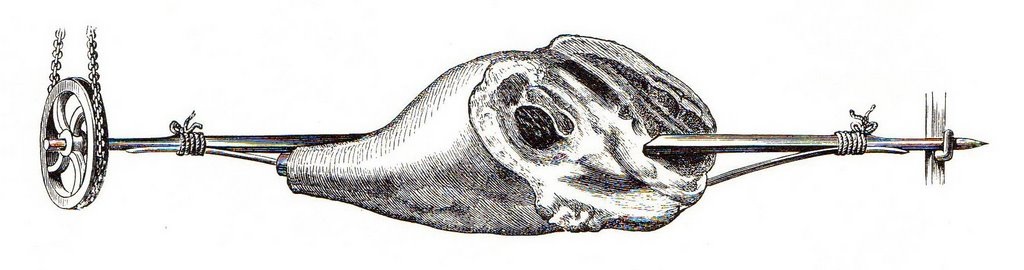
No. Absolutely, and completely reassuringly, NO. They ate Gigot à la Broche, a dish with historic roots so deep that even though the word is acknowledged to be French the origin is unknown. How elegantly appropriate is that?

There are many old recipes for jigget, gigget, jigot, geegot - here is a delicious-sounding one from Gervase Markham’s “English Housewife …” (1615)

To Roast a Gigget of Mutton.
To roast a Gigget of Mutton which is the legge splatted and halfe part of the loine together; you shall after it is washt, stop it with cloves, so spit it, and lay it to the fir, and tend it well with basting: Then you shall take vinegar butter and currants, and set them on the fire in a dish or pipkin; then when it boiles you shall put in sweete herbs finely chopt, with the yelke of a couple of egges, and so let them boile together; then the meat being half roasted, you shall pare of some part of the leanest and brownest, then shred it small and put it into the Pipkin also; then season it up with sugar, cinamon, ginger, and salt, and so put it into a cleane dish: the draw the Gigget of Mutton and lay it on the sauce, and throw salt on the top, and so serve it up.


Tomorrow: Crimea Cooking (changed to 'A Huge Pie')

Quotation for the Day …

Good cooking is when things taste of what they are. Curnonsky.

Wednesday, August 02, 2006

Musings on Moose.

Today, August 2nd …

Thoreau was equivocal about moose. He thought they were ugly but magnificent, and although he ate moose-meat several times himself (“It tasted like tender beef, with perhaps more flavor, - sometimes like veal”) he felt guilty about their “murder”, and sad “as it affected the innocence, destroyed the pleasure of my adventure”.

On this day in 1857, during his third trip into the Maine woods, he noted in his journal:

“The Indian was quite sick this morning with the colic. I thought that he was the worse for the moose-meat he had eaten”.

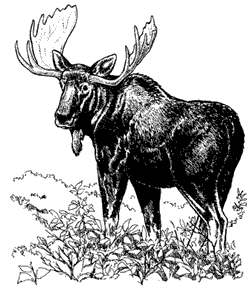
The moose is the largest member of the deer family, weighing in at up to 1,600 pounds (727 kg), which translates to about 650 pounds (nearly 300 kg) of pure meat, which is an awful lot of venison however you look at it. As a missile coming through the windscreen of a car, it is usually a fatal amount of venison for the driver as well as the moose, but unfortunately (for both) this appears to be an increasing problem. It certainly represents a spectacularly large amount of road kill to dispose of, or protein going to waste, when it does happen.

The local authorities in Vermont and Alaska have devised an interesting solution (for humans, not moose) for this problem. Volunteers (or prisoners in Alaska) collect and butcher the meat, and pack it for delivery to charities that feed the needy. Nowadays the surplus bounty is frozen, but in earlier times it would have been dried, as described in “The Trapper’s guide, a manual of instructions …..” a Canadian publication from 1867:

Jerked Meat.
If you have the fortune to kill a deer or moose in warm weather, and have an over-supply of meat that is likely to be tainted, you can preserve it by the following process: Cut all the flesh from the bones in thin strips, and place them, for convenience, on the inside of the hide. Add two or three quarts of salt for a moose, and a pint and a half for a deer, well worked in. Cover the whole with the sides and corners of the hide to keep out flies, and let it remain in this condition about two hours. Drive four forked stakes into the ground so as to form a square of about eight or ten feet, leaving the forks four feet high. Lay two poles across one way in these forks, and fill the whole space the other way with poles laid on the first two, about two inches apart. The strips of flesh should then be laid across the poles, and a small fire of clean hard wood should be started underneath, and kept up for twenty-four hours. This process will reduce the weight of the flesh by more than half, bringing it to a condition like that of dried or smoked beef, in which it will keep any length of time. This is called jerked venison. It is good eating, and always commands a high price in the market.

Tomorrow: Gastronomic Society.

Quotation for the Day …

Until the lions have their historians, tales of the hunt shall always glorify the hunter. African Proverb.

Tuesday, August 01, 2006

Lammas Time.

Today, August 1st …

This day in the Northern hemisphere is Lammas Day, one of the “cross-quarter” days that occurred at the midway point between the solstice and equinox and divided the seasons of the ancient Celtic calendar. It is the beginning of the harvest season, and the name probably comes from “loaf mass”, as it was traditional for a loaf of bread from the first ripe corn (i.e wheat) to be taken to church to be blessed.

Of course, the roots of the festival go way back before the Christian era, and another explanation of the name is that it may come from the Feast of Lughnasadh, or Lugh – the ancient Irish sun-goddess. The Irish certainly lay claim to the oldest continuing Lammas fair, which has been held in Ballycastle in County Antrim since the fifteenth century. If you can get there today, the traditional specialties of dulse and yellowman are the things to buy.

Dulse is the healthy food choice - an edible seaweed with deep purplish-red fronds, and is sold dried in bags, to be munched on like popcorn, or boiled or roasted, or added to salads or bread. Yellowman on the other hand, is holiday fair food – a honeycomb toffee which must be a relatively recent tradition as it relies on the use of baking soda – an early nineteenth century invention – to give it the characteristic texture. In fact “toffee” (or “taffy”) is a relatively new word, and the first references in the OED also come from the early nineteenth century. It must surely be related to “taffeta”, which has referred to a glossy fabric since at least the fourteenth century?

And, miraculously, between taffeta and toffee we find recipes for Taffety Cream (a dish of cream and eggs) and Taffety Tarts, which usually contained apple. Here is a spectacularly fragrant sounding version – the apple pulp scented and flavoured with orange, quince, rose-water, and violets!

To make Taffaty-Tarts.
Mix a quarter of a Peck of Fine Flour, with a quarter of a Pint of Yeast, and as much hot Liquor as will make it into a stiff Paste, with two Pound of butter, the Yolks of twelve Eggs, and half a Pound of fine Sugar; make it up into small Balls, and then roll it out into thick Plates; wash round their Brims with Milk: Boil Pippins soft, peel them and scrape the Pulp from the Cores, mingle the Pulp with fine Sugar, a little Marmalade of Quinces, the Scrapings of candied Orange-peel, and Rose-water: Make up your Tarts, dry them in a warm Place, bake them, scrape Sugar, and sprinkle Essence of Violets or Roses over them, and serve them up.
(The Cook’s and Confectioner’s Dictionary” 1724)


Tomorrow: Musings on Moose.

Quotation for the Day …

Laughter is brightest, in the place where the food is. Irish proverb

Monday, July 31, 2006

“Black Tot” Day.

Today, July 31st …

A centuries-old Royal Naval tradition ended on this day in 1970 at precisely 6 bells in the forenoon watch (i.e at 11 am), when the last rum ration was issued. A black day indeed.

Before rum, there was beer. The sailors ration before 1731 was a gallon of beer a day, which sounds like a lot, but trimming sails and doing things with yardarms was thirsty work. In 1731 for reasons which are unclear but which no doubt have some economic rationale, half a pint of rum was made equivalent to the gallon of beer, thus starting off almost a decade of rum-bliss for H.M’s sailors. The slide down to the dreadful day in 1970 began in 1731 when (for the cited reason of drunkenness) the ration was ordered to be mixed with water to the ratio of a quart of water to half a pint of rum, and doled out in two instalments each day; in 1740 the ration was further polluted with sugar and lime.

Naval men stoically made the best of it, as they still do, although one wonders what the officers now use for their traditional noontime toasts. The ritual was (is?) to toast first, the reigning monarch, and secondly:

on Monday “Our ships at sea”
on Tuesday “Our men”
on Wednesday “Ourselves”
on Thursday “A bloody war and quick promotion”
on Friday “A willing soul and sea room”
on Saturday “Sweethearts and wives, may they never meet”
on Sunday “Absent friends and those at sea”

Rum, of course, is a drink distilled from the by-products of sugar production, which must make it the most brilliant example of re-cycling in the entire history of the human race. Should you have some rum left over from drinking, it can be re-cycled further in any number of recipes, such as this one, from the 1870’s, which also re-cycles leftover bread.

Rum Pudding.
Grate three ounces of stale bread-crumbs, and pour over them as much rum as will moisten them. When they are well soaked, beat them up with six ounces of sugar, a little grated nutmeg, and first the yolks, and afterwards the well-whisked whites, of four eggs. Pour the mixture into a buttered mould, and let it steam until done enough. Turn it upon a hot dish, pour half a tumblerful of rum over it, set light to this, and serve immediately. Time to steam the pudding, one hour. Probable cost, 8d., exclusive of the rum. Sufficient for three persons


Above and Beyond ...

There are several other rum recipes in the extract from Cassells’ Dictionary of Cookery.

Tomorrow: Lammas Time.

Quotation for the Day …

Don't talk to me about naval tradition. It's nothing but rum, sodomy and the lash. Winston Churchill

Saturday, July 29, 2006

Saturday "Sauce Vénitienne".

Today, July 29th ....

.... which is Saturday, but you deserve an extra story this week, dont you?

If you love Venice, or if you’ve never been but love it anyway, then you’ll love my friend Greybeard’s site Love Venice. I absolutely love it, and could say that looking at it every day is almost as good as being there, but that would be patently stupid, as I am sure Greybeard himself would agree. He posts one of his wonderful photos of Venice virtually every day, accompanied by a short story. I thought of him when I came across a reference to something cooked “à La Vénitienne” the other day, and, not being certain what it was, looked it up. It sounds simple enough – a white wine based sauce flavoured with herbs, and especially good with fish, fowl, and eggs – then I found the following recipe (or actually, series of recipes-within-a-recipe), which demonstrates why one really does suffer from the terrible shortage of kitchen staff these days.

From Larousse:

Venetian Sauce ; Sauce vénitienne (for eggs and poultry).
Cook down by two-thirds ½ cup (1 decilitre) of vinegar to which a chopped shallot and 2 tablespoons of chopped chervil and parsley have been added. Stir in 1 cup (2 decilitres) of Allemande sauce*, finish off with 3 tablespoons (50 grams) of Green butter**, strain and add a tablespoonful of chopped chervil and tarragon.

*Allemande sauce.
This sauce is often wrongly included among “basic” sauces. Allemande, which in spite of its name is entirely French in origin, is a compound sauce.

For 2 ½ cups (5 decilitres): put into a pan with a thick, flat bottom, 2 egg yolks (3 if they are small) and 2 cups (4 decilitres) of light veal or chicken stock. Mix together. Add 2 ½ cups (5 decilitres) of Velouté sauce***, mix with a whisk. Begin cooking over a good heat, stirring with a wooden spoon to keep the sauce from sticking to the bottom of the pot. Cook down carefully without boiling until the sauce coats the spoon well. At the last moment add three tablespoons (50 grams) of butter, rectify the seasoning and strain through a cloth. Keep in the bain-marie (double boiler) until the moment of using (beat the sauce while it is in the bain-marie and butter the surface to prevent skin forming).
Note. Depending on its intended use and according to taste, this sauce can be seasoned with a pinch of grated nutmeg and sharpened with a squeeze of lemon juice
.

**Green butter.
Ordinary butter, softened to a paste and mixed with green spinach, prepared in the following manner: pick over, wash and dry the spinach leaves and pound them in a mortar uncooked. Put the spinach into a very strong cloth, twist the cloth to extract all the juice from the spinach, which should be collected into a little saucepan, set this juice to coagulate in a bain-marie (double boiler) ant turn out onto a fine cloth stretched out over a receptacle. Scrape off the green residue which remains on the cloth with a spoon. This substance is called vert d’épinard (spinach green). To this spinach green add double its weight in butter. Rub this butter through a fine sieve or tammy.


*** Velouté sauce.
For 2 ½ quarts: stir 2 ¾ quarts (litres) of white stock made with veal or chicken into 1 cup (325 grams) of pale blond roux made with butter and flour. Blend well together. Bring to the boil, stirring with a wooden spoon until the first bubbles appear. Cook the Velouté very slowly for an hour and a half, skimming frequently. Strain through a cloth. Stir until it is completely cold.
Note. Velouté is a great basic sauce, and it may be prepared in advance. Obviously it may also be made just before it is used.
As the white stock which is used for making it is seasoned and flavoured, it is not necessary to add other flavourings to this sauce. An exception may be made for skins and trimmings of mushrooms which may be added when available, this addition making the sauce yet more delicate.


I don’t know when Sauce Vénitienne was developed, or why it should have a French-originated “German” sauce as its base , but its roots clearly show in this white wine “Italian” sauce from the 1769 cookbook by Menon, “The professed cook: or the modern art of cookery, pastry, and confectionary, made plain and easy… ”:

Sauce Italienne Blanche.
White Italian Sauce.
Simmer on a slow Fire a Spoonful of Oil, chopt Truffles, two Cloves of Garlick, two whole Chibbol, Parsley, half a Leaf of Laurel, two Slices of Lemon, first peel’d. and good Consumee, viz. Jelly Broth, a Glass of white Wine; skim it well and sift it.


Now all I need for this simple sauce is a goodly supply of truffles ....

Friday, July 28, 2006

Duck at Sea.

Today, July 28th ...

Day 5 of "Duck and Dessert".

Our final day of “Duck and Dessert” is going to be aboard ship. On this day in 1913 the Cunard ship R.M.S “Franconia” was at sea, probably on its usual route between Liverpool and Boston, and the dinner menu was:


Caviar d’Astrakan Hors d’oeuvres Varies
-
Consomme Dame Blanche Crème de Celeri
-
Halibut –Cardinal Greyling au Gratin
-
Cotelettes d’Agneau aux Petits pois
Vol au Vent – Toulouse Tete de Veau-Financiere
-
Sirloin and Ribs of Beef
Boiled Chicken Aylesbury Duckling
Saddle of Mutton
-
Mushrooms Saute
Boiled Rice Cauliflower
Potatoes – Boiled Mashed and Noisette
-
Quail au Cresson
-
Plum Tart Victoria Pudding
Gelee au Madere Cocoanut Macaroons
-
Ice Cream
-
Cheese Dessert Coffee
-
TO ORDER FROM THE GRILL (15 Minutes)
Sirloin Steak Chops Squab Chickens.

The chef did not feel it necessary to specify how the duck was prepared but had ensured that it was the very best type of duck that England could offer – the Aylesbury, named for the town in Buckinghamshire where it originated about two hundred years ago. At one time flocks of the ducks were “walked” the 40 miles to London to market, their feet protected by a coating of tar and sawdust, and accommodation being provided in special yards at inns along the way.

We can be certain that the chef aboard the “Franconia” was male, but make no apologies for offering this rather delicious-sounding recipe from “The Woman’s Book: contains everything a woman ought to know” (1911).

Roast Duck.
Fill the duck with apples peeled and cut in quarters and a few French Plums* which have been soaked and stoned. Roast in the same way as a fowl. It will take from three-quarters of an hour to one hour. Serve with brown gravy and salad
.

*presumably this means prunes.

And from the same book, something we could also call Cocoanut Macaroons:

Cocoanut Biscuits.
2 oz Dessicated Coconut; 2 oz. Castor Sugar; 1 tea-spoonful flour; 1 white of egg; Wafer paper.
Chop the cocoanut a little more finely if necessary, and mix it in a basin with the other dry ingredients. Whip the white of egg to a stiff froth, and bind all together with this. Put small squares of wafer paper on a dry baking-tin, arrange a tea-spoonful of the mixture on each, and bake in a slow oven for half an hour, or until the biscuits are firm and of a pale brown colour. Cool them in a sieve, breaking off the wafer paper which projects beyond the edges. These biscuits should be kept in paper in an air-tight tin box.


On Monday: Black Tot Day.

Quotation for the Day …

The white Aylesbury duck is, and deservedly, a universal favourite. Its snowy plumage and comfortable comportment make it a credit to the poultry-yard, while its broad and deep breast, and its ample back, convey the assurance that your satisfaction will not cease at its death. Isabella Beeton, 1861.

Thursday, July 27, 2006

Gertrude, Alice, and Duck.

Today, July 27th …

Day 4 of “Duck and Dessert”.

Today was very nearly a ducky disaster when a little last minute fact-checking revealed that the planned and written story for the day – featuring Dorothy Wordsworth, sister of William – actually happened yesterday. Luckily for us - but not for her - this day in 1946 was the day that Gertrude Stein died. As the maximum allowable number of degrees of separation between any person and any food item is three, we just make it thanks to her life partner, Alice B. Toklas, who, luckily for us, wrote a cookbook containing several recipes for duck (but only one for Haschich Fudge).

Alice’s book is fascinating as much for the anecdotes as for the recipes, and she describes how “murder in the kitchen” (i.e the killing of the main ingredient for the next meal) had to be done before Gertrude got home, “for she didn’t like to see work being done”. They were both spared the ordeal when their pet Barbary duck Blanchette was mauled by a neighbour’s dog, and the cook, anticipating that the poor thing was going to die of fright, administered three tablespoons of eau-de-vie (to flavour her flesh) and then put her out of her misery. Blanchette was cooked with orange sauce, but we have had a recipe for that this week, so today we will have duck prepared from another recipe in Alice’s book, with figs and port.

Duck in Port Wine.
Put 24 figs in a wide jar to marinate for 36 hours in an excellent dry port wine and cover hermetically. Put the duck in a preheated 450 degree oven. After ¼ hour commence to baste it with the port wine in which the figs have been macerating, and which has been heated. Continue to baste every 15 minutes. Turn the duck on each side so that the legs are browned. When all the port has been used for basting, put the figs around the duck and baste with veal bouillon. Continue to baste. The duck will be cooked in an hour unless it is a very old duck indeed.


And for dessert:

Flaming Peaches.
Fresh peaches are preferable, though canned ones can be substituted. If fresh, take 6 and cover with boiling water for a few minutes and peel. Poach in 1 ½ cups of water over low flame for 3 or 4 minutes. Place in a chafing dish, add ¼ cup sugar and ¾ cup peach brandy. Bring to the table and light the chafing dish. When the syrup is about to boil light and ladle it over the peaches. Serve each peach lighted.

Tomorrow: Duck at Sea.

Quotation for the Day …

What is sauce for the goose may be sauce for the gander but is not necessarily sauce for the chicken, the duck, the turkey or the guinea hen. Alice B. Toklas; The Alice B Toklas Cookbook.

Wednesday, July 26, 2006

For those of Moderate Income.

Today, July 26th …

Day 3 of "Duck and Dessert"

Ibsen’s play “A Doll’s House” was first performed in 1879 in Copenhagen, and its ferocious indictment of the prevailing attitudes to the marital relationship and the role of women provoked outrage throughout Europe. Meanwhile, in England, Victoria was in the thirty-second year of her reign, and one can probably fairly safely assume that she would not have been amused by the play. The Victorian Englishwoman’s place, if she was of the burgeoning middle class, was firmly in the home and firmly in control of the servants and the goings-on in the kitchen. Luckily, a spate of books appeared in the second half of the nineteenth century to help.

Phyllis Browne’s “A Year’s Cookery” was published in 1879, and addressed to “people of moderate income, with moderate domestic help, and ordinary kitchen utensils”. A menu was given for breakfast, dinner, tea, and supper for each day of the year, with recipes, shopping lists, instructions for advance preparation, and daily lists of “Things that must not be Forgotten”. The menu for dinner on this day in 1879 was: Filleted Turbot, Roast Ducklings (of course!), Green Peas, Cherry Pie, and Cheese.

Roast Ducklings.
Stuff the ducks with sage and onion stuffing such as is used for roast goose. If this is objected to, it can be omitted. Put the birds down to a brisk clear fire, and baste them well till done enough. Send them to table with good brown gravy (made by stewing the necks, gizzards, and livers with onions) poured round but not over them.


Phyllis gives general instructions for fruit fillings for pies, and several recipes for pastry – advising that “for both pies and tarts a light crust is always to be preferred”, the best being Puff Paste. Should this be regarded as “either too troublesome to make or too rich for digestion”, she suggests:

Flaky Crust.
To make this, put half a pound of flour into a bowl, with a pinch of salt, half a teaspoonful of sifted sugar, and half a teaspoonful of baking powder; mix all thoroughly, and make to a stiff paste by stirring in the white of one egg whisked to a stiff froth and a little water. Weigh a quarter of a pound of butter or clarified dripping and divide this into two portions. Roll out the pastry to the thickness of a quarter of an inch, spread one portion of the butter evenly over it, and dredge flour upon this. Fold the paste in three, turn it round with the edges to the front, and roll it again. Spread the remainder of the butter over it, dredge flour on it again, and roll it to the shape that is required. Bake in a brisk oven.

Tomorrow: Gertrude, Alice, and Duck.

Quotation for the Day …

An apple is an excellent thing - until you have tried a peach. George du Maurier.

Tuesday, July 25, 2006

St James (the Great) Day.

Today, July 25th …

Today is the feast day of St James the Great, the patron saint of Spain. Luckily for us, there are a number of foods associated with him.

“Coquilles St Jacques” are the most obvious, and are named in recognition of his symbol of a cockle shell. The explanation for this piece of symbolism is by no means clear, but by extension, he is especially associated with oysters. In England it used to be forbidden to sell oysters until St James’ day, and it was said (or hoped) that whoever consumed oysters on the day would not go without money for the year. In other places there were other traditions - apples were blessed, mutton pies handed out by the village vicar, and in Grenoble, bread and red eggs were blessed and eaten.

Another old belief was that if you gathered chicory at noon or midnight of St James’ day, using a golden knife, and not speaking during the procedure, the chicory would gain the power to open sealed doors and boxes by merely being held against the lock. At a pinch therefore, you could (after opening any necessary locks) celebrate the day by having a nice chicory salad.

All of which is very interesting, but this week’s theme is “Duck and Dessert”, and there does not appear to be a single association of St James with ducks. Luckily, ‘The universal cook, and city and country housekeeper…. (F.Collingwood, 1797) gives a recipe for duck with oysters.

To boil Ducks the French Way. Another French Method.
Having larded your ducks, and half roasted them, take them off the spit, and put them into a large earthen pipkin, with half a pint of red wine, a pint of good gravy, some chestnuts roasted and peeled, half a pint of large oysters, the liquor strained and the beards taken off, two or three little onions minced small, a very little stripped thyme, mace, pepper, and a little ginger finely beaten, with the crust of a French roll grated. Cover it close, and let it stew half an hour over a slow fire. When they are enough, take them up, and pour the sauce over them.

And for dessert, this recipe from the same book may be stretching the “red eggs” tradition a bit, but it sounds delicious:

Pink-coloured Pancakes.
Having boiled a large beet-root till it is tender, beat it fine in a marble mortar. Put to it the yolks of four eggs, two spoonfuls of flour, and three spoonfuls of cream. Sweeten it to your taste, grate in half a nutmeg, and add a glass of brandy. Mix all well together, and fry them as before directed. Garnish with green sweetmeats, green sprigs of myrtle, or preserved apricots.


Tomorrow: For those of Moderate Income.

Quotation for the Day …

It is proven by experience that, above five or six dozen, oysters cease to be a pleasure. Grimod de la Reyniere; Almanach des Gourmandes.

Monday, July 24, 2006

Dining with Marie Antoinette.

It is some time since we had a theme for the week, so it is time to address that deficit. A perusal of the Recipe Archive shows that there has not been, to date, an Old Foodie story with a recipe for duck. This seems an oversight of enormous proportions, given that it is a favourite food of the The Old Foodie Spouse, so as compensation we will have “Duck and Dessert” this week.

We start with a very classic duck dish, enjoyed by Marie Antoinette at her little place called the Trianon, in that carefree time before she lost her head.

Today, July 24th …

On this day in 1788, this was dinner at the Trianon:

QUATRE POTAGES
Le riz
Le Scheiber
Les croutons aux laitues
Les croutons unis pour Madame.

DEUX GRANDES ENTRÉES
La pièce de bœuf aux choux
La longe de veau à la broche.

SEIZE ENTRÉES
Les pâtés à l'espagnol
Les côtelettes de mouton grillées
Les hatelets de lapereaux
Les ailes de poulardes à la maréchale
Les abatis de dindon au consommé
Les carrés de mouton piqués à la chicorée
Le dindon poele à la ravigote
Le ris de veau au papillote,
La tête de veau sauce pointue
Les poulets à la tartare
Le cochon de lait à la broche
La poule de Caux au consommé
Le caneton de Rouen à l'orange
Les filets de poularde en casserole au riz
Le poulet froid
La blanquette de poularde aux concombres.

QUATRE HORS-D'ŒUVRE
Les filets de lapereaux
Le carré de veau à la broche
Le jarret de veau au consommé
Le dindonneau froid.

SIX PLATS DE ROTS
Les poulets
Le chapon pané
Le levraut
Le dindonneau
Les perdreaux,
Les lapreaux

SEIZE PETITS ENTREMETS

Did she chose the “Le caneton de Rouen à l'orange”? Citrus had been a common flavouring for all sorts of dishes from medieval times, whether lemon, citron, or orange, but the original, bitter “Seville” orange seems to have a special affinity with duck. Naturally, only the best duck would have been served to the Queen, and the ducks in France are the heavy big-breasted birds from Rouen.

The French cook François Menon’s book “The professed cook; or the modern art of cookery, …." was translated into English, and this recipe is from the 1769 edition:

Canetons de Roüen à la Broche.
If you would have it for a First-course Dish, give it a few turns with Butter, in a Stew-pan over the Fire, wrap it up in Paper to roast; it must not be too much done; serve with a good Consumee Sauce, chopt Shallots, the Juice of an Orange, Pepper, and Salt: if for a Second-course Dish, roast it without Paper crisp: also serve with Juice of Seville Orange.

We don’t know what sweet things the Queen enjoyed at the dinner, but this recipe from Menon’s book has the right name!

Crème à la Reine. Queen’s Cream.
Boil a Pint of Cream to half reduced, with fine Sugar, Orange-flower Water; when half cold, mix with six Whites of Eggs well beat up; bake it between two very moderate Fires, and to remain in its natural Colour.

Tomorrow: St James the Great.

Quotation for the Day …

When there is no more cookery in the world, there will be no more letters, no quick and lofty intelligence, no pleasant easy relationships; no more social unity. Carême.

Saturday, July 22, 2006

Coffee Recipes.

As a special weekend treat for my loyal readers, I have added a further eight new recipes dating from 1873 to the 1920's to the archive of Coffee Recipes.

All of today's additions are for coffee cakes - cakes using coffee as an ingredient that is, but there are recipes for coffee mousse, souffle, Ice-cream, bon-bons, wafers and other goodies in the archive.

More will be added as time permits.

Friday, July 21, 2006

Feasting with Hemingway.

Today, July 21st …

Ernest Hemingway was born on this day in 1899 in Oak Park, Illinois. In December 1921, already a war veteran, he arrived in Paris determined to be a writer, and hungry to experience the flourishing artistic life of the city. It was not as easy as he thought, and his hunger was rather more physical for rather too long before he made his mark.

Hemingway clearly loved eating, and his writing is full of evocative descriptions of food. There is no better example than the posthumously published “Moveable Feast” - by which he meant the city of Paris itself. One day, when he was very hungry, he suddenly received 600 francs from a German publisher. He went straight to the Brasserie Lipp, which still specialises in dishes from Alsace, and ordered a meal. Here is his classic description:

The beer was very cold and wonderful to drink. The pommes à l'huile were firm and marinated and the olive oil delicious. I ground black pepper over the potatoes and moistened the bread in the olive oil. After the first heavy draft of beer I drank and ate very slowly. When the pommes à l'huile were gone I ordered another serving and a cervelas. This was a sausage like a heavy, wide frankfurter split in two and covered with a special mustard sauce.
I mopped up all the oil and all of the sauce with bread and drank the beer slowly until it began to loose its coldness …


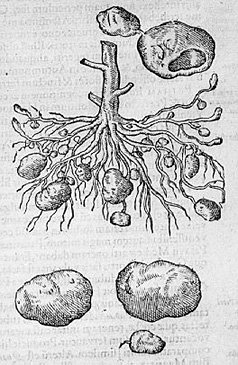
The German influence is clear in this meal, with its use of potatoes and mustard. It is apt then, that the first known European recipe for potatoes, in 1581, comes from a German cookbook. Or does it?

The recipe is in “Ein new Kockbuch” by Marx Rumpolt (1581), and it is for “Erdapfel” or “Earth Apples”. The recipe reads:

Earth apples. Peel and cut them small, simmer them in water and press it well out (strain it?) through a fine cloth; chop them small and fry them in bacon that is cut small; take a little milk thereunder and let it simmer therewith so it is good and welltasting.

For a long time “earth apples” were assumed to be potatoes. Food historians are now unsure, and some feel that they were a type of squash. With either ingredient, and however the instructions are interpreted, it is a good hearty dish, eminently suitable for hungry writers.

On Monday: Dining with MarieAntoinette.

Quotation for the Day …


Just give me a potato, any kind of potato, and I'm happy. Dolly Parton

Thursday, July 20, 2006

The proper appreciation of sparrows.

Today, July 20th …

The New York Times ran an article on this day about the proper appreciation of sparrows:

English Sparrows are being properly appreciated. Hundreds of them are now caught by enterprising people for sale to certain restaurants where reed birds are in demand. A German woman on Third Avenue has three traps set every day, and she catches probably seventy five a week. They are cooked and served to her boarders the same as reed birds and are declared quite as great a delicacy. This German woman bastes them, leaving the little wooden skewer in the bird when served. They are cooked with a bit of bacon. She tempts them with oats, and after the catch they are fed a while with boiled oaten meal. She sprinkles oaten meal in the back yard also, and thereby fattens the free birds. … So soon as it becomes known that the Sparrow is a table bird their number will rapidly grow less.
People don't like to experiment, but when it is discovered that the Sparrow has been declared good by those upon whom they have been tried, no boarding house meal will be deemed in good form unless a dish of fat Sparrows adorns it. Sparrow pie is a delicacy fit to set before a king.

Sparrow pie has a reputation for making the eater sharp-witted, so perhaps the writer of this tongue-in-cheek article had partaken of it himself. In reality, sparrows have always been the survival choice in times of hardship and war, or the alternative bird when you have no reed-birds, or larks, or pigeons, as these historic recipes show:

Tourte of young pigeons.
Make a fine past, and let it reste, then take your young pigeons, cleanse them, and whiten them. If they are too big, cut them, and take gaudiveaux, sparagus, mushrums, bottomes of hartichocks, beef marrow, yolks of eggs, cardes, pallats of beef, troufles, verjuice of grapes, or goose-berries, garnish your tourte with whatever you have, not forgetting the seasoning, then serve. (The French Cook, 1653)


There is no mention of substitutes at this point, but suddenly, after a recipe for Tourte of Beatilles, the same author adds:

The tourte of sparrows is served like that of young pigeons with a white sauce.

Lark, or Sparrow Pye.
You must have five dozen at least; lay betwixt every one a Bit of Bacon as you do when you roast them, and a Leaf of Sage and a little Force-meat at the Bottom of your Crust; put on some Butter a top and lid it; when bak’d for one Hour, which will be sufficient, make a little thicken’d Gravy, put in the Juice of a Lemon; season with Pepper and Salt, so serve it hot and quick. (Charles Carter’s “City and Country Cook … “ 1736)

Tomorrow: Feasting with Hemingway.

Quotation for the Day …

I went to a restaurant that serves "breakfast at anytime". So I ordered French Toast during the Renaissance. Steven Wright.

Wednesday, July 19, 2006

A royal Pullman breakfast.


Today, July 19th …

King George VI and Queen Elizabeth set off on an official visit to Paris on this day in 1938, to confirm the allegiance between the two countries in the face of the threatening war. They traveled by train from Victoria station to Dover, and had breakfast in their Pullman carriage.


Grapefruit
Orange Juice
Porridge & Cream
Fried Fillets of Sole
Finnan Haddock Kippers
Bacon Egg Tomatoes
Lamb’s Kidneys Mushrooms
Omelettes
York Ham Saute Potatoes
Preserves
Tea Coffee Chocolate

The usual royal breakfast fare, or a final comforting meal before they hit French shores and ineffectual French breakfasts? Methinks the former is most likely.

Notice the choice of fish. One each from the two big families – big in the sense of their historic importance that is - herring (kippers) which came up in an earlier Old Foodie story, and haddock, which is from the cod family.

Genuine Finnan haddock (“haddie”) is traditionally from Findon in Aberdeenshire (beware of imitations), and is considered a delicacy by afficionados. The fish is headed, gutted, lightly salted, and should properly be cold-smoked over a peat fire.

Mrs Dalgairns (1840) tells us how to prepare them:

Finnan or Aberdeen Haddocks.
Clean the haddocks thoroughly, and split them; take off the heads, put some salt on them, and let them lie two hours, or all night, if they are required to keep more than a week; then, having hung them two or three hours in the open air to dry, smoke them in a chimney over peat or hardwood saw-dust.
Where there is not a chimney suitable for the purpose, they may be done in an old cask open at both ends, into which put some saw-dust with a red-hot iron in the midst; place rods of wood across the top of the cask, tie the haddocks by the tail in pairs, and hang them on the sticks to smoke; the heat should be kept as equal as possible, as it spoils the fish to get alternately hot and cold. When done, they should be of a fine yellow colour, which they should acquire in twelve hours at farthest. When they are to be dressed, the skin must be taken off. They may be boiled, or broiled; and are generally used for breakfast.


Mistress Meg Dods (1856) would have been horrified at the Frenchified “Finnan en Cocotte” recipe given in an earlier story. Her advice is that they should simply be “skinned, broiled over a quick and clean fire, and served in a napkin.”

Tomorrow: The proper appreciation of sparrows.

Quotation for the Day …

“A Finnan haddock has a relish of a peculiar and delicate flavour, inimitable on any other coast than that of Aberdeenshire. Some of our Edinburgh philosophers tried to produce their equal in vain. I was one of a party at dinner wher the philosophical haddocks were placed in competition with the genuine Finnan fish. These were served round without distinguishing whence they came; but only one gentleman out of twelve present espoused the cause of philosophy.” Sir Walter Scott, quoted in Boswell’s Life of Johnson.

Tuesday, July 18, 2006

Half a Bucke.

Today, July 18th …

Samuel Pepys’ diary gives us our second story for the week. On this day in 1660, he wrote:

“I dined at my house in Seething lane. Thence to my Lord about business; and being in talk, in comes one with half a Bucke from Hinchingbrooke, and it smelling a little strong, my Lord did give it to me, though it was as good as any could be. I did carry it to my mother to dispose of as she pleased.”


A smelly piece of meat seems a strange gift today, but in the days before refrigeration it was common to share out meaty largesse such as this amongst one’s friends – and in spite of quick distribution it would get high pretty quickly in July.

Two days later Sam happened to call at his parent’s home, where he finds his own wife and several guests dining on a venison pasty made from that self-same Bucke.
It is to be hoped the taint was not obvious. Perhaps the family cook knew of this method, from Hannah Wooley’s “Gentlewoman’s Companion … “ (1673):

Venison how to recover when tainted.
Take a clean cloth and wrap your Venison therin, then bury it in the Earth one whole night, and it will take away the ill scent or favour.


Of course, there were recommended ways of keeping it sweet for the longer term, and another of Hannah’s books, “The Cook’s Guide … “ (1664) tells us how:

To keep Venison nine or ten months good and sweet.
Take a haunch of Venison and bore holes in it, then stop in seasoning into it as you
do parsley into beef in the inside of it if it be red Deer, take pepper, nutmeg, cloves, mace and salt; if it be fallow deer then only pepper and salt; when it is thus seasoned dip it in white wine vineger, and put it in an earthen pot with the salt side down and having first sprinkled good store of spice into the pot; if it be fallow deer three pound of butter will serve, but if red deer then four pounds; when you put it into the oven lay an earthen dish over it, and paste it close up that no air can get out nor in, so let it stand six or seven hours in a very hot oven; when it is baked take off the cover and put in a trencher and a stone upon it to keep the meat down in the liquor; fill up the pot with melted butter and so keep it, serve it to the table in slices with mustard and sugar.


Tomorrow: A royal Pullman breakfast.

Quotation for the Day …

Wine is the intellectual part of a meal, meats are merely the material part. Alexandre Dumas.

Monday, July 17, 2006

Walthamstow Wine.

Today July 17th …

Wine from Walthamstow was enjoyed by Samuel Pepys on this day in 1667 – that is, wine from grapes grown a mere 6.4 miles from Charing Cross.

Sam wrote:

“I at Sir W.Batten's …. and there for joy he did give the company that were there a bottle or two of his own last year's wine growing at Walthamstow, than which the whole company said they never drank better foreign wine in their lives”

At that time Walthamstow was “the country”, where the wealthy such as Sir William had their country estates, and popular hobby of noblemen was grape-growing and experimenting with wine-making.

At the time of the Domesday survey in 1086 there were 40-something vineyards listed in southern England, although in reality there were probably more. Various reasons are given for the decline –the dissolution of the monasteries by Henry VIII (most of the wine being made by monks), the introduction of tea and coffee - and climate change (the weather was warmer in England a few centuries ago). Perhaps global warming is helping with the resurgence of interest in the production of wine in England over the last few decades- there is no doubt that it is happening, and some of the wines are doing very well in blind tastings alongside those from more traditional grape-growing areas of Europe.

During centuries when England’s vineyards were languishing, her citizens never left off their tradition of making “wine” from all sorts of things other than grapes – everything from parsnips to cowslips, but especially fruit. Sam Pepys’ contemporary, Sir Kenelm Digby, included many recipes for fruit wines in his book, including this one:

The Countess of Newport’s Cherry Wine.
Pick the best Cherries free from rotten, and pick the stalk from them; put them into an earthen Pan. Bruise them, by griping and straining them in your hands, and let them stand all night; on the next day strain them out (through a Napkin; which if it be a course and thin one, let the juyce run through a Hippocras or gelly bag, upon a pound of fine pure Sugar in powder, to every Gallon of juyce) and to every gallon put a pound of Sugar, and put it into a vessel. Be sure your vessel be full, or your wine will be spoiled; you must let it stand a month before you bottle it; and in every bottle you must put a lump (a piece as big as a Nutmeg) of Sugar. The vessel must not be stopt until it hath done working.


Tomorrow: Half a Bucke.

Quotation for the Day …

Reasons For Drinking:
If all be true that I do think,
There are five reasons we should drink:
Good wine— a friend— or being dry—
Or lest we should be by and by—
Or any other reason why.
Henry Aldrich.

Thursday, July 13, 2006

A pretext for a good dinner.

Today, July 14th …

Today is the anniversary of the day in 1789 that the oppressed peasants rose up and stormed the terrible prison in Paris called the Bastille, liberating its political prisoners and turning the tide of history inevitably towards the founding of the Republic. No - actually, it was the day that a rioting mob, seeking the weapons stored there, managed to overcome about 112 guards (80 of whom were invalides) and in the process managed to liberate the seven remaining prisoners – four forgers, two madmen, and one dissolute young aristocrat placed there by his family. The real story notwithstanding, the events became symbolic of the founding of the Republic, and it is the National Day of France.

Naturally then, it is a day for French food, for as Jean Anouilh said “Everything ends this way in France – everything. Weddings, christenings, duels, funerals, swindlings, diplomatic affairs – everything is a pretext for a good dinner”. We have the pretext, but what shall we chose from the classic French repertoire for our dish of the day?

The French gourmet Grimod de la Rèyniere who lived through it all supposedly said, with reference to the French Revolution, and with great relief, something along the lines of: “If it had lasted any longer, we might have lost the recipe for fricassée of chicken” It seems apt to choose this dish then, and to make it even more appropriate, the good Baron Brisse (1868) gives us a version named for one of the mistresses of Louis XV:

Fricassée of fowls à la Du Barry.
Cut up your fowls into joints, and soak for an hour in cold water, which change two or three times; drain, and dry them carefully in a cloth, and cook in water; as soon as it begins to boil, remove the pieces of fowl, and pass the liquor through a tammy. Warm a lump of butter, some scraped bacon, and a slice of Bayonne ham over a slow fire; when quite hot, add the pieces of fowl, and as soon as they begin to stiffen, stir in a tablespoonful of flour; take the saucepan off the fire, moistent the fricassée with equal quantities of stock, and the liquor in which the fowls were boiled; season with a bouquet of mixed herbs, an onion stuck with cloves, and boil for three quarters of an hour, remove the onion and herbs, and if the sauce is not sufficiently reduced stir in some yolks of eggs, and serve.

Tomorrow: Walthamstow Wine.

An extra treat for Bastille Day ...

A special day sometimes justifies a special treat, so I give you a number of quotations today, each one giving a different perspective on the French and their food. Please comment, if you feel so inclined, on the one you feel most closely matches your own feelings, and of course, please submit any others you may know.

“Food: Part of the spiritual expression of the French, and I do not believe that they have ever heard of calories.” Sir Beverley Baxter.

Thanksgiving is America's national chow-down feast, the one occasion each year when gluttony becomes a patriotic duty. In France, by contrast, there are three such days: Hier, Aujourd'hui and Demain." Michael Dresser.

“The French are not rude. They just happen to hate you. But that is no reason to bypass this beautiful country, whose master chefs have a well-deserved worldwide reputation for trying to trick people into eating snails. Nobody is sure how this got started. Probably a couple of French master chefs were standing around one day, and they found a snail, and one of them said: "I bet that if we called this something like `escargot,' tourists would eat it." Then they had hearty laugh, because "escargot" is the French word for "fat crawling bag of phlegm." ” Dave Barry.

“Bouillabaise is only good because cooked by the French, who, if they cared to try, could prepare an excellent and nutritious substitute out of cigar stumps and empty matchboxes.” Norman Douglas.

“Mayonnaise: One of the sauces which serve the French in place of a state religion.” Ambrose Bierce.

“We heard one evening, under the eye of the imperturbable Paul, a foreign lady ask for a milk chocolate drink to accompany a fillet of sole Cubat, the chefs specialty. Sacrilege! Just as well that Marcel Proust and Boni de Castellane were not here to see that.” Simon Arbellot.

"If any one element of French cooking can be called important, basic and essential, that element is soup." Louis Diat.

"Never forget that the pheasant must be awaited like the pension of a man of letters who has never indulged in epistles to the ministers nor written madrigals for their mistresses." Francois des Essarts

“A man should not so much respect what he eats, as with whom he eats.” Michel Eyquem de Montaigne.

"The only cooks in the civilized world are French cooks. … Other nations understand food in general; the French alone understand cooking, because all their qualities - promptitude, decision, tact - are employed in the art. No foreigner can make a good white sauce." Louis Victor Nestor Rocoplan.

“To be a gourmet you must start early, as you must begin riding early to be a good horseman. You must live in France, your father must have been a gourmet. Nothing in life must interest you but your stomach.” Ludwig Bemelmans.

“Without butter, without eggs, there is no reason to come to France”. Paul Bocuse.

“In France, cooking is a serious art form and a national sport”. New York Times journalist, 1986.

“Truffles are a luxury, and the first requirement of a luxury is that you should not have to economize." James de Coquet.

"Light, refined, learned and noble, harmonious and orderly, clear and logical, the cooking of France is, in some strange manner, intimately linked to the genius of her greatest men." Marcel Rouff.

The Prince in the Colonies.

Today, July 13th …

In 1920 the Prince of Wales (the future King Edward VIII) arrived in Australia on an official visit with the specific purpose of thanking its citizens for their contribution to the recent war. The citizens were suitably awed, and this time did not attempt to assassinate him – although in truth it was a rabid Irishman, not a true Australian that had taken a shot at the first royal prince (Alfred) in 1867.

Successive local authorities spared no expense in trying to outdo each other in royal offerings. In Adelaide, they took him to the hotel on this day in 1920, and gave him offal for lunch.

MENU
Huitres au Naturel.

Consomme a la Macedoine.
Potage Crème de Celeris.

Merlans à la Excellence.

Ris de Veau à la St.Cloud.

Filets de Mignon aux Champignons.

Sarcelle à la Chevreuil.

Asperges au Beurre.

Pouding à la Chanceliere.
Charlotte Russe.

Glace Nesselrode.

AUSTRALIAN WINES

Hock, Claret, Sherry, Madeira (old), Port, Sparkling Hock.

“Ris de Veau” are veal sweetbreads, which are “the pancreas, or the thymus gland, of an animal” and “esteemed a delicacy” according to the OED. Princely food, Huh? At least the wine list was impressive. Something for everyone there. The Madeira was not new, and the bubbly was not labelled “Australian Champagne”. We’ve come a long way in the Colonies since 1920.

When H.M. Queen Elizabeth travels overseas, a list of forbidden ingredients is sent ahead to the host nation – no garlic (cause royal bad breath) no oysters (uncooked, risk of royal diarrhoea), no spaghetti (royal bosom might get bespeckled with sauce), no berries (unsightly berry seeds on royal teeth). No BERRIES ?!

Luckily, offal does not appear to be on the royal “off” list, so should a member of The Family come to stay, you could cook them sweetbreads. Here is the exact recipe from the cookbook of Queen Victoria’s chef, Francatelli.

Sweetbreads à la St.Cloud.
These should be scalded and pressed in the usual way, and studded over in neat circular order with pieces of black truffle or red tongue, cut in the form of large hobnails; then make twelve openings with a blunt wooden skewer in each sweetbread, in a introduce in these the nail-like pieces of tongue perpendicularly. Braize them according to the directions in the foregoing, and when done, dish them up with a white Toulouse ragout; garnish the entrée around the base with a border of small quenelles decorated with truffles, and place a group of trimmed crayfish-tails, previously tossed in a little glaze, coloured with lobster coral; slightly glaze the sweetbreads, and serve.

Tomorrow: A pretext for a good dinner.

Quotation for the Day …

One must always welcome guests sincerely, with a certain effusion of the heart, for when they come to your table they must already be happy with you. Baron Brisse

Wednesday, July 12, 2006

"Furry Things"

Today July 12th …

The master of the good ship ‘Felicity’ recorded in his log on this day in 1820 his decisive action in the face of potential disaster.

“Mate reports that seaman had brought one of those furry things on board in a covered cage. Ordered its neck wrung and body thrown overboard.”

What is difficult to understand is how any seaman would have considered taking a “furry thing” aboard ship in the first place. A longstanding sailors’ superstition was that “furry things” would bring unspeakably bad luck at sea, notwithstanding that a single one of their feet is considered bring the opposite on dry land. Even speaking the real name of the “furry thing” (if you are on dry land right now, you can say it - “rabbit”) was considered extremely risky. Rabbits were sometimes believed to be the avatars of witches, so perhaps the sailors’ fear of “furry things” was part of the general superstition about women aboard ships – a ship being a woman herself, therefore prone to jealousy and acts of violent revenge.

It seems fairly certain that rabbit stew would never come out of any ship’s galley, but luckily, there are no superstitions about serving rabbit to guests on dry land. A good host would never willingly shock the guests with the choice of dinner dish, but it is always good to surprise them:

Rabbits Surprised.
Take young rabbits, skewer them, and put the same pudding into them as directed for roasted rabbits. When they be roasted, draw out the jaw-bones, and stick them in the eyes, to appear like horns. Then take off the meat clean from the bones; but the bones must be left whole. Chop the meat very fine, with a little shred parsley, some lemon-peel, an ounce of beef marrow, a spoonful of cream, and a little salt. Beat up the yolks of two eggs boiled hard, and a small piece of butter, in a marble mortar; then mix all together, and put it into a tossing pan. Having stewed it five minutes, lay it on the rabbit where you took the meat off, and put it close down with your hand, to make it appear like a whole rabbit. Then with a salamander brown it all over. Pour a good brown gravy, made as thick as cream, into the dish, and stick a bunch of myrtle in their mouths. Send them up to table, with their livers boiled and frothed.


[From ‘The London art of cookery, ...’ Farley, John (1800)]

Tomorrow: The Prince in the Colonies.

Quotation for the Day …

I don't go for the nouvelle approach-serving a rabbit rump with coffee extract sauce and a slice of kiwi fruit. Jeff Smith (the Frugal Gourmet).